


Raphis Flabellata Variegata - A Rare Plant
Description
This section is from "The Horticulturist, And Journal Of Rural Art And Rural Taste", by P. Barry, A. J. Downing, J. Jay Smith, Peter B. Mead, F. W. Woodward, Henry T. Williams. Also available from Amazon: Horticulturist and Journal of Rural Art and Rural Taste.
Raphis Flabellata Variegata - A Rare Plant
Raphis Flabellata Variegata
Of this well-known elegant dwarf Palm, the present form had the leaves striped with more or less white.
A Rapid Growing Tree
At the Knap Hill Nursery, Surrey, England, is a specimen tree of the Popolus Canadensis, nova, a variety of the Cottonwood, which in three years has made the extraordinary growth of twenty feet, forming well made trees. It is esteemed by Messrs. Waterer as a better grower than any other Poplar, and its habits free and healthy.
Rapidity In Striking
The London Florist says: "The rapidity with which new plants (even those which, a few years since, were considered difficult) are now struck and got ready for sale, is a strong evidence of improvement in this department. The seed trade has kept pace with that of the nursery, and affords proof that the better classes of vegetables are becoming more extensively known".
Rare Books
Our readers will find in Mr. Miller's advertisement a collection of books not easy to be got in this country. Many of them are rare, and are worthy of special examination.
A Rare But Beautiful Pine
In the grounds of Joseph Perkins, Esq., of Cleveland, Ohio, is a beautiful pine, of which the accompanying is a pretty good illustration on a small scale. The name under which it was received has been lost, and I am unable to say clearly what it is, but believe it the pinus bruttia, or Calabri-an pine. It is certainly a very beautiful pine, with long, wavy leaves, longer than the Corsican or larico, and of a green, brighter and more yellowish, like the Austrian (Austriaca). The tree stands in low ground, fully exposed, and has proved perfectly hardy. F. R. E.
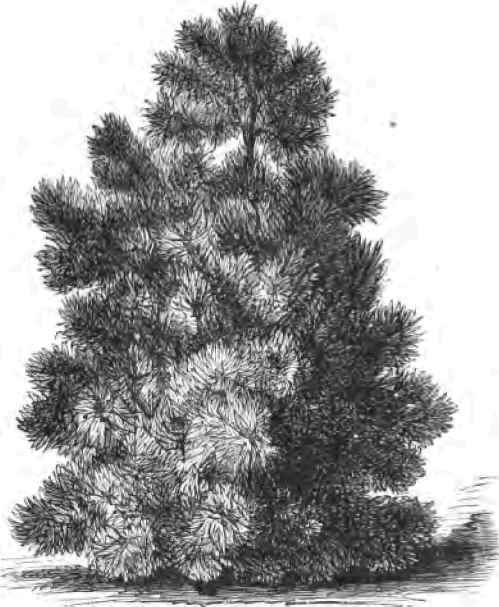
Fig. 33. - A Rare but Beautiful Pine.
Rare Chance. - The Best Yet
A First-Class Weekly Family Hew York Paper.
Perfect Treasury of Amusement and Information.
A Rare Magnolia
In the Dixie Farmer published at Nashville, Tenn., we find an account of a visit to the grounds of J. 8. Downer, Elkton, Ky., and notice of "a magnificent specimen of the magnolia of which Mr. D. has not been able to get the correct name ; some botanists who have examined it pronounced it the result of a cross of M. grandiflora and M. glauca; it has the towering habits of growth of the M. grandiflora and the leaf cones and fragrance of the glauca, and the writer believes it belongs to the latter without any admixture, but is a grand improvement in habit of growth over the normal type of its species' [Has Mr. Downer or Mr. Heaver compared this with Magnolia longi-folia? - Ed.] .
A Rare Plant
The London Garden describes the Godwinia gigas, lately in full flower for the first time in that country. It is an Arold, with a very large leaf and flower. The flower, or more properly, spathe, was nearly two feet long and a foot and a half in circumference, on a stem only 18 inches high. It came from Nicaragua, where it is stated the petiole is often 10 feet long.
Continue to:


My Books

