


Frontispiece
Description
This section is from "The Horticulturist, And Journal Of Rural Art And Rural Taste", by P. Barry, A. J. Downing, J. Jay Smith, Peter B. Mead, F. W. Woodward, Henry T. Williams. Also available from Amazon: Horticulturist and Journal of Rural Art and Rural Taste.
Frontispiece
The mansion, of which the northeastern aspect is given in the frontispiece, is being built by me on Tilton Hill, near Wilmington, Del., for C. W. H., Esq.
This hill is isolated, of an unusu ally symmetrical conical shape, and the tall pines belonging to the old mansion, rise from its summit like a crown of nodding plumes. The view from this fine locality covers a wide range; the spires in Philadelphia, at the distance of 28 miles, can be seen in fine weather; while the horizon, in the opposite direction, at a nearly equal distance, is formed by a bold range of hills almost mountainous in character Wilmington is spread out at your feet, with its tallest spires much below your stand-point; the undulating country around it is divided by three pretty serpentine streams besides the Delaware, while New Jersey and her pine forests bound the horizon in this direction. There are an unlimited number of building sites, commanding this noble view, and hitherto unaccountably neglected by Philadelphians.
The improvement in the present instance consists of large additions to, and the entire remodelling of an old house. The property, when purchased by the present owner, consisted of a simple stone house, fronting the finest part of the view, 38 feet on all sides, without back-buildings, and having a basement kitchen. Yon entered by the high bank of steps at A (on view and plan); a ball B (on plan), 17 x 20 feet, opening to a parlor C, 14 x 17. Back of this, were dining-room D, 15x17, stairs 9x17, and a closet and small room E, 11x12. The present owner, feeling the want of a separate drawing-room, and of a covered outside entrance, constructed a back veranda F (on view and plan), and yon now enter by the end-steps G, plan (seen at F on view), and so by the door under the stairs H, plan, which makes what was the old hall sufficiently private for use as a drawing-room. This, however, still left the house without any commodious entrance-hall; the dining-room was felt to be much too small, and the library somewhat so; the kitchen was inconveniently situated in the basement; the want of shade and a veranda on the side A, at once the sunny side, and that next the finest view, was much felt; the attic was crowded by the hip-roof; the second story was deficient in chamber-room, and without a bath-room; and the only place that could be used as a hired man's sleeping-room was the chamber E, on the .principal floor.
These inconveniences it was desirable to remedy, without interfering with the commodious back veranda which had already been added.
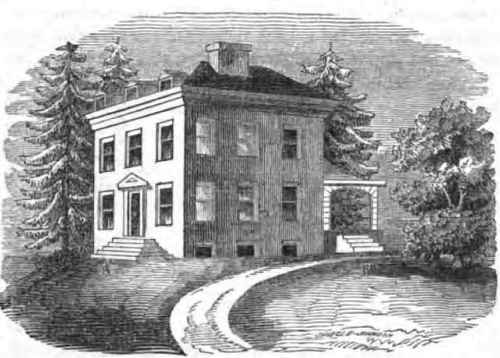
VIEW.
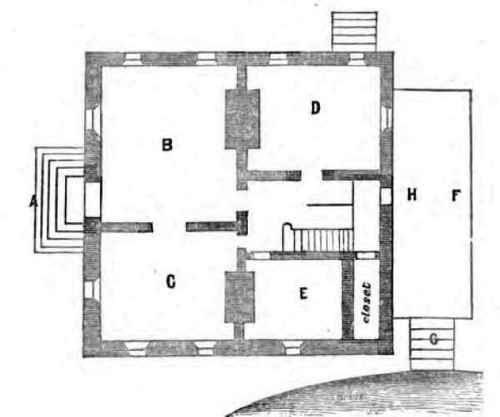
PLAN 1. Drive.
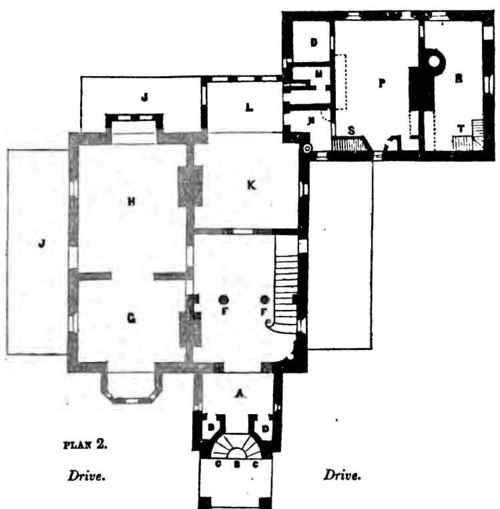
The new tower is situated on Plan 2 at A. This is to have a carriage-porch, with arches, through which the carriage-drive passes; the porch to be roofed, and to have a balcony on top. Visitors, in descending from a carriage, will step upon a raised platform B, while pedestrians will use the steps C C. In the tower, we have a vestibule, with coat-closets D D. The chamber E, Plan 1st, being thrown into one, with the stairway, and the first flight of stairs turned ronnd, gives a fine entrance hall, with columns at F F. A bay window being added, makes the library G a pleasant one: the drawing-room is improved by a recessed double window, and verandas, J J, added. The dining-room, Kt is made 17 X24 feet, by throwing out a square bay window L, with glass on two sides, and doors next the back building. In the new back building M, is a double china closet, with a slide for the leaves of the extension dining-table N, a 4 feet wide passage, in which is a basin and a side-table; O, pantry, 6x6; P, kitchen, 16 X 19, clear, with two closets, dressers, and sink; B, back-kitchen, with wash-boiler, and floor-sink; S, back-stairs; T, man's stairs.
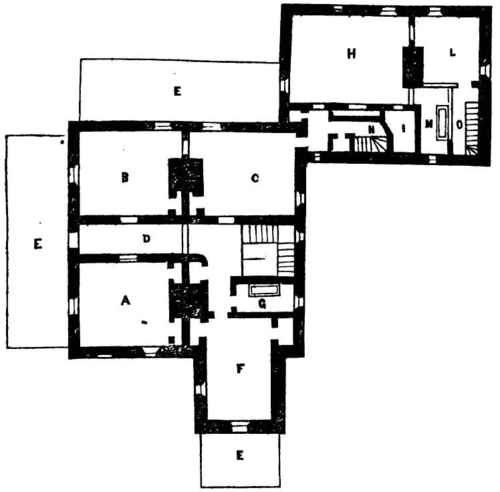
Plan 3.
In the second story, Plan 3, A, B, and G, are old chambers, left undisturbed; D, a pleasant hall, opening on balcony; E E E, balconies; F, tower chamber, 12 x 16; G, bath-room; H, nursery; I, closet, 6x5 feet; L, bedroom; Mt nursery bath-room; N, back-stairs (not continued); 0, man's stairs (continued). The attics contain, in the back building, a man's room, and a drying-room, with a cistern; in the main, the old attics, much enlarged by the partial raising of the roof; in the tower is a cistern for spring water, to be raised by a power pump, over which is the observatory, with balconies on the sides, and an iron rail on the top. The old walls being of stone, of a good color, the new walls will be built to match; the cornices, window-dressings, and veranda will be executed in oak, without paint, and oiled. The style is the pure Italian rural. The cost of a similar building, entirely new, would vary from $6,000 to $8,000, according to the degree of finish. R. MORRIs SMITH, Architect, 74 South Fourth Street, Philadelphia.
Frontispieces #1
For this and the succeeding three months, we will print frontispieces of our engravings, on tinted paper. The illustration for the present month is one of an elegant Bird Cage with Flowers, exhibited at the recent Paris Exposition, where it attracted the most flattering attention.
Continue to:


My Books

