


Water, Form, Walls
Description
This section is from the "Kitchen Gardening Made Easy" book, by George M. F. Glenny. Also see Amazon: Kitchen Gardening Made Easy.
Water, Form, Walls
Water
Another consideration engaging our attention is water, a plentiful supply of which is essential to a good kitchen garden, it being no-cessary alike to the commencement and progress of vegetation. In short, it is the vehicle which conveys to vegetables all the substances useful to their support, and without this element no one will continue to vegetate properly, and if kept long without, the leaves will droop and assume a withered appearance. Indeed, it is for want of moisture alone that many kitchen garden crops are lost, or the produce reduced to very inferior quality. From whatever source this material is furnished, it should be conducted to and reserved in an open pond, tank, or basin, as near the centre of the garden as possible, as being the most convenient. Well-water recently drawn is very improper for watering any kind of vegetable; yet if it has stood in a pond, tank, or basin, until acted upon by the sun's rays it may be applied with safety; but soft or rain water is much more conducive to healthy vegetation. The garden should be situate near a river, pond, or brook, if possible, from which the water may be conducted to it by drains or pipes, being careful to lay them sufficiently low to receive the water in the driest season, when it is most required.
If the situation be such as to need the water to be pumped or drawn up from deep wells, it should be exposed to the sun and air some days previous to using. Where a force-pump is necessary, and it frequently is, one of Oakley's Improved Pumps (Fig. 1) will be found of great service. Those who have abundance of available water at a distance necessarily require to convey it to certain spots in the garden, and for this purpose one of his Portable Pumos on Wheels (Fig. 2) or his Fire Annihilates (Fig. 3) will be found most suitable. Next to these pumps, especially in small establishments and for glass structures, a length of rubber hose and a branch pipe (Fig. 4) will be found very useful. A hose-reel will be necessary for the protection of the hose, and there is no better than that represented at Fig. 5.

Fig. 1.

Fig. 2.

Fig. 3.

Fig. 4.
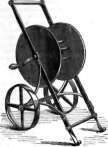
Fig. 5.
Form
This will be another very important item for contemplation; but so far as we have observed, there is none more proper or convenient than a geometrical square, or a parallelogram, giving a decided preference to the former. It must be borne in mind, however, that the form here spoken of more properly refers to the space enclosed by the wall or walls, than the entire quantity surrounded by the ring or outer fence.
Walls
Kitchen gardens are mostly, or should be, bounded by walls, chiefly intended for the production of fruit; but where they are destined for the growth of vegetables only, they may be as completely fenced by hedges as walls; and indeed, where hedges are good they are more secure from depredators. In laying out a garden of this description with walls the principal considerations are, height, aspect, construction, and materials.
Height
In respect to the height of walls, it is more commonly determined by the size of the garden, and the inclination of its surface, than with regard to the training of fruit-trees. A small plot enclosed by high walls has a bad, gloomy look, whereas if they are erected of suitable heights this unsightly appearance will, in a great measure, be obviated. In a garden of an acre, and nearly or quite of a geometrical square, and greatly elevated, the north wall may be raised to fourteen feet; the east and west walls to twelve feet, and the south wall to ten feet above the surface of the ground. If the garden be larger, the wall may be somewhat higher, but not in proportion if it extends to several acres. The extreme height of the north wall of any garden should not exceed eighteen feet; the east and west walls fifteen feet, and the south wall twelve feet. Our readers will please to observe that the term north and south are here used to denote the north and south sides of the garden; but in speaking of wall-fruit, if it be said a tree requires a south wall it must be understood to mean a wall with a south aspect.
It may possibly, nay, probably, be asked by many, why are the walls of different heights ? or why is the back, or north wall, built so much higher than the others? granting this to be the case, then we can give two reasons. First, by being raised higher, it shelters the garden from the north blast; and secondly, it affords ample space for training the choice sorts of fruit trees on the south side of the wall, or best aspect of the garden.
Aspect
This-will of necessity have to be duly regarded, as, unless it is, success cannot possibly follow. South aspects are generally considered the best for fruit-trees, but reason and experience teach us that an aspect a few points to the east is the most suitable for all sorts of fruits that require the most regular heat to bring them to perfection and earliest to maturity. It may be argued that the hottest part of the day is the afternoon, and that the sun shines stronger then than in the morning; and so it does, because it continues to act upon air already heated by the influence of the morning's rays. Yet it is not so healthy, as the great heat of the sun causes the trees to exhale their juices faster than the roots can absorb them, which causes the fruit to be smaller, the pulp harder, and the flavour worse, than if they received the heat more regularly. On the other hand, on an aspect towards the south-east, the trees will catch the sun's rays earlier, by which the cold night dews will be sooner and more gently dispersed, and the scorching rays of the afternoon's sun earlier off.
Continue to:


My Books

