


Exercise X. A Study Of Bulbs
Description
This section is from the book "Laboratory Manual Of Horticulture", by George W. Hood. Also available from Amazon: Laboratory Manual Of Horticulture.
Exercise X. A Study Of Bulbs
Material and apparatus. Bulbs of the hyacinth, tulip, onion, and lily; sharp knife.
Bulbs of all kinds are specialized buds. They are made up of a short and rudimentary axis closely incased in transformed and thickened leaves called bulb scales. Bulbs occur only in plants which are accustomed to long periods of inactivity, and are divided into two classes determined by the scales.
1. Study bulbs of the hyacinth, onion, tulip, and tiger lily or Easter lily. Make a drawing of each one, natural size, showing the external characteristics. Describe fully the differences in each bulb. How does the lily differ from the hyacinth?
2. Keep a close watch for bulbils, which are little bulbs found on the parent bulb. Where do you find these located? Are they in essentially the same place in each bulb? Make a drawing of the bulbil, natural size, showing the attachment to the parent.
3. Draw a cross section, natural size, of each bulb. What differences do you observe? Carefully examine and describe the bulb scales of the hyacinth and the tulip. How does the scale of the lily differ from that of the tulip and the hyacinth?
4. Draw a cross section of each scale. Describe in detail the differences. Measure the thickness of each bulb scale. What significance does the thickness of the bulb scale have? What is contained in the scales of all bulbs? How do the scales of the lily differ in arrangement and shape from those of the hyacinth and the tulip?
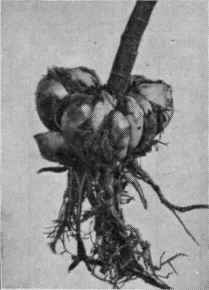
Fig. 4. Bulb of Easter lily.
Reference
Bailey, "The Nursery Book," chap. ii.
Continue to:


My Books

