


Exercise XIX. Peach. A Study Of Buds (Amygdalus Sp.)
Description
This section is from the book "Laboratory Manual Of Horticulture", by George W. Hood. Also available from Amazon: Laboratory Manual Of Horticulture.
Exercise XIX. Peach. A Study Of Buds (Amygdalus Sp.)
Material and apparatus. Branches of the several races of the peach, bearing fruit buds and branch buds; razor, dissecting lens.
The Peach
The peach is divided into five somewhat distinct races. The characteristics which separate each race are more or less pronounced. Each one includes a number of different varieties, some of which are of commercial importance, while others do not rank so high. A comparative study of the buds and branches of each type will aid in bringing out the differences.
1. North China race. The North China race {Amygdalus persica) includes the following varieties: Albert, Chinese Cling, Elberta, Smock, Spottswood, Thurber, Ford, Family Favorite, and others. The original parent of this race is almost a dwarf. The trees bloom later than the Persian types, and the flowers are nearly always larger. The foliage hangs on well during drought, but sheds off early in the fall. This race is supposed to have originated in northern China, and is adapted to zones north of those suited to the Spanish race.
a. Secure branches from several varieties of this race and make a drawing, natural size, and four inches in length, showing both the flower bud and the branch bud. How are the buds arranged? Describe.
b. Select a fruit bud and a branch bud, taking care that both are mature and perfect, and make a drawing, one inch in length, of each. What difference is observed between the two? How are they arranged, and where do yon find the branch buds with reference to the fruit buds? Describe the scales and pubescence of the buds?
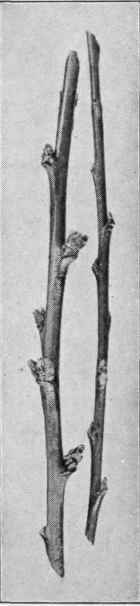
Fig. 13. Fruit buds and branch buds of the peach. Note the cluster of bud.
c. Make a longitudinal and a cross section of both a flower bud and a branch bud. How do the flower buds and the branch buds differ in internal and in external structure? How many ovules are present in a flower bud? Is the number constant or variable? How old is the wood on which the flower buds are found? Does the age of the wood on which the flower buds are borne differ from that of the other fruits studied?
2. Persian race. The Persian race (Amygdalus persica) includes the following varieties: Lemon, Alexander, Conkling, Crawford's Late, Golden Drop, Old Mixon Free, St. John, Sal-way, Scott, Mountain Rose, Hale Early, and several others.
The trees of this race are of medium size, with short, thick limbs. The bark on the young wood is usually a rich purplish red. The bloom is variable, and the foliage is crumpled and has a purplish tinge. The trees require a long period of rest. The fruit is highly colored and of good flavor. This race is best adapted to northern sections and is not recommended for Southern planting.
a. Study branches from several of the above-named varieties. Make a drawing, natural size, and four inches in length, showing the details of the branch and of the fruit buds and branch buds. How are the buds arranged, and does this arrangement differ from that of the North China race? What is the color of the bark on the small branches? Is the color constant or variable?
b. Make a drawing, at least one inch in length, of both a flower bud and a branch bud. Compare the buds with those of the North China race in respect to size. Describe.
3. South China race. The South China race (Amygdalus persica) includes the following varieties: Honey, Pallas, Climax, Coleman, Early China, and others.
The trees are of medium size, and the branches come out at an angle of about fifty degrees and are less willowlike than the Peen-to. The bloom is large and profuse. This race is valuable for Southern planting.
Secure branches from one or more of the above varieties and study carefully. Make a drawing, natural size, and four inches in length, of a branch, including both fruit buds and branch buds. Describe the arrangement of the buds. What color is the young wood?
4. Spanish race. The Spanish race (Amygdalus persica) includes the following varieties: Cobler, Columbia, Victoria, Texas, Sanders, and several others. The trees are very large; the limbs large, long, and spreading; the branches low; the flowers usually large; the foliage small and flat. The fruit is very decided in character, very late, and nearly always yellow. This race is adapted to isothermal lines north of those in which the South China race flourishes.
Secure branches from one or more varieties of this race. Study carefully and compare with the races already studied. Make a drawing, natural-size, and four inches in length, of a branch, showing the position and arrangement of the buds. Describe any differences in this respect between this race and the others studied. What is the color of the bark? Where do you find the fruit buds?
5. Peen-to race (Amygdalus platycarpa). The Angel and the Waldo are two varieties which are seedlings of the Peen-to. This is probably the least important race, and the varieties are restricted as to the location in which they will grow. The trees are rather large and vigorous, with willowlike branches and large flowers.
Secure branches from one-year-old and two-year-old wood of the above varieties. Make a drawing, natural size, and four inches in length, of a branch, showing both leaf and branch buds. Describe fully. Compare this race with the South China race, and describe any difference.
Comparative study of the peach. Describe in detail the differences between the races - in the twigs, in the leaf and flower buds, in the color of the branches, in the position and arrangement of the buds, etc. - as seen by your study.
References
Bailey, "The Pruning Book," pp. 50-54.
Bulletin No. 39, Texas Agricultural Experiment Station.
Continue to:


My Books

