


Form
Description
This section is from the book "Laboratory Manual Of Horticulture", by George W. Hood. Also available from Amazon: Laboratory Manual Of Horticulture.
Form
The form of a fruit means the shape and is described by the following terms:
Angular. Having sides more or less ribbed.
Conical. Tapering gradually from the base to the apex.
Globose, globular, or round. Terms used to describe fruit which is nearly spherical, as the Fameuse. Oblate. Flattened, having the height less than the breadth. Oblique. Having an axis which slants obliquely.
This form is sometimes called lopsided. Oblong. A term used to describe a fruit whose length exceeds its breadth and whose sides are nearly parallel. Obovate. Reversed ovate; a term used to describe an egg-shaped fruit whose smaller end is at the base instead of at the apex. Ovate, egg-shaped. Terms used to describe fruit whose length somewhat exceeds its breadth, and which has a slightly rounded taper from the base to the apex. Roundish. Varying slightly from round, or having the length and the breadth nearly equal.

Fig. 44. Oblong.
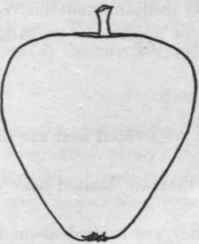
Fig. 45. Conical.

Fig. 46. Oblate-conical.

Fig. 47. Oblate.

Fig. 48. Obovate.

Fig. 49. Ovate.

Fig. 50. Round-ovate.
Continue to:


My Books

