


1. Plants For Carpet-Beds
Description
This section is from the book "Manual Of Gardening", by L. H. Bailey. Also available from Amazon: Manual of Gardening.
1. Plants For Carpet-Beds
The beauty of the carpet-bed lies largely in its unity, sharp contrast and harmony of color, elegance - often simplicity - of design, nicety of execution, and the continued distinctness of outline due to scrupulous care. A generous allowance of greensward on all sides contributes greatly to the general effect, - in fact it is indispensable.
Whatever place is chosen for the bed, it should be in a sunny exposure. This, nor any kind of bed, should not be planted near large trees, as their greedy roots will rob the soil not only of its food, but of moisture. The shade also will be a menace. As the plants stand so thick, the soil should be well enriched, and spaded at least a foot deep. In planting, a space of at least six inches must be left between the outer row of plants and the edge of the grass. The very style of the bed requires that lines be straight, the curves uniform, and that they be kept so by the frequent and careful use of the shears. During dry periods watering will be necessary. The beds, however, should not be watered in the hot sunshine. Foliage plants are most in use, and are the ones which will prove the most satisfactory in the hands of the inexperienced, as they submit to severe clipping and are thus more easily managed.
The following list will be helpful to the beginner. It embraces a number of the plants in common use for carpet-bedding, although not all of them. The usual heights are given in inches. This, of course, in different soils and under different treatment is more or less a variable quantity. The figures in parentheses suggest in inches suitable distances for planting in the row when immediate effects are expected. A verbena in rich soil will in time cover a circle three feet or more in diameter; other plants mentioned spread considerably; but when used in the carpet-bed, they must be planted close. One cannot wait for them to grow. The aim is to cover the ground at once. Although planted thick in the row, it will be desirable to leave more room between the rows in case of spreading plants like the verbena. Most of them, however, need little if any more space between the rows than is indicated by the figures given. In the list those plants that bear free clipping are marked with an asterisk (*):
Lists For Carpet-Beds
The figure immediately following the name of plant indicates its height, the figures in parentheses the distance for planting, in inches.
1. Low-Growino Plants. A. Foliage Plants
Crimson.*Alternanthera amcena spectabilis, 6 (4-6).
Alternanthera paronychioides major, 5 (3-6). Alternanthera versicolor, 5 (3-6). Yellow. - Alternanthera aurea nana, 6 (4-6). Gray, or whitish. - Echeveria secunda, glauca, 1½ (3-4).
Echeveria metallica, 9 (6-8). Cineraria maritima, 15 (9-12). Sempervivum Californicum, 1½ (3-4). Thymus argenteus, 6 (4-6).
Bronze brown.Oxalis tropaeoloides, 3 (3-4).
Variegated (white and green). Geranium Mme. Salleroi, 6 (6-8). *Sweet alyssum, variegated, 6 (6-0). B. Flowering Plants.
Scarlet. Phlox Drummondii, Dwarf, 6 (4-6).
Cuphea platycentra, Cigar Plant, 6 (4-6). White. - Sweet alyssum, Little Gem, 4 (4-6). Sweet alyssum, common, 6 (6-8). Phlox Drummondii, Dwarf, 6 (4-6). Blue. - Lobelia, Crystal Palace, 6 (4-6). Ageratum, Dwarf Blue, 6 (6-8).
2. Plants Of Taller Growth. A. Foliage Plants
Crimean. *Coleus Verschaffeltii, 24 (9-12).
♦Achyranthes Lindeni, 18 (8-12).
*Achyranthes Gilsoni, 12 (8-12).
*Achyranthes Verschaffeltii, 12 (8-12).
*Acalypha tricolor, 12-18 (12). Yellow. - *Coleus, Golden Bedder, 24 (9-12).
♦Achyranthes, aurea reticulata, 12 (8-12).
Golden feverfew (Pyrethrum parthenifolium aureum), (6-8).
Bronze geranium, 12 (9). Silvery white. - Dusty miller (Centaurea gymnocarpa), 12 (8-12)
♦Santolina Chamaecyparissus incana, 6-12 (6-8).
Geranium, Mountain of Snow, 12 (6-9). Variegated (white and green). - ♦Stevia serrata var., 12-18 (8-12).
Phalaris arundinacea var. (grass), 24 (4-8).
Cyperus alternifolius var., 24-30 (8-12). Bronze. - ♦Acalypha marginata, 24 (12).
B. Flowering Plants
Scarlet. Salvia splendens, 36 (12-18). Geraniums, 24 (12).
Cuphea tricolor (C. Llavae), 18 (8-12). Dwarf nasturtium (Tropaeolum), 12-18 (12-18). Begonia, Vernon, 12 (6-8). Verbenas, 12 (6-12). Phlox Drummondii, Dwarf, 6 (4-6). White. - Salvia splendens, White-flowered, 36 (12-18). Geraniums, 18-24 (12). Lantana, Innocence, 18-24 (8-12). Lantana, Queen Victoria, 24 (8-12). Verbena, Snow Queen, 12 (6-12). Ageratum, White, 9 (6-9). Phlox Drummondii, Dwarf, 6 (4-6). Pink. - Petunia, Countess of Ellesmere, 18 (8-12). Lantana, 24 (8-12). Verbena, Beauty of Oxford, 6 (8-12). Phlox Drummondii, Dwarf, 6 (4-6). Yellow. - Dwarf nasturtium, 12 (12-18).
Anthemis coronaria fl. pl., 12 (6-8). Blue. - Ageratum Mexicanum, 12 (6-8). Verbenas, 6 (6-12). Heliotrope, Queen of Violets, 18 (12-18).
In Fig. 240 are shown a few designs suitable for carpet-beds. They are intended merely to be suggestive, not to be copied precisely. The simple forms and component parts of the more elaborate beds may be arranged into other designs. Likewise the arrangement of plants, which will be mentioned as suitable for making a given pattern, is only one of many possible combinations. The idea is merely to bring out the design distinctly. To accomplish this it is only necessary to use plants of contrasting color or growth. To illustrate how varied are the arrangements that may be used, and how easily different effects are produced with a single design, several different combinations of color for the bed No. 1 will be mentioned:
No. 1
Arrangement A: Outside, Alternanthera amcena spectabilis; inside, Stevia serrata variegata. B: lobelia, Crystal Palace; Mme. Salleroi geranium. C: lobelia, Crystal Palace; scarlet dwarf phlox. D: sweet alyssum; petunia, Countess of Ellesmere. E: coleus, Golden Bedder; Coleus Verschaffeltii. F: Achyranthes Lindeni; yellow dwarf nasturtium.
No. 2
Outside, red alternanthera; middle, dusty miller; center, pink geranium.
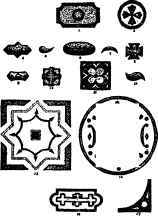
240. Designs for carpet-beds.
No. 3
Outside, Alternanthera aurea nana; middle, Alternanthera amoena spectabilis; center, Anthemis coronaria.
No. 4, 5, 6, 7, 8, 12
No. 4, 5, 6, 7, 8, 12 may each be filled with a single color, or given a border of suitable plants if the planter so chooses.
No. 9
Ground, Alternanthera aurea nana; center, Acalypha tricolor; black dots, scarlet geranium.
No. 10
Ground of Centaurea gymnocarpa; circle, Achyranthes Lindeni; cross, Golden coleus.
No. 11
Border, Oxalis tropaeoloides; center, blue heliotrope, blue ageratum, or Acalypha marginata; cross about the center, Thymus argenteus,or Centaurea; scallop outside the cross,blue lobelia; corners, inside border, santolina.
Designs 13 and 14 are, in character, somewhat in the style of a parterre; but instead of the intervening spaces in the bed being ordinary walks they are of grass. Such beds are of a useful type, because they may be made large and yet be executed with a comparatively small number of plants. They are especially suitable for the center of an open plot of lawn with definite formal boundaries on all sides, such as walks or drives. Whether they are to be composed of tall-growing or of low-growing plants will depend upon the distance they are to be from the observer. For a moderate-sized plot the following plants might be used:
No. 13
Border, red alternanthera; second row, dwarf orange or yellow nasturtium; third row, Achyranthes Gilsoni, or Acalypha tricolor; central square, scarlet geraniums, with a border of Centaurea gymnocarpa; intervening spaces, grass. Instead of the square of geraniums, a vase might be substituted, or a clump of Salvia splendens.
No. 14
Composite beds like this and the former are always suggestive. They contain various features which may readily be re-combined into other patterns. Sometimes it may be convenient to use only portions of the design. The reader should feel that no arrangement is arbitrary, but merely a suggestion that he may use with the utmost freedom, only keeping harmony in view. For No. 14, the following may be an acceptable planting arrangement: Border, Mme. Salleroi geranium; small dots, dwarf scarlet trope-ohim; diamonds, blue lobelia; crescents, Stevia serrata variegata; inner border, crimson achyranthes or coleus; loops, Centaurea gymnocarpa; wedge-shaped portions, scarlet geranium.
No. 15
Suitable for a corner. Border, red alternanthera; second row, Alternanthera aurea nana; third row, red alternanthera; center, Echeveria Californica.
No. 16
Border, crimson alternanthera (another border of yellow alternanthera might be placed inside of this) ; ground, Echeveria secunda glauca; inner border, Oxalis tropaeoloides; center, Alternanthera aurea nana. Or, inner border, Echeveria Californica; center, crimson alternanthera.
No. 17
Another bed intended to fill an angle. Its curved side will also fit it for use with a circular design. Border, dwarf blue ageratum; circle, blue lobelia; ground (3 parts), crimson alter-nanthera. Other carpet or mosaic beds (after Long), with the plants indicated, are shown in Figs. 241, 242.
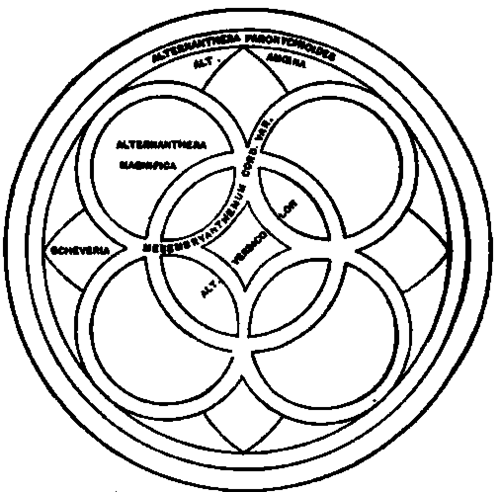
241. Carpet-bed for a bay or recession in the border planting.

242. Another circular carpet-bed.
Continue to:


My Books

