


Coldframes
Description
This section is from the book "Manual Of Gardening", by L. H. Bailey. Also available from Amazon: Manual of Gardening.
Coldframes
A coldframe is nothing more than an enlarged hand-box; that is, instead of protecting but a single plant or a single hill with a single pane of glass, the frame is covered with sash, and is large enough to accommodate many plants.
There are three general purposes for which a coldframe is used: For the starting of plants early in spring; for receiving partially hardened plants that have been started earlier in hotbeds and forcing-houses; for wintering young cabbages, lettuce, and other hardy plants that are sown in the fall.
Coldframes are ordinarily placed near the buildings, and the plants are transplanted into the Geld when settled weather comes. Sometimes, however, they are made directly in the field where the plants are to remain, and the frames, and not the plants, are removed. When used for this latter purpose, the frames are made very cheap by running two rows of parallel planks through the field at a distance apart of six feet. The plank on the north is ordinarily ten to twelve inches wide, and that on the south eight to ten inches. These planks are held in place by stakes, and the sashes are laid across them. Seeds of radishes, beets, lettuce, and the like, are then sown beneath the sash, and when settled weather arrives, the sash and planks are removed and the plants are growing naturally in the field. Half-hardy plants, as those mentioned, may be started fully two or three weeks in advance of the normal season by this means.
193. Glass forcing hill.
One of the simplest types of coldframes is shown in Fig. 194, which is a lean-to against the foundation of a house. A sill is run just above the surface of the ground, and the sashes, shown at D, are laid on rafters which run from this sill to the sill of the house, A. If this frame is on the south side of the building, plants may be started even as early as a month before the opening of the season. Such lean-to frames are sometimes made against greenhouses or warm cellars, and heat is supplied to them by the opening of a door in the wall, as at B. In frames that are in such sunny positions as these, it is exceedingly important that care be taken to remove the sash, or at least to give ample ventilation, in all sunny days.
A different type of lean-to structure is shown in Fig. 195. This may be either a temporary or permanent building, and it is generally used for the protection of half-hardy plants that are grown in pots and tubs. It may be used, however, for the purpose of forwarding pot-plants early in the spring and for the protection of peaches, grapes, oranges, or other fruits in tubs or boxes. If it is desired merely to protect the plants through the winter, it is beat to have the structure on the north side of the building, in order that the sun may not force the plants into activity.
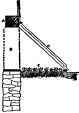
194. Cold frame against a building. Plants at E; sill of house at A; basement opening at B.
195. Weather screen, or cold-frame, against a building.
196. A pit or cold frame on permanent walls, and a useful adjunct to a garden. The rear cover is open (a).
197. The usual form of coldframe.
Another structure that may be used both to carry half-hardy plants over winter and for starting plants early in spring is shown in Fig. 196. It is really a miniature greenhouse without heat. It is well adapted for mild climates. The picture was made from a structure in the coast region of North Carolina. The common type of coldframe is shown in Fig. 197. It is twelve feet long and six feet wide, and is covered with four three-by-six sash. It is made of ordinary lumber loosely nailed together. If one expects to use coldframes or hotbeds every year, however, it is advisable to make the frames of two-inch stuff, well painted, and to join the parts by bolts and tenons, so that they may be taken apart and stored until needed for the next year's crop. Figure 198 suggests a method of making frames so that they may be taken apart.
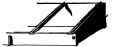
198. A strong and durable frame.
199. A frame yard.
It is always advisable to place coldframes and hotbeds in a protected place, and particularly to protect them from cold north winds. Buildings afford excellent protection, but the sun is sometimes too hot on the south side of large and light-colored buildings. One of the best means of protection is to plant a hedge of evergreens, as shown in Fig. 199. It is always desirable, also, to place all the coldframes and hotbeds close together, for the purpose of economizing time and labor. A regular area or yard may be set aside for this purpose.
200. Portable coldframe.
Various small and portable coldframes may be used about the garden for the protection of tender plants or to start them early in the spring. Pansies, daisies, and border carnations, for example, may be brought on very early by setting such frames over them or by planting them under the frames in the fall. These frames may be of any size desired, and the sash may be either removable, or, in case of small frames, they may be hinged at the top. Figs. 200-203 illustrate various types.
Continue to:


My Books

