


The Hoe
Description
This section is from the book "Manual Of Gardening", by L. H. Bailey. Also available from Amazon: Manual of Gardening.
The Hoe
The common rectangular-bladed hoe is so thoroughly established in the popular mind that it is very difficult to introduce new patterns, even though they may be intrinsically superior. As a general-purpose tool, it is no doubt true that a common hoe is better than any of its modifications, but there are various patternsof hoe-blades that are greatly superior for special uses, and which ought to appeal to any quiet soul who loves a garden.
The great width of the common blade does not admit of its being used in very narrow rows or very close to delicate plants, and it does not allow of the deep stirring of the soil in narrow spaces. It is also difficult to enter hard ground with such a broad face. Various pointed blades have been introduced from time to time, and most of them have merit. Some persons prefer two points to the hoe, as shown in Marvin's blades, in Fig. 95. These interesting shapes represent the suggestions of gardeners who will not be bound by what the market affords, but who have blades cut and fitted for their own satisfaction.
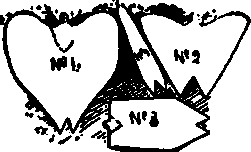
95. Useful forms of hoc-blades.
96. A stack of gardening weapons, comprising tome of Tarryer'a weeding spuds and thimbles.
Persons who followed the entertaining writings of one who called himself Mr. A. B. Tarryer, in "American Garden," a few years back, will recall the great variety of implements that he advised for the purpose of extirpating his hereditary foes, the weeds. A variety of these blades and tools is shown in Figs. 96 and 97. I shall let Mr. Tarryer tell his story at some length in order to lead my readerpainlessly into a new field of gardening pleasures.
Mr.Tarryer contends that the wheel-hoe is much too clumsy an affair to allowof the pursuit of an individual weed. While the operator is busy adjusting his machine and manipulating it about the corners of the garden, the quack-grass has escaped over the fence or has gone to seed at the other end of the plantation. He devised an expeditious tool for each little work to be performed on the garden, - for hard ground and soft, for old weeds and young (one of his implements was denominated "infant-damnation")- "Scores of times during the season," Mr. Tarryer writes, "the ten or fifteen minutes one has to enjoy in the flower, fruit, and vegetable garden - and that would suffice for the needful weeding with the hoes we are celebrating - would be lost in harnessing horses or adjusting and oiling squeaky wheel-hoes, even if everybody had them. The 'American Garden' is not big enough, nor my patience long enough, to give more than an inkling of the unspeakable merits of these weapons of society and civilization.
When Mrs. Tarryer was showing twelve or fifteen acres of garden with never a weed to be seen, she valued her dozen or more of these light implements at five or ten dollars daily; whether they were in actual use or adorning the front hall, like a hunter's or angler's furniture, made no difference. But where are these millennial tools made and sold? Nowhere. They are as unknown as the Bible was in the dark ages, and we must give a few hints towards manufacturing them.
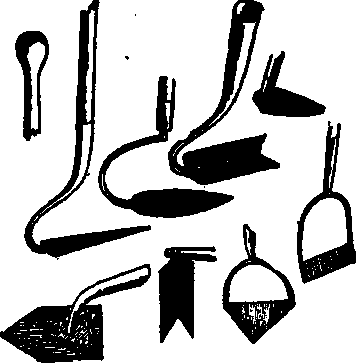
97. Some of the details of the Tarryer tools.
"First, about the handles. The ordinary dealer or workman may say these knobs can be formed on any handles by winding them with leather; but just fancy a young maiden setting up her hoe meditatively and resting her hands and chin upon an old leather knob to reflect upon something that has been said to her in the garden, and we shall perceive that a knob by some other name would smell far sweeter. Moreover, trees grow large enough at the butt to furnish all the knobs we want - even for broom-sticks - though sawyers, turners, dealers, and the public seem not to be aware of it; yet it must be confessed we are so far gone in depravity that there will be trouble in getting those handles. . . .
"In a broadcast prayer of this public nature, absolute specifications would not be polite. Black walnut and butternut are fragrant as well as beautiful timber. Cherry is stiff, heavy, durable, and, like maple, takes a slippery polish. For fine, light handles, that the palm will stick to, butt cuts of poplar or cottonwood cannot be excelled, yet straight-grained ash will bear more careless usage.
"The handles of Mrs. Tarryer's hoes are never perfectly straight. All the bayonet class bend downward in use half an inch or more; all the thrust-hoe handles bend up in a regular curve (like a fiddle-bow turned over) two or three inches. Unless they are hung right, these hoes are very awkward things. When perfectly fit for one, they may not fit another; that is, a tall, keen-sighted person cannot use the hoe that is just fit for a very short one. . . . Curves in the handles throw centers of gravity where they belong. Good timber generally warps in a handle about right, only implement makers and babes in weeding may not know when it is made fast right side up in the hoe.
98. A scarifier.
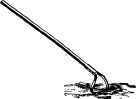
99. Home-made.
"There are plenty of thrust-hoes in market, such as they are. Some have malleable iron sockets and bows - heavier to the buyer and cheaper to the dealer - instead of wrought-iron and steel, such as is required for true worth".
Continue to:


My Books

