


Transplanting Established Plants And Trees
Description
This section is from the book "Manual Of Gardening", by L. H. Bailey. Also available from Amazon: Manual of Gardening.
Transplanting Established Plants And Trees
In setting potted plants out of doors, it is nearly always advisable to plunge them, - that is to set the pots into the earth, - unless the place is very wet. The pots are then watered by the rainfall, and demand little care. If the plants are to be returned to the bouse in the fall, they should not be allowed to root through the hole in the pot, and the rooting may be prevented by turning the pot around every few days. Large decorative plants may be made to look as if growing naturally in the lawn by sinking the pot or box just below the surface and rolling the sod over it, as suggested in Fig.

133. Dibber and crow-bar combined.

134. Strawberry planter.
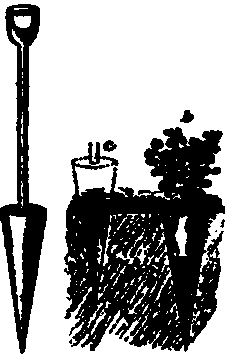
135. The plunging of pots.
136. A space around and below the tub may be provided to insure drainage.
Tub-Plants
For the shifting of very large tub-plants, a box or tub with movable sides, as in Fig.
137, is handy and efficient. The plant-box recommended to parties who grew plants for exhibition at the World's Fair is shown in Fig. 138. It is made of strong boards or planks.
At A is shown the inside of one of two opposite sections or sides, four feet wide at top, three feet wide at bottom, and three feet high. The cleats are two-by-four scantlings, through which holes are bored to admit the bolts with which the box is to be held together. B is an outside view of one of the alternating sections, three feet four inches wide at top, two feet four inches at bottom, and three feet deep. A one-by-six strip is nailed through the center to give strength. C is an end view of A, showing the bolts and also a two-by-four cleat to which the bottom is to be nailed. This box was used mostly for transporting large growing stock to the exposition, the stock having been dug from the open and the box secured around the ball of earth.
136. Setting large tub-plants in the lawn.

137. Plant-box with a movable aide.

138. Box for transporting Urge transplanted stock.
When To Transplant
In general, it is best to set hardy plants in the fall, particularly if the ground is fairly dry and the exposure is not too bleak. To this class belong most of the fruit trees and ornamental trees and shrubs; also hardy herbs, as columbines, peonies, lilies, bleeding-hearts, and the like. They should be planted as soon as they are thoroughly mature, so that the leaves begin to fall naturally. If any leaves remain on the tree or bush at planting time, strip them off, unless the plant is an evergreen. It is generally best not to cut back fall-planted trees to the full extent desired, but to shorten them three-fourths of the required amount in the fall, and take off the remaining fourth in the spring, so that no dead or dry tips are left on the plant. Evergreens, as pines and spruces, are not headed-in much, and usually not at all.
All tender and very small plants should be set in the spring, in which case very early planting is desirable; and spring planting is always to be advised when the ground is not thoroughly drained and well prepared.
Depth To Transplant
In well-compacted land, trees and shrubs should be set at about the same depth as they stood in the nursery, but if the land has been deeply trenched or if it is loose from other causes, the plants should be set deeper, because the earth will probably settle. The hole should be filled with fine surface earth. It is generally not advisable to place manure in the hole, but if it is used, it should be of small amount and very thoroughly mixed with the earth, else it will cause the soil to dry out. In lawns and other places where surface tillage cannot be given, a light mulch of litter or manure may be placed about the plants; but the earth-mulch (page 98), when it can be secured, is much the best conserver of moisture.
Making The Rows Straight
In order to set trees in rows, it is necessary to use a garden line (Fig. 96), or to mark out the ground with some of the devices already described (Figs. 113-120); or in large areas, the place may be staked out. In planting orchards, the area is laid out (preferably by a surveyor) with two or more rows of stakes so placed that a man may sight from one fixed point to another. Two or three men work to best advantage in such planting.

139. A planting board.

140. Device for placing the tree.
There are various devices for locating the place of the stake after the stake has been removed and the hole dug, in case the area is not regularly staked out in such a way that sighting across the area may be employed. One of the simplest is shown in Fig. 139. It is a narrow and thin board with a notch in the center and a peg in either end, one of the pegs being stationary. The implement is so placed that the notch meets the stake, then one end of it is thrown out of the way until the hole is dug. When the implement is brought again to its original position, the notch marks the place of the stake and the tree. Figure 140 is a device with a lid, in the end of which is a notch to mark the place of the stake. This lid is thrown back, as shown by the dotted lines, when the hole is being dug. Figure 141 shows a method of bringing trees in row by measuring from a line.
141. Lining a tree from a stake.
Cutting-Back; Filling
In the planting of any tree or bush, the roots should be cut back beyond all breaks and serious bruises, and fine earth should be thoroughly filled in and firmed about them, as in Fig. 142. No implement is so good as the fingers for working the soil about the roots. If the tree has many roots, work it up and down slightly several times during the filling of the hole, to settle the earth in place. When the earth is thrown in carelessly, the roots are jammed together, and often an empty place is left beneath the crown, as in Fig. 143, which causes the roots to dry out.

142. Proper planting of a tree.

143. Careless planting of a tree.
The marks on the tops of these trees in Figs. 142 and 143 show where the branches may be cut. See also Fig. 152. Figures 144 and 145 show the tops of trees after pruning. Strong branchy trees, as apples, pears, and ornamental trees, are usually headed back in this way, upon planting. If the tree has one straight leader and many or several slender branches (Fig. 146), it is usually pruned, as in Fig. 147, each branch being cut back to one or two buds. If there are no branches, or very few of them, - in which case there will be good buds upon the main stem, - the leader may be cut back a third or half its length, to a mere whip. Ornamental bushes with long tops are usually cut back a third or a half when set, as shown in Fig. 45. Always leave a little of the small bud-making growth. The practice of cutting back shade trees to mere long clubs, or poles, with no small twigs, is to be discouraged. The tree in such case is obliged to force out adventitious buds from the old wood, and it may not have vigor enough to do this; and the process may be so long delayed as to allow the tree to be overtaken by drought before it gets a start.
Continue to:


My Books

