


Chapter VIII. The Best Shrubs To Plant
Description
This section is from the book "Town Planting And The Trees, Shrubs, Herbaceous And Other Plants That Are Best Adapted For Resisting Smoke", by Angus D. Webster. Also available from Amazon: Town Planting: The Trees, Shrubs, Herbaceous And Other Plants That Are Best Adapted For Resisting Smoke.
Chapter VIII. The Best Shrubs To Plant
As regards choice of town shrubs one must be guided greatly by the particular district in which planting is to be engaged, and it should be distinctly understood that all those recommended in the following notes will not succeed equally well in every part of London. Thus it would be unwise, in the worst smoke-infested areas, to plant several species that are well known to give satisfaction in the more open parts where the air is comparatively pure, and the further we recede from smoke and other atmospheric impurities, so the number of suitable species increases. With wall shrubs the Ivy, Ampelopsis, and Vine are by far the best and are planted in numbers, but in more favoured situations many others, including the Pyracantha, Ake-bia, Polygonum, Lonicera, .and one or two species of Clematis, thrive in quite a satisfactory way when afforded wall protection. Wherever shrubs are to be planted in smoke-infested situations, matters of the greatest importance are choosing healthy well rooted specimens and providing suitable soil, and, where both these conditions are attended to, the chances of success are greatly enhanced. Slipshod methods of inserting shrubs in unprepared ground that has not been deeply worked and rendered suitable in quality are to be discountenanced, and the little expense involved in carrying out such work on the most approved principle is money well spent. We certainly cannot change the nature of a tree or shrub that is unsuitable for withstanding the heated air of our more smoky centres of industry, but, by attending to its peculiar wants in the matter of soil and using only healthy well-rooted specimens to start with, the chances of success, if even for a while, are greatly increased. Among the most suitable shrubs for planting in smoky localities the following are to be recommended. Evidently deciduous species possess an advantage over evergreen kinds in the total annual renewal of their leaves; and hence it follows that, as with trees, deciduous shrubs should have the preference: -
The Holly Leaved Osmanthus (Os-manthus ilicifolius)
The Holly Leaved Osmanthus (Os-manthus ilicifolius) is one of the handsomest of evergreen shrubs, and also one of the few that succeed in a satisfactory way when subjected to the impurities of a town atmosphere. In the smokiest districts of both London and Liverpool, it is unquestionably one of the best all-round shrubs. The holly-like leaves are thick and of firm substance, and the inconspicuous yellowish-green flowers are much like those of the Holly.
The Bladder Senna (Colutea arbores-cens)
The Bladder Senna (Colutea arbores-cens) is entitled to rank high amongst town shrubs,for it may be seen flowering and fruiting in the most smoky parts of many of our largest cities. It does well in the very centre of London, and is largely planted in Liverpool, Manchester, Warrington, and Glasgow. The pretty yellow flowers and the curious bladderlike seed-pods are both showy and interesting, and render the plant one of the brightest shrubbery ornaments during nearly half of the year. Few soils come amiss, but it succeeds best in a warm and sunny position, and is well adapted for use as a wall plant. This curious and ornamental shrub may be seen in unusually good form on the railway embankments of the London and South Western Railway nearly all the way from Clapham Junction to Wimbledon, but particularly near the latter place. Many passengers seem puzzled as to what is the name of the shrub with the inflated bladder-like pods, and which, from being tinged with red, add no little to the peculiar aspect and beauty of the plant. It is a shrub of the readiest culture, one that will succeed well in the poorest of soils, and is perfectly hardy in every part of these isles. For planting in smoky districts it is an especial favourite, the bright foliage and yellow pea-shaped flowers, which are succeeded by the curious bladder-like fruit covering, being especial points of attraction. It is of South European origin, and has been known in this country at least from the days of Parkinson, where, in his "Paradisus," he speaks of it as the "greater bastard senna with bladders." Being readily raised from seed and of the simplest culture, it should make owners of waste ornamental ground where the soil is not of first-rate quality plant it in numbers, for certainly a more curious or interesting specimen is not to be found in the whole range of hardy shrubs.
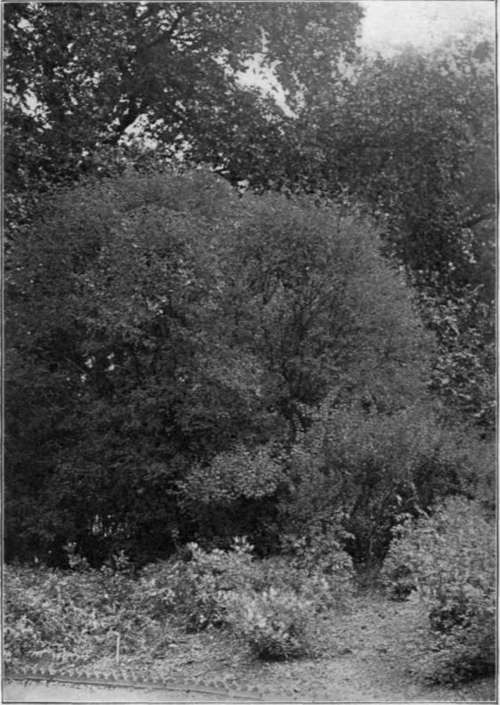
The Bladder Senna (Colutea). To face Page 88.
Continue to:


My Books

