


Chapter XIII. Bedding Plants
Description
This section is from the book "Town Planting And The Trees, Shrubs, Herbaceous And Other Plants That Are Best Adapted For Resisting Smoke", by Angus D. Webster. Also available from Amazon: Town Planting: The Trees, Shrubs, Herbaceous And Other Plants That Are Best Adapted For Resisting Smoke.
Chapter XIII. Bedding Plants
So-called bedding plants that are grown under glass and only planted out during Summer, when atmospheric conditions are most favourable for vegetation generally, naturally succeed well, especially if strong, healthy specimens and suitable soil composts are used. There are, however, some species that do much better than others when subjected to the impure atmosphere of our town gardens, and of these the following may be recommended: - Fuchsias of most kinds are well suited for planting where smoke and dust abound, and at several places in London-notably the Royal Mint - several varieties of Fuchsia have been found preferable to most other plants when used for bedding purposes.
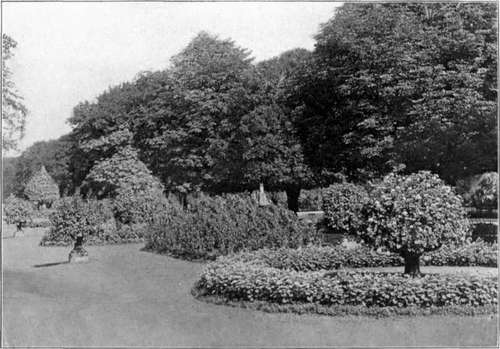
Bedding Plants. To face page 160.
The procumbent and beautiful-leaved variety named Golden Treasure grows with unusual luxuriance. Some of the best Fuchsias for town gardening are Display, Meteor, Empress Eugene, Mrs. Marshall, Golden Treasure, and Madame Cornellion.
Geraniums, as every one knows, succeed well and are used largely as bedding plants in every part of the metropolis, some of the best being Paul Crampel, Flower of Spring, the Ivy-leaved, Mrs. Jacoby, Lucrece, and Princess of Wales.
Calceolaria Burbidgei
Calceolaria Burbidgei is a capital town plant, of noble port and very floriferous.
Heliotropes also do well, the three best being Lord Roberts, President Garfield, and Miss Nightingale.
Salvias are very ornamental bedding plants, but if exposed to great extremes of temperature lose their leaves and become shabby. One of the best is Glory of Zurich.
Begonias, especially the tuberous-rooted and semperflorens type, are not to be recommended for smoky parts of the metropolis, but where the air is fairly pure they succeed and are highly ornamental.
Abutilon Thompsonii
Abutilon Thompsonii is a valuable foliage plant for the town garden, where it succeeds well even in very confined quarters. Dracaena congesta and some of the Agaves are amongst the most useful of foliage plants for the town garden, and they are able to resist a great amount of smoke, dust, and heat. The common white, perpetual-flowering Marguerite (Chrysanthemum) is one of the most valuable town plants we possess, and is cultivated in several of our town squares and confined spaces where few other plants could succeed; of splendid constitution and free-flowering, it is always a welcome plant wherever it is used, and blooms continuously for nearly four months of the year. There are worthless forms that produce only one set of flowers, but with the perpetual-flowering a continuation of blooming for the whole season may be relied upon. Triumph and Queen Alexandra are two of the best.
A bed of succulent plants has attractions that differ from those of the general run of bedding plants. There are many kinds, and their quaint and curious forms can be displayed to advantage on an irregularly shaped bed or mound.
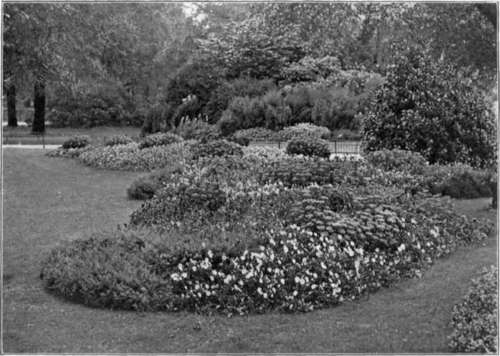
Violas For Town Planting. To face page 162.
Violas should on no account be omitted from the list of bedding plants that are suitable for town gardening, and how well they succeed may be seen by the large irregular mound of these which is annually planted in the flower garden at Regent's Park. There are many varieties, so that excellent effects may be obtained. One of the best bedding plants for withstanding smoke is the Ox-eye Daisy, and for this reason it is used in positions where other plants of a similar kind could not succeed. Cannas are used for bedding in the London parks, but unless in open airy situations they cannot be generally recommended. There are many other plants in use for bedding purposes throughout our larger towns, such as Palms, Grevillea robusta, Eucalyptus of sorts, Hydrangea Thomas Hogg, and others.
Amongst Annuals that have from long experience been found suitable for town gardening special mention must be made of the Marigold, Rocket, dwarf Pyrethrum, Balsam, and Lychnis. These four plants not only thrive, but actually seem to revel under the worst conditions of soil and atmosphere.
Thus, in the gardens attached to the Tower of London - one of the smokiest and most chemically impure of London atmospheres-these plants have for many years reproduced themselves from seed and flowered profusely.
For wild gardening in towns they have certainly few equals, and any plant that will thrive and reproduce its kind regularly for a number of years under such unfavourable surroundings is well worthy of attention. As dwarf edging plants for the town garden, the various forms of Lobelia, Alyssum maritimum, Iresine Lindeni, and I. Wallacei are to be preferred.
As before stated, almost any plant, if sufficiently hardy, will do well when transferred from the greenhouse to the open borders during the summer months, so that the variety to choose from is very large.
Continue to:


My Books

