


Chapter 19. On Garden Walks
Description
This section is from the book "Beautiful Gardens - How To Make Them And Maintain Them", by Walter P. Wright. Also available from Amazon: Beautiful Gardens: How To Make And Maintain Them.
Chapter 19. On Garden Walks
Modern flower gardening has given the walk a new significance. It is no longer regarded as merely the medium by which transit is effected from one part of the garden to another, but as something pleasing and beguiling in itself. It must have its own borders, and thus play a specific part in enhancing the beauty of the garden. As will be seen in the chapter on edgings, walk and border may really be made to blend; the association between them being then too intimate for any well-defined line of demarcation to be drawn.
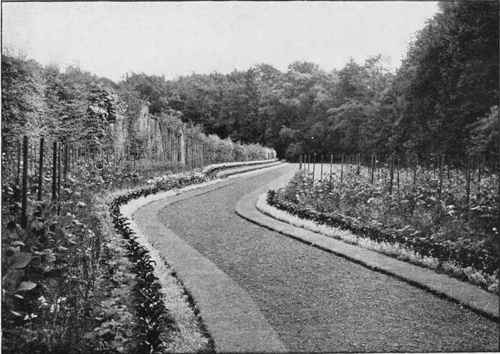
Fig. Gravel, grass and flowers. A walk in the grounds of the Rt. Hon. Sir Henry Campbell-Bannerman at Belmont Castle, Meigle, N.B.
While, however, the artist as well as the navvy has his part in the making of garden walks, it must be remembered that certain principles of construction are essential. A main walk should be well built up, to enable it to carry fairly heavy traffic. It should have 6 inches of rubble in the bottom, well rammed down on a firm base, and 3 inches of gravel on the top, the finer particles on the surface. The path should rise from the edges to the centre, at the rate of 2 inches for every 4 feet. This will ensure water being carried to the sides, where grated take-away pipes will carry it to the 3-inch ground drains, laid in the ballast. A walk so made will serve for all ordinary garden work, and be available in all weathers. If regularly rolled it will have a neat appearance. In these days of cheap weed-killers there should be no trouble from weeds, as one application a year, or two at the most, will keep them under.
If there is much heavy traffic a more substantial basis is needed: cart and carriage traffic really demand something more than what is commonly called a "walk."
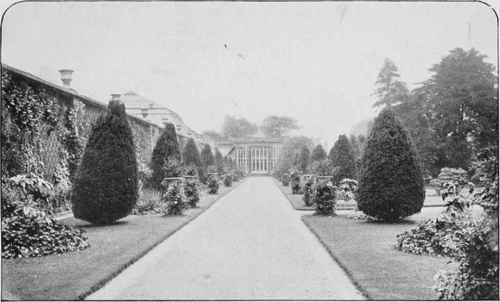
Fig. The Conservatory Walk At Tatton Park, A Formal Straight Walk With Conifers And Vases.
The width of the walk must be regulated by its use. A main walk may be 8 feet wide, for a side path 4 feet will suffice. Economic, if no other, considerations will dictate that walks shall not be made wider than is necessary. Where material has to be brought from a distance walk making is apt to become expensive. Moreover, a garden may be made ugly with too much gravel.
Asphalte cannot be recommended as strictly appropriate for a garden walk, although its use is not uncommon. It has a "towny" look at all times, and is apt to be smelly in hot weather. At the same time, it has an advantage over gravel (which it shares with concrete) in sharply sloped gardens, wherein gravel is often badly washed down in heavy downpours of rain. A pathway made of large flagstones, the joints of which are left open so that dwarf plants may establish themselves, wears well, is good in wet weather, and when bordered with flowers has a pleasant, cool, old-world look about it.
The grass walk should be introduced whereever possible. Where there is cart or wheelbarrow traffic it is not suitable, but for ordinary flower garden walks it is much the most appropriate of all. What so beautiful a foil for flower borders! What so charming a base under pergolas or arches! The objection may be raised that grass walks are disagreeable, because damp in wet weather and when heavy dews prevail. This holds good to some extent, but when the grass is regularly mown and rolled it is not so serious. The further objection that grass paths are not satisfactory under trees, where the soil is impoverished by greedy roots, and where the shade is heavy, must be accepted; nevertheless, the grass walk remains important. It is easy to overdo gravel in a garden, but very difficult to overdo grass. Given gravel or any other non-vegetable walks, the aim must be to reduce them in area to the utmost possible extent, because they are only a convenience, like a spout or a toolshed. Given grass walks, the area may be increased to the utmost degree, consistently with the capacity for mowing, rolling, and trimming, as they add to the beauty of the garden. A series of winding grass walks, with borders of flowers, and arches in places, will be far more varied and interesting than any square-cut, bed-and-gravel garden. Indeed, a very beautiful garden could be made of them without any beds at all.
It is surely more pleasant to wander from one pleasant, special spot in the garden to another, with "flowers, flowers all the way," fresh objects of interest meeting the eye at each turn, grass beneath one's feet, than to stand on an expanse of gravel and be dazzled - almost startled - by one large group of beds. In the one case pleasure comes in many sweet sips; in the other it is swallowed at a gulp.
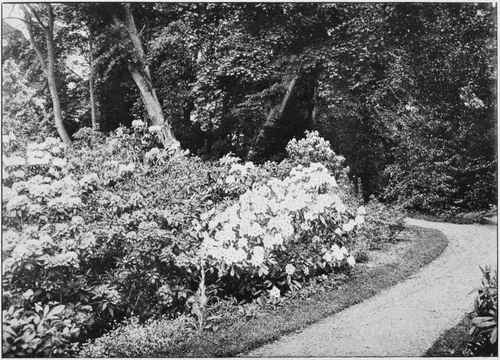
Fig. An informal walk, winding, with belts of shrubs.
Continue to:


My Books

