


Chapter 4. On Laying Out Gardens
Description
This section is from the book "Beautiful Gardens - How To Make Them And Maintain Them", by Walter P. Wright. Also available from Amazon: Beautiful Gardens: How To Make And Maintain Them.
Chapter 4. On Laying Out Gardens
Designing a garden is one of the supreme joys of life. The true garden lover will not dispose of it at a gulp; he will savour it, as he would a choice wine. While common minds are disporting themselves, after the evening meal, with the political moonshine in the daily papers, or in losing winning hazards on the billiard table, the garden designer will be covering "Bristol board" with blotches, circles, and zigzags.
If he be wise enough to get the very utmost out of his fascinating recreation, he will begin his designing in the summer time, so that he may have several months of pure happiness before autumn puts an end to planning, and starts the work.
Tom Pinch called attention to the singular fact that in advertisements one man is advertising requirements and another qualifications which exactly correspond, and yet the two do not seem to come together. It is an equally remarkable thing that professional landscape gardeners are for ever making designs for gardens of the exact area which other people want to fill, but the two do not harmonise. The fact is, a garden gives scope for expressing individuality to a degree that nothing else affords. A true garden lover will no more be satisfied with one plan by a professional than he will with his own first attempt. He will "lay out" his domain on paper so carefully that every inch is occupied, apparently to the best advantage, but over the next evening's coffee improvements will suggest themselves, or mayhap an entirely new method of treatment will come to mind.
For the author's own part, he has altered an evening's work completely because the original scheme would not permit of the interpolation of an afterthought in the form of a Sweetbrier hedge. Was a Sweetbrier hedge, then, so essential that a promising design had to be completely sacrificed? Well, the fact that the hedge did not seem able to squeeze itself in led to its being wanted very badly indeed!
Although much latitude for variety of treatment may be permitted, there are certain rules which the garden designer will be wise to observe.
In the first place, he should work as much as possible in curves. His path or carriage drive may run as straight as a gun-barrel from the entrance gate to the front door, but it will look far better if it is made to take a gentle sweep. His side borders may be cut in a perfectly straight line, but the effect will be superior if the edge is waved. The flower beds may be rectangles, but circles, ovals, and crescents will be much prettier. A bed of Rhododendrons might be cut in a dead square, but it would be more pleasing to the eye as a bay.
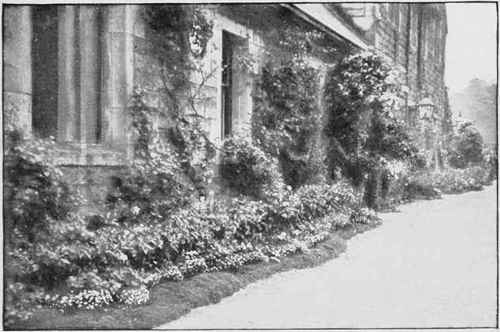
Fig. An undulating border under a wall.
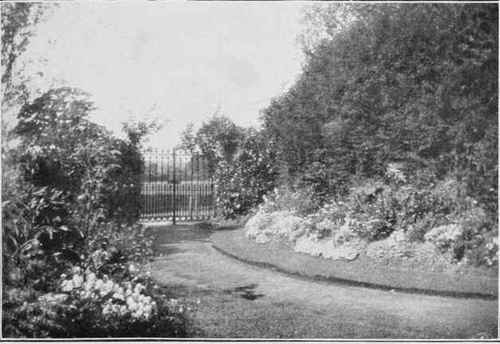
Fig. A pretty entrance. Note the curving walk.
Secondly, there must be an adequate foil of turf for every border or bed. Groups of colour lose half their effect if they lack a soft setting of greensward.
Thirdly, there must be irregularity of height as well as of outline. With clever planning, a flat garden may be almost as well broken up as one that possesses natural mounds and dells. A group of pillar Clematises, arches of Crimson Rambler, and other Roses, a framework meshed with Honeysuckle, low stumps clothed in Wichuraiana or other selected Roses, groups of shrubs, hedges of Golden Privet, Euonymus, Sweetbrier, Tamarisk, and green or Golden Yew, with a rock-bed or two, will impart a welcome diversity.
Fourthly, an endeavour should be made to mask the walls or fences. This has the effect of disguising the area, and imparting an appearance of space and freedom.
Fifthly, due thought must be devoted to the task of providing beauty for all seasons of the year. A plan that merely provides a brilliant effect in summer is essentially faulty.
These points might be rounded off with the general appeal, so old, yet so often repeated, to lean so to Nature that Art is concealed. "In laying out a Garden," wrote Addison, in one of his incomparable essays in the Spectator, "we are to copy Nature as much as possible." "To conceal every appearance of Art, however expensive, making the whole appear the production of Nature only," was one of the laws laid down by Capability Brown's pupil, the famous Humphrey Repton. Let us, however, avoid the mistake made by gardeners of every school - that of concentrating attention on the plan, and forgetting the plant. There is something to be said alike for the formal terrace-and-avenue garden of Le Nôtre, the landscape of Kent, and the modern rock-garden of Robinson, but the best system of gardening is that which ignores unnatural Art as severely as artificial Nature, and, planning with grace and freedom, completes its work by making every plant grown a notable example of its kind.
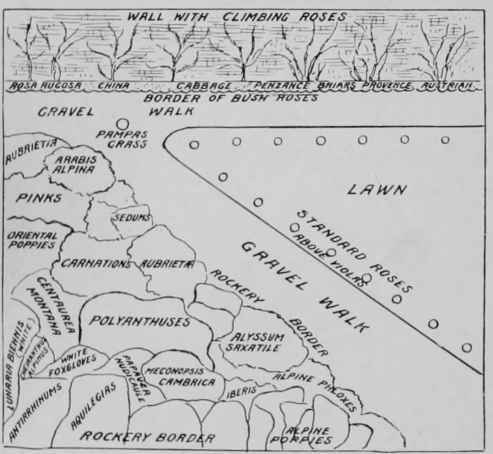
Fig. A Pretty Garden End
He who builds wisely in our chill, cloudy clime will turn his house's face to the south. In the southern counties it need not be due south, but may have a turn to the east, so as to meet the sun full about 11 a.m.; but the main aspect must be southerly. Then the principal living rooms will be comparatively warm and healthy in the autumn, winter, and spring, even though demanding shade in the height of summer. He will build, too, on a gentle declivity rather than on an arid and boisterous hilltop, or in a damp and relaxing bottom.
How will these considerations of building affect the garden? Well, plants, like human beings, thrive best, other things being equal, with plenty of light and warmth. So far as aspect is concerned, a southern slope is excellent for a garden. As regards soil, it may suffer in comparison with the bottom lands, the layer of mould being generally shallower; against this, however, may be set the fact that it will not catch frosts so severely. All things considered, the southern slope is what we want. If the site is so favoured as to extend to the bottom lands, and there takes in a stream, it will give us almost perfect conditions for making a beautiful garden. We shall adorn the stream sides, contrive a pretty bridge, and provide cool, shady walks for the hot summer weather.
The house may stand on a terrace spacious enough to allow a good area in front of the windows. The terrace may end in a sloping bank, but shall preferably be supported by a wall, creeper-covered. In the border at the foot of the wall shall be grown Tea Roses, Hollyhocks, Paeonies, Madonna Lilies, white Phloxes, and other beautiful plants. A broad flight of stone steps shall lead from the terrace to the lower grounds, and the vases at the foot of the stone balustrades shall be filled with Tropaeolums or Ivy-leaved Geraniums. The walk in front of the wall borders must, of course, be paved with irregular, unjointed flagstones, and edged with Box.
In the simplicity of this plan there lies an undoubted charm. One sees it in many a sweet old garden. And the terrace walk, with its pleasant odours, comes to be a favourite promenade. None the less, it is out of harmony with modern ideas. Our garden must begin under the windows, and with the smallest possible area of gravel on which a vehicle can turn, it must fall in lawn, rockery and border to the limit.
The border under the wall need not be a wide one - three to six feet will suffice - but it must have generous cultivation. Unless the soil in this hot, dry spot be deep and well manured, the creepers planted to cover the house, as also the dwarf plants in front of them, will fail to flourish. One of the indispensables for a house wall is Veitch's Virginian Creeper, variously known as Ampelopsis Veitchii and Vitis inconstans; and this, as a nurseryman's man once remarked to the author, is "a werry good plant to die." It certainly will not live in poor, parched soil, and albeit its proneness to an early demise may be very satisfactory from the nursery man's point of view, who has to supply fresh plants, it is less pleasing to the planter. Roses, Clematises, and other plants such as are often grown on house fronts, equally object to starving and roasting. Give them rich, deep soil, plant them by mid-March, so that they may get established before hot weather comes, and they will thrive.
We have seen that our path or drive from the entrance is not coming up to the house in a straight line. As a matter of fact, we are not going to see much of that path, even when we are walking on it. For the greater part of its length it may have to serve for both visitors and tradesmen, but before it reaches the house it must fork, one branch going to the front and the other to the back door. Both forks shall be well screened with shrubs, and the area which they enclose shall be a level of the finest turf, relieved, perhaps, but certainly not covered, by flower beds.
In its progress to the gate the path shall gently curve away among clumps of shrubs, isolated Conifers, and bold beds of flowers. It shall be spanned at intervals by an arch. At no point shall we be able to look along it and see an unbroken stretch of gravel. On the contrary, we shall see it constantly melting into breaks of cool foliage and brilliant breadths of bloom. Remember that this plan can be followed in a small suburban as well as in a larger country garden.
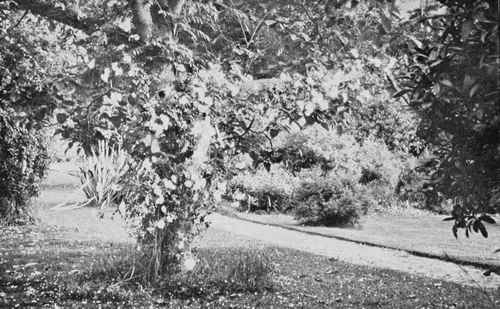
Fig. A Rose Over A Path At The Garden House, Saltwood Hytme.
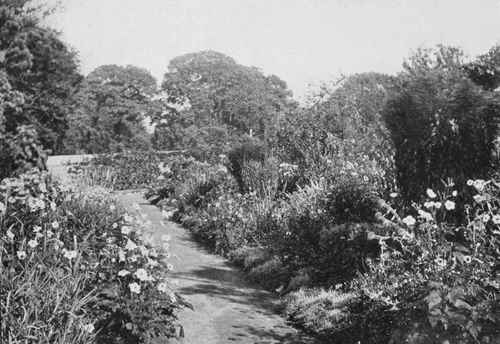
Fig. A flower bordered path at Coombe Lewes.
The entrance must be well screened by shrubs, of which a list shall be given in another chapter. Evergreens of the more common kinds, such as Laurels and Aucubas, are often reviled in these days, but flower gardeners whose means are limited must not despise useful and inexpensive things for plain purposes. A good deal of affected nonsense is talked about shrubs. The people who indulge in it do not, as a rule, lay down Turkey carpets in their kitchens. Plants of low growth may skirt the drive if desired.
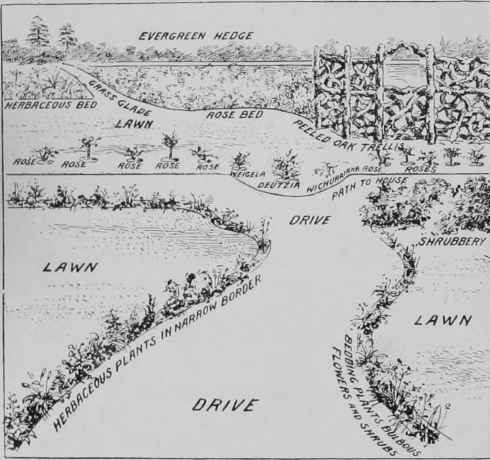
Fig. A pretty main entrance.
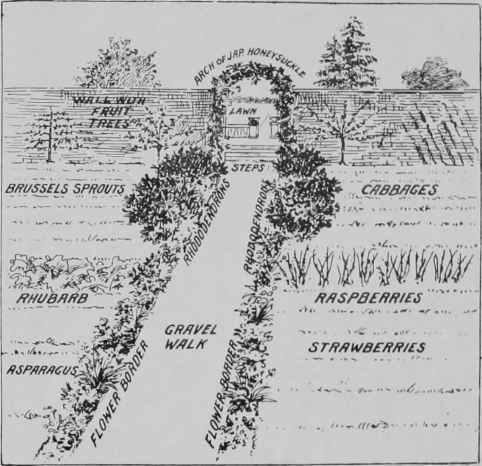
Fig. A pleasant entrance to a kitchen garden.
Continue to:


My Books

