


Where Can We Establish Beautiful Groups Of Herbaceous Plants
Description
This section is from the book "Beautiful Gardens - How To Make Them And Maintain Them", by Walter P. Wright. Also available from Amazon: Beautiful Gardens: How To Make And Maintain Them.
Where Can We Establish Beautiful Groups Of Herbaceous Plants
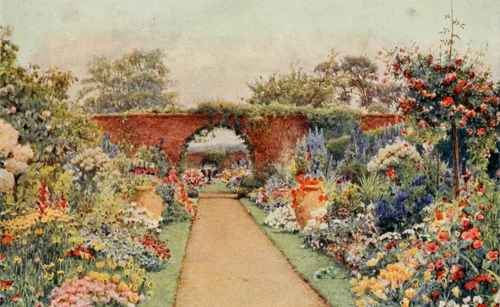
Fig. Garden At Harleyford Manor, Great Marlow. From a Water Colour Drawing by E. A, Roive.
Now, let us ask ourselves the question where we can best establish beautiful groups of herbaceous plants.
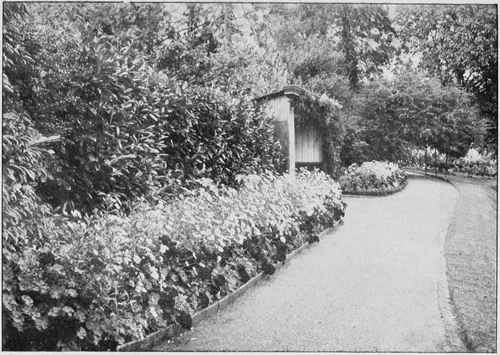
Fig. Front the shrubbery with a broad belt of herbaceous plants.
(1) As borders to shrubberies. The old style of shrubbery was a dense bank of evergreens, frequently of the most common kinds. Such a mass may have value as a wind break, screen, or stop gap, but it will have no artistic importance, nor will it give any intellectual pleasure. It will be as useful, and as wanting in interest, as a Thorn hedge. Front the shrubbery, however, with a broad belt of good herbaceous plants, and for six or seven months out of the twelve it will be interesting. A mere "skirting" half a yard wide is useless; the belt should be 4 to 6 feet wide.
(2) As house or other wall borders. Ugly buildings or bare walls could be hidden for the greater part of the year with herbaceous plants. Here again a narrow fringe of plants is of very little value; breadth is essential. Special care must be taken in preparing the soil, as such sites are often dry and impoverished.
(3) As lawn beds. We speak of herbaceous borders, generally. Well, a "border," as generally understood, is only the front portion of a certain area of garden ground. But there is no reason why a whole slice of garden should not be given up to beds of herbaceous plants. A group of such beds, with grass paths between, and with Rose-clad arches at different points, makes a beautiful garden in itself. Do not skimp space for the beds. Give them every inch there is available. A bed from 12 to 20 feet across will afford room for some bold and brilliant effects.
(4) In small gardens. In a quite small garden the herbaceous plants will probably serve the best purpose in a border round the outskirts. The fences should be masked with evergreen trees and shrubs, so that they may not be revealed in naked ugliness when the herbaceous plants sink to their winter rest. The latter may form a broad belt in front of them. Carry the border round in a series of bays and promontories.
(5) As kitchen garden borders in large places. Great gardens are steadily adopting the use of herbaceous borders in the vegetable department. Large kitchen gardens are generally walled, and intersected by gravelled paths, approaching the width of carriage drives. Time was when these splendid walks were skirted by nothing more attractive than lines of espalier fruit trees; now the tendency is to fringe them with broad belts of herbaceous plants, and the espaliers, if provided at all, are set farther back. One sees this system in such noble gardens as those of his Majesty the King at Sandringham; those of the Earl of Haddington at Tyningehame; those of Lord Battersea at Overstrand, and many others.
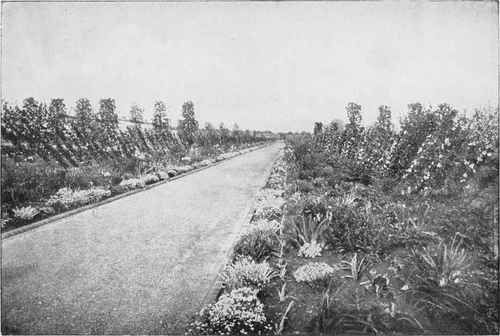
Fig. Fringed with borders of herbaceous plants. A Border In The Kitchen Gardens Of His Majesty The King At Sandringham
(6) Dwarf hardy plant borderings. An interesting and charming plan is that of having a narrow waved bordering of pretty dwarf rock Alpines amongst small stones along the side of paths. Lord Battersea adopts this system in his lovely garden near Cromer. It robs the walks of all stiffness.
Continue to:


My Books

