


How To Prune Pear Trees
Description
This section is from the book "Pictorial Practical Fruit Growing", by Walter P. Wright. Also available from Amazon: Pictorial Practical Fruit Growing.
How To Prune Pear Trees
Pears are comparatively easy to prune, for they do not present the great variations which have been noted as occurring in Apples. The twelve-cordons-on-a-tree type - i.e. specimens with a limited number of branches trained well apart, the breastwood pruned to six leaves in August, and spurred to a couple of eyes in winter, or before growth starts in spring - is the most healthy and productive.
N.B. - ln pruning Pears - and, indeed, all classes of fruit - avoid leaving stumps or "snags." A "snag" is the portion of shoot, ranging in length from 1/2 inch to 2 inches, which many pruners leave on each piece of growth which they cut. Such stumps are a source of danger to the tree, as they inevitably decay. The cuts should be made with a sharp knife close to the bud, then no "snag" is left. (See Fig. 11, and Fig. 12.)

Fig. 11. Where To Make The Cuts In Pruning Fruit Trees
References
A, shoot cut in advance of the bud, leaving a snag, a: b, proper direction of cuts.
C, cut made on same side as bud, leaving a short snag, e: f, proper direction and place.
D, cut made partly below the bud, g, resulting shoot; not good.
H, oblique shoot shortened to top side bud, m, to secure a straight branch, n.
I, top of pyramid: o, leader shortened; p, new leader; q, side shoots; r, side shoot shortened to outside bud, right; t, shoot shortened to inside bud, wrong; s, u, resulting shoots.
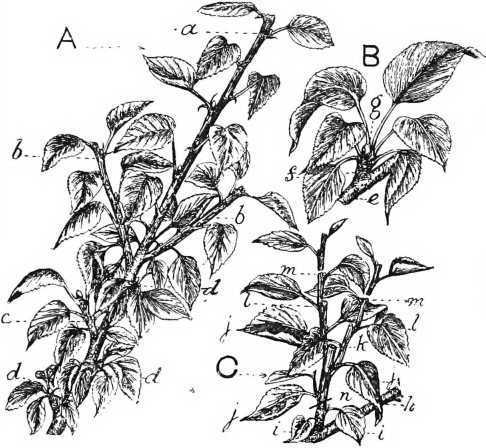
Fig. 12. Pruning Pear Trees
References
A, portion of an extending branch: a, continuation or extension shoot, to be trained in its full length in the case of a tree extending on an espalier or wall; b, side shoots to be laid in (in the case of a fan-trained tree) if required for furnishing the space properly with branches, otherwise they should be pinched to three good leaves (not counting basal ones) to form spurs (sec C); c, short shoot terminated by a large, somewhat rounded bud, not to be stopped; d, natural spurs - short, stubby growths, terminated by a corona of leaves and with a prominent central bud in the centre of each - usually a blossom bud.
B, natural spur: e, previous year's wood; f, current year's growth; g, central bud from which fruit is produced in the Pear,
C, shoot (such as b in A) pinched to form spurs: h, previous year's wood; i, small basal leaves: j, good characteristic leaves; k, point of stopping the shoot; l, laterals stopped at second joint; m, sublaterals pinched to one leaf; n, point of shortening at winter pruning.
Continue to:


My Books

