


What Are Remedies For Insects And Fungi On Fruit Trees
Description
This section is from the book "Pictorial Practical Fruit Growing", by Walter P. Wright. Also available from Amazon: Pictorial Practical Fruit Growing.
What Are Remedies For Insects And Fungi On Fruit Trees
I now propose to give a list of recipes for insecticides and fungicides. I have tried each one before admitting it, and proved it to be efficacious. The various washes will be found to provide material for attacking all the major and many of the minor pests of the fruit garden. I may, however, point out that every practical grower has made one discovery, if no more - namely, that to give an insecticide or fungicide a chance of doing its work it must be brought into play in the first stage of the enemy's attack.
Several of the names given are coined ones. I am of opinion that they might be generally adopted with advantage.
No. 1. - Soaparite

Useful for keeping American blight, scale, and aphides in check. Apply in the evening.
No. 2. - A Good Lime Wash For Fruit Trees
8 lb. of lime.
1 lb. of soft soap.
4 gallons of water. A little size.
Mix and paint on the stems.
No. 3. - Paris Green
1 oz. of Paris Green paste.
2 oz. of soft soap.
12 gallons of water.
Thoroughly mix and keep the mixture vigorously stirred while in use.
Good for checking the winter moth, codlin moth, and other caterpillars.
No. 4. - Quassia
1 lb. of quassia chips. 10 gallons of water.
Soak for 8 hours and apply.
or
1 lb. of quassia chips. 1/2 lb. of soft soap.
Boil well in 10 gallons of water.
Quassia extracts are good for all sucking insects, such as fly, but not for caterpillars.
No. 5. - Sulpharite

Good for eradicating red spider after the leaves have fallen, also for American blight.
No. 6. - Tobacco Solution

An excellent mixture tor checking thrips.
No. 7. - Sulpotide
1 oz. sulphide of potassium (liver of sulphur). 3 gallons of water.
Dissolve.
No. 8. - Carbam
1 oz. of carbonate of copper. 1/2 pint of liquid ammonia.
When the copper is dissolved, mix with 10 gallons of water.
Both this and No. 7 are good for scab and mildew.
No. 8a. - Bordeaux Mixture
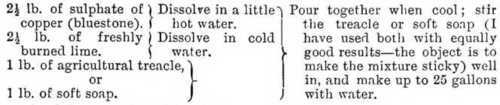
Good for many fungoid pests.
No. 9. - Soap And Sulphur

A good remedy for red spider.
No. 10. - To Prevent Hares Barking Fruit Trees

No. 11. - Sodash

Good for cleansing tree trunks of moss and other foul growth. Keep it off the hands and clothing.
Continue to:


My Books

