


Coal - Plant Fuels
Description
This section is from the book "Plants And Their Uses - An Introduction To Botany", by Frederick Leroy Sargent. Also available from Amazon: Plants And Their Uses; An Introduction To Botany
Coal - Plant Fuels
Coal, like peat, consists of the decomposed and compacted remains of plants. It differs from peat principally in being harder and more completely reduced to carbon. But peat passes into coal by insensible gradations so that none but an arbitrary line can separate them. The coal with which we are most familiar may be regarded as a peat-like material of very great antiquity, so ancient that the plants from which it was formed have been extinct for many ages. Some idea of the appearance of certain of these coal plants may be gained from Figs. 277, 278. In comparison with wood and peat as a fuel, coal has the advantage of possessing greater compactness and more power of heating. It will convert into steam about 7 to 9 times its own weight of water. The most objectionable features of coal are its large amount of troublesome ash, which often interferes with good combustion, and its offensive smoke, which is excessive from soft coal.
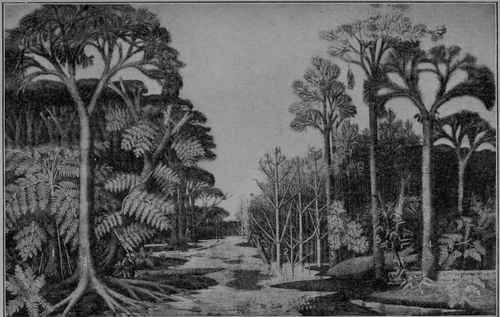
Fig. 277.-Coal Plants as they are supposed to have appeared growing in a swamp during the middle of the "Carboniferous Period" believed to be, very roughly, about 40,000,000 years ago. 1, a tree-fern (Pecopteris) with brace-roots; to the right, a climbing fern (Sphenopteris); below this a prostrate fern trunk (Megaphyton). 2. A giant "scouring rush" (Calamites ramosus). 3. A giant "club-moss" (Lepidodendron). 4. Other "club-mosses," two erect (Sigillaria), a conoidal prostrate trunk (Syringodendron), and a cylindrical one with large scars (Ulodendron); near these are climbing ferns (Mariopteris). 5. Large leaved gymnosperms (Cordaites); "wedge-leaf " plants (Sphenophyllum cuneifolium) trail on the right bank near the front. (Potonié.)
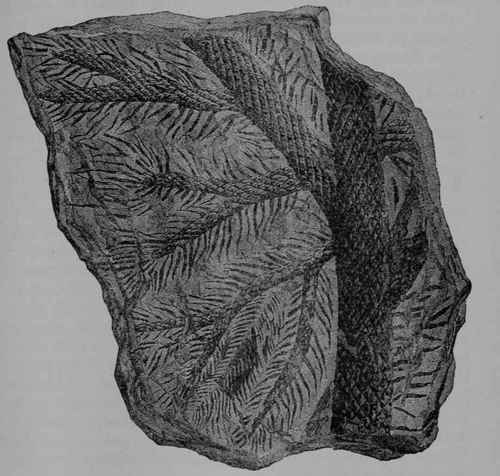
Fig. 278.-Fossil remains of a giant club-moss (Lepidodendron sp., Scale-tree Family, Lepidodertdraceoe). From the coal period. (Baillon.)
Coke - Plant Fuels
Coke bears somewhat the same relation to coal that charcoal does to wood. It is similarly obtained by smothered combustion in covered piles, or by heating in special ovens or retorts. Like charcoal it is nearly pure carbon, and is used extensively in metallurgy and for other purposes where a smokeless fuel is required. It was originally a by-product in the manufacture of illuminating gas. Now it is manufactured expressly for metallurgical purposes, the ovens being so constructed that the inflammable gases driven off are made to serve largely as a source of heat in the process.
Continue to:


My Books

