


Part 174. The Green Algae - Plant Life-Histories. Part 3
Description
This section is from the book "Plants And Their Uses - An Introduction To Botany", by Frederick Leroy Sargent. Also available from Amazon: Plants And Their Uses; An Introduction To Botany
Part 174. The Green Algae - Plant Life-Histories. Part 3

Fig. 313.-Wool-weed (Ulothrix zonata, Wool-weed Family, Ulotrichacece). A, young plant with basal cell (r) serving as a root-like organ of attachment, B, part of plant with escaping swarm-spores. C, single swarm-spore. D, formation and escape of gametes. E, free-swimming gametes. E, gametes conjugating. G, conjugation complete. H, zygote. J, zygospore after a period of rest. K, zygospore after division of its protoplast into swarm-spores. B-K, 360/1. (Dodel-Port.)- Abundant on submerged rocks, especially in fresh water.
Eventually in some of the cells (B) the protoplasm assumes a spheroidal form or may divide into from two to eight smaller masses each provided with a nucleus through division of the original one. These globular masses soon begin to move and presently make their way into the surrounding water through an opening in the old cell-wall. When outside, however, they are still surrounded by a delicate cellulose membrane, but this soon ruptures setting free the naked protoplasts. Each of these (C) is now seen to be somewhat pear-shaped, with a colorless pointed end from which come four slender lash-like projections, called flagella.9 The rounded part is grass-green and contains a bright red granule termed the eye-spot. As soon as they are free, these naked protoplasts swim about with rapid motion, propelled by their lashing flagella. After a while they come to rest, secrete a cellulose wall, and germinate by fission, the lower one of the two cells first formed becoming the pseudo-root by elongation and attachment to the substratum, while the upper cell develops into a long green multicellular thread by repeated divisions. A naked motile protoplast, by means of which a plant is multiplied non-sexually we call a swarm-spore. Ulothrix reproduces also by motile gametes in which may be discerned occasionally a slight inequality in size suggesting the beginnings of difference in sex although for the most part they appear quite alike. These sexual or subsexual gametes arise from the cells of the filament in much the same way as the swarm-spores do, but they are more numerous and smaller, and possess only two flagella (D, E). They unite sidewise (F) with their tips together, thus producing what looks like a swarm-spore (G), with its four flagella, but which differs in having two eye-spots. A protoplast resulting from the fusion of two protoplasts, whether they be alike or unlike, is termed a zygote.10 The zygote of Ulothrix soon absorbs its flagella (H), becomes round, and secretes a cellulose wall, thus becoming a resistant zygospore ready for a period of rest. The zygospore germinates by forming several swarm-spores (K) each of which in turn grows into a thallus as already described.
9 Fla-gel'lum - L. a whip.
10 Zy'gote - Gr. zygotos, yoked.
In the sheath algae (Coleochaete) the thallus (Fig. 314), is in the form of a flat disk or cushion-like mass attached to some support by the lower surface. This disk as in the species figured usually consists of branching filaments which elongate by repeated division of the terminal cell and branch by its frequent forkings. (B,a-g). In other species the filaments instead of being distinct grow together into a mass by the coalescence of adjacent cells. Many of the cells produce hair-like outgrowths, and they are all uninucleate.
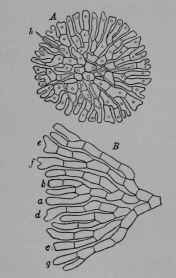
Fig. 314.-Free-branching Sheath-alga (Coleochoete soluta, Sheath-alga Family, Coleochoetaceoe). A, plant showing flat system of branching, and bristle-like outgrowths (h), 170/1. B, part of disk, further enlarged; a-g show successive stages in the branching of terminal cells. (Pringsheim.)-Thallus forming bright green spots on plants or other submerged objects in fresh water, in Europe and America.
Any of the cells may form a single swarm-spore like that shown in Fig. 315 D, which, as will be noticed, has but two flagella. Such a spore, after attaching itself to some support, divides into a cell-row which by further division becomes a mature thallus. Besides this non-sexual method of propagation a well-marked sexual reproduction takes place as follows. The protoplasts of certain small usually terminal cells (an, Fig. 315, A) become transformed into flagellate bodies like the swarm-spores only smaller (z); while other terminal cells (og, Fig. 315, A) enlarge, become flask-shaped by the formation of a long neck opening at the top, and finally contract the protoplast into a sphere at the base. The motile body as soon as it is set free swims to the flask-cell, enters the opening, forces its way down the neck to the large protoplast, and fuses with it.

Fig. 315.-Cushion Sheath-alga (Coleochoete pulvinata, Sheath-alga Family, Coleochoetaceoe). A, part of a thallus bearing male (an) and female (og, og") gametangia; and bristle-like projections sheathed at the base (h, h); male gametes, z, z, 300/1. B, ripe oospore in its rind (r). C, oospore germinating by the formation of swarm-spores (sch). D, swarm-spores of different ages. B-D, 240/1. (Pringsheim.)- Found with the other species, forming small cushions.
The smaller motile protoplast is plainly the male gamete, and the larger, non-motile one, the female. Hence the cells in which they arise may be called respectively the male and the female gametangia,11 the cells in which non-sexual spores appear, being termed sporangia.12 Union of a male with a female gamete is distinguished as fertilization. As a result of this process in Coleochaete the fertilized gamete, still remaining within the gametangium, enlarges, and incloses itself in a new cell-wall, thus forming what is called an oospore,13 which becomes further protected by an envelope of branches (r, Fig. 315 B); for a cell at its base is stimulated to produce several new cells, which, growing up around the game-tangium-base and oospore produce a sort of rind. Thus protected the oospore rests through the winter. In spring the protoplast, by division of its nucleus and the formation of partitions, is transformed into a little mass of cells firmly united with one another but quite distinct from the old cells surrounding them. In this little mass we have, in fact, a new plant entirely different from the sexual plant which produced it. It never produces gametes, but from each cell comes a single swarm-spore which under favorable conditions grows into a sexual plant like the one already described. Thus in the life-history of Coleochaete a sexual form producing gametes, alternates with a form of plant which produces only non-sexual spores. That which bears gametes is termed the gametophyte, 14 while the merely spore-bearing one is the sporophyte.15 Each represents a generation; hence the plants whose life-history is thus divided are said to exhibit an alternation of generations.
11 Gam"e-tan'gi-um - Gr. angeion, a vessel.
12 Spor-an'gi-um - Gr. spora, spore.
13 O'o-spore - Gr. oon, an egg.
14 Gam'et-o-phyte - Gr. gametes, spouse; phyton, plant.
15 Spor'o-phyte - Gr. spora, spore.
Continue to:


My Books

