


Part 189. The Liverworts Or Hepatics - Plant Life-Histories
Description
This section is from the book "Plants And Their Uses - An Introduction To Botany", by Frederick Leroy Sargent. Also available from Amazon: Plants And Their Uses; An Introduction To Botany
Part 189. The Liverworts Or Hepatics - Plant Life-Histories
Part 189. The liverworts or hepatics (Class Hepaticae) take their name from a fancied resemblance of the broad-lobed thallus of certain lower forms to the lobed liver of an animal.
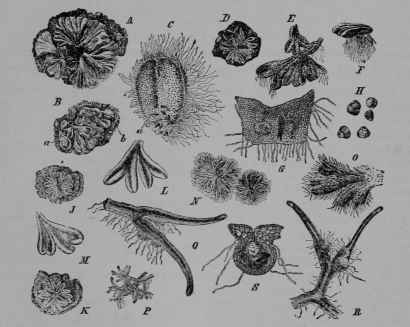
Fig. 338.-Crystal worts (Riccia spp., Crystal wort Family, Ricciaceae). A-C, R. Bischoffii; A, B, clumps of the plant growing on mud, (2/3) a, male plant; b, female plant. C, male plant, enlarged, showing the male gametangia or antheridia (a). D-H, R. minima. D, plants (2/3). E, fruiting plant enlarged, top view. E, a lobe, side view. G, a fruiting lobe, cut vertically through the young "fruit" or sporophyte, still more enlarged. H, spore-groups and spores. J-M, R. glauca. J, K, plants (2/3). L, M, lobes, enlarged. N, O, R. ciliata. N, two plants (2/3). O, lobes, enlarged. P-S, R. canaliculata. P, plant (!). Q, fruiting lobes, enlarged, top view. R, same, under side. S, lobe cut vertically through the sporophyte. (Bischoff.)-Plants growing in moist places.
There are about 3,000 species in the group. The most primitive liverworts belong to the group known as crystal-worts, occurring in all parts of the world and including many species. Some of these grow floating on the surface of still, fresh water and finally come to lie upon the mud when the water subsides in dry seasons. Other forms grow more upon moist earth or rocks; in these the thallus shows the broad liver-like lobing especially well, and often appears as a flat rosette (Fig. 338, A, B). The more aquatic forms have narrow, much-branched, ribbon-like lobes (P, Q, R), and bear a striking resemblance to such algae as carrageen, while the forms with disk-like thallus (J, K), are closely similar to forms of sheath-algae. In both crystalworts and sheath-algae a lobe elongates by the continued division of a single terminal cell, which by its occasional forking gives rise to similar branches. Compare Fig. 314 with Fig. 338, P.
One consequence of this continuous terminal growth and branching is that when the older parts die and decay the newer parts are distinct plants which have thus arisen by a sort of vegetative reproduction. No swarm-spores are produced, but the thallus often propagates non-sexually by single mature cells in various parts of the thallus dividing like a terminal cell and so producing a tiny bud or brood-body which, separating, becomes a distinct plant. The main structural difference between the alga and the liverwort-thallus is a somewhat more advanced differentiation of the latter. As the cells of Riccia grow older they may give rise on the lower surface to filamentous pseudo-roots and sometimes scale-like or tongue-like pseudo-leaves, while at the upper surface they may form a firm protective layer. Gametangia arise on the upper surface as in Coleochaete but soon become immersed in the thallus through the growth of surrounding cells. Although strictly homologous with the gametangia of Coleochaete those of the liverwort are somewhat more elaborate in structure. The male gametangium (Fig. 339, A-D) includes a number of cells producing motile gametes each having two flagella like the male gametes of Coleochaete and differing from them chiefly in having a more slender body. The female gametangium (E, a") is a flask-shaped multicellular organ containing a single female gamete. A female gametangium thus constructed is distinguished as an archegonium,1 the female gamete being called an egg-cell. In some cases both male and female gametangia are borne on the same thallus, that is to say, the thallus is bisexual; while in other cases, a thallus has but one kind of gametangium, making it thus unisexual. In the bisexual plants close-fertilization can doubtless occur; while in the unisexual, only cross-fertilization is possible. Fertilization is effected by a single male gamete, which because of its slender form is able to make its way down the projecting neck of the archegonium to the egg-cell. The zygote becomes surrounded by a cellulose wall, and through repeated division forms a spherical mass of cells which at first are all much alike. This mass is a rudimentary sporophyte or embryo. The inner cells each divide into four spores, while the outer cells become somewhat thickened to form a protective case or capsule (Fig. 338 Q, R, S). At the same time the basal part of the archegonium grows apace and may become so thickened as to give additional protection to the spores over the winter. When thus developed it is termed a calyp-tra.2 The spores are set free in spring by the breaking down of the coverings about them, and they germinate by producing a row of cells of which the apical one finally develops a thallus like that already described. We have thus in Riccia quite as evident an alternation of generations as we found in Coleochaete, both the gametophyte and the sporophyte being somewhat more highly developed.
1 Ar-che-go'ni-um - Gr. arche, first; gonos, generation.
2 Ca-lyp'tra - Gr. kalyptra, a veil.
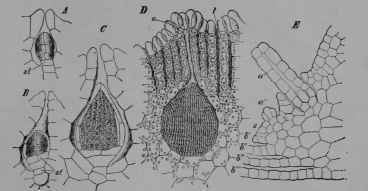
Fig. 339.-Crystalworts. A-C, Riccia glauca (260/1): A, young antheridium; st, stalk. B, same, older. C, same, still older, showing the many cells, in which motile gametes (spermatozoids) are produced. D, ripe antheridium of R. minima (112/1); e, outer cells of thallus; 1, air-spaces. E, R. ciliata (200/1), growing-tip cut vertically to show the terminal cell (s) which by its successive divisions produces all the rest of the plant, the pseudo-leaves (b'-b"") which project from the lower surface of the thallus and hold water for it, and archegonia, very young (a') and full grown (a"), ready for fertilization. (Waldner, Kny.)
Continue to:


My Books

