


Part 39. Miscellaneous Food Products. Part 2
Description
This section is from the book "Plants And Their Uses - An Introduction To Botany", by Frederick Leroy Sargent. Also available from Amazon: Plants And Their Uses; An Introduction To Botany
Part 39. Miscellaneous Food Products. Part 2
On the subject of poisonous plants we shall have more to say in a subsequent chapter. The only safe rule is for a person to avoid touching, and on no account to eat, any part of a plant which he does not surely recognize and know to be harmless. Every summer brings the sad news of children and older persons horribly poisoned through ignorance of our commonest plants. In a large proportion of these cases the plant eaten has been one which was thought to be harmless because it somewhat resembled a cultivated species or was mistaken for some harmless wild plant that is commonly eaten. Hence it should be remembered that, even though a wild plant looks like a familiar garden vegetable, there may be danger in eating or chewing any part of it.
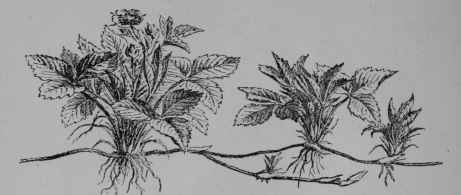
Fig. 98, I.-Strawberry (Fragaria vesca, Rose Family, Rosaceoe). Plant showing manner of propagating by means of slender horizontal stem-branches, called "runners" which develop roots and shoots near their scale-like leaves. (Baillon.)-The plant is thus a perennial herb; leaves sparsely hairy, light green; flowers white; fruit red. Besides this species F. chiloensis, F. virginiana, and F. moschata, have yielded cultivated varieties, the first being of most importance.
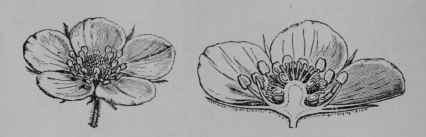
Fig. 98, II.-Strawberry flower, entire, and cut vertically. (Baillon.)
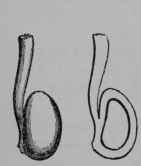
Fig. 98, III.-Strawberry pistil, entire, and cut vertically to show the single ovule within; and floral diagram. (Baillon.)
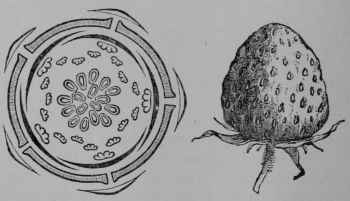
Fig. 99.-Strawberry fruit, showing the swollen end of the flower-stalk which becomes red and fleshy and bears the ripened pistils over its surface. (Baillon.)
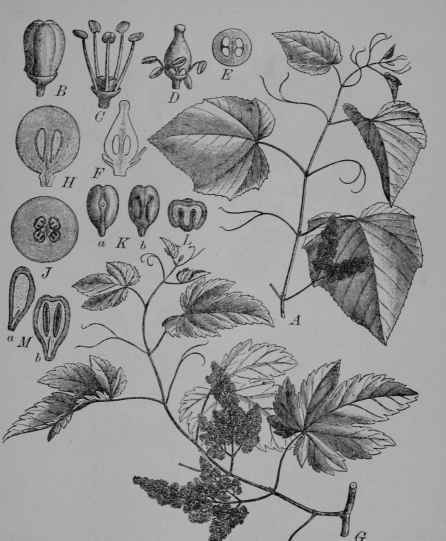
Fig. 100.-Grapes (Vitis labrusca and V. vinifera. Grape Family, Vitacece). A-F, northern fox grape (V. labrusca). A, flowering branch. B, flower bud, one petal (at the left) beginning to separate. C, staminate flower, with petals fallen. D, pistillate flower with rudimentary stamens. E, ovary cut across. F, ovary, cut vertically. G-M, European grape (V. vinifera). G, flowering branch. H, berry, cut vertically. J, same, cut across. K, seeds, front view (a), back view (b). L, seed, cut across. M, seed, cut vertically from front to back (a), and from side to side (b). (Gilg.)-Woody vines climbing by tendrils; flowers greenish; fruit greenish, reddish, or dark purple often with a bloom.
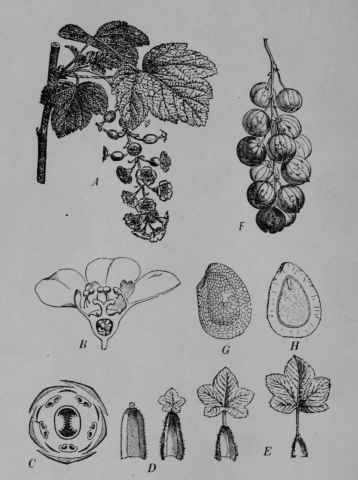
Fig. 101.-Common Currant (Ribes rubrum, Saxifrage Family, Saxifragaceoe). A, flowering branch. B, flower, cut vertically. C, floral diagram. D, bud scales. E, leaves. F, fruit cluster. G, seed, side view. H, same, cut vertically. (Baillon.)-Shrub; leaves becoming smooth; flowers yellowish-green or purplish; fruit shining, bright red, yellowish-white or striped. Includes all the cultivated varieties of red or white currants.
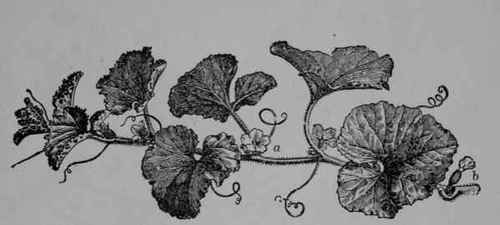
Fig. 102.-Muskmelon (Cucumis Melo, Gourd Family, Cucurbitaceoe). Shoot showing staminate flower at a, and pistillate flower at b. (Nicholson.)-A long-running, annual, herbaceous vine; hairy and prickly; flowers yellow, very like those of cucumber; fruit various in size, shape, and color, mostly dull-greenish or orange.
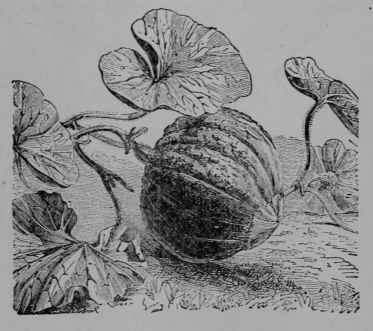
Fig. 103.-Muskmelon. Fruit, much reduced. (Baillon.)
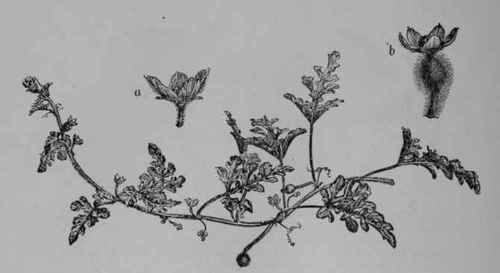
Fig. 104.-Watermelon (Citrullus vulgaris, Gourd Family, Cucurbitaceoe). Vine bearing leaves, flowers, and very young fruit; a, staminate flower; b, pistillate flower. (Nicholson.)-Plant an annual herbaceous vine; leaves hairy or smooth; flowers yellow; fruit greenish with pale markings, smooth, globular or oval, sometimes 60 cm. long.
Continue to:


My Books

