


Part 93. The Seedling And Its Development
Description
This section is from the book "Plants And Their Uses - An Introduction To Botany", by Frederick Leroy Sargent. Also available from Amazon: Plants And Their Uses; An Introduction To Botany
Part 93. The Seedling And Its Development
Part 93. The seedling and its development. When the seed germinates, the radicle is the first part to appear (Fig. 279B). Soon it grows into a root (Fig. 279C) covered with hairs through which absorption of soil-water takes place. Meanwhile the cotyledons have been feeding upon the albumen to get material for their growth and for the elongation of the caulicle and root; and when finally this reserve food is exhausted, the empty seed-coat is cast off, the cotyledons become green and expand in the sunlight (Fig. 279D), and the plumule develops into a leafy shoot (Fig. 279E). As the root penetrates downwards into the soil it sends forth branches in various directions (Fig. 217I). At the same time the leafy shoot grows upward developing stem and leaves by the continual unfolding of a bud at its tip which began as the plumule (Fig. 279F).
The place at which a leaf joins the stem is called a node,1and the length of stem between two nodes, an internode.2
1 Node - L. nodus, a knot, the joint being likened to a knot in a cord.
2 In-'ter-node - L. inter, between.

Fig. 279.-Flax Germination. A, seed, cut vertically to show the seed-coat (c), seed-food (f), embryo (e), with its seed-leaves (1), seed-bud (b), seed-stem (s) and seed-root (r). B, seed beginning to sprout; the seed-stem (caulicle) has just pushed through the seed-coat and is pushing the seed-root (radicle) into the ground. C, later stage in which the radicle has elongated and produced root-hairs, while the caulicle has pushed up the seed. D, still later stage in which the caulicle has become further elongated and arched and the seed-leaves or cotyledons are growing out of the seed. E, plantlet showing pair of cotyledons expanded and ready to act like leaves; also three pairs of primary leaves and a stem developed from the seed-bud or plumule. F, plantlet still older, showing, in addition, secondary leaves, formed one at a joint. (Original.)
After a while new buds appear on the sides of the stem at points just above the nodes (Fig. 280), that is to say, in the axil1 or upper angle between leaf and stem; and these buds as they expand become lateral branches, which in turn may branch similarly. Finally, some of these buds, instead of producing more foliage, develop flowers (Fig. 217 I).
1 Ax'-il - L. axilla, arm-pit.
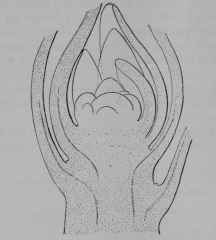
Fig. 280.-Flax Bud cut vertically and much enlarged to show the development of the leaves from protrusions arising at the side of the domelike stem-tip which consists of formative material. (Original.)
Continue to:


My Books

