


10. Eucalyptus robusta
Description
This section is from the book "A Research On The Eucalypts Especially In Regard To Their Essential Oils", by Richard T. Baker, Henry G. Smith. Also available from Amazon: A Research On The Eucalypts And Their Essential Oils.
10. Eucalyptus robusta
(Sm., in Bot. Nov. Holl, pp. 39-40, t. 13.) Swamp Mahogany.
Systemriic. - A fairly large tree, with reddish, brittle bark-between a "Stringybark " and a "Bloodwood" bark. Leaves large and coarse, leathery; lateral veins n numerous, straight and parallel; intramarginal vein prominent, close to the edge. Venation thus indicates pinene in the oil. Peduncles axillary, thick, flattened, about 1 inch long. Flowers large. Calyx turbinate and green; operculum cream-coloured, rostrate and slightly larger and broader than the calyx tube.
Fruit. - Urceolate; rim bevelled; valves well sunk ; only rarely exserted; 9 lines long, including the pedicel.
A decidedly distinct fruit with its sharp-edged rim and sunken horizontal valves.
Habitat. Coastal swamps of New South Wales and South Queensland.
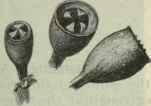
REMARKS - A tree easily identified by its comparatively large fruits and by its large, coarse leaves, and habitat, being rarely, if ever found growing away from low. swampy ground. The timber is red-coloured, hard and durable.
ESSENTIAL OIL. - Leaves and terminal branchlets for distillation were obtained from La Perouse, near Sydney, in August, 1900. The yield of oil was 0.16 per cent. The crude oil was red in colour, and had a turpentine-like odour. It consisted largely of pinene; phellandrene was also detected, but this constituent was only present in a very small amount. Only a trace of cineol could be detected in the second fraction. The oil distilling at near 270° C, consisted mostly of the sesquiterpene.
The crude oil had specific gravity at 15° C. = 0.8777 ; rotation aD + 4.0° ; refractive index at 20° = 1.4744, and required 8 volumes of 80 per cent. alcohol to form a clear solution. The saponification number for the esters and free acid was 9.1.
On rectification the usual amount of acid water and aldehydes came over below 1570 C. (corr.). Between 157-1620, 59 per cent. distilled; between 162-1830, 22 per cent. came over; between 183-2550, 7 per cent. distilled; and between 255-2790, 5 per cent. distilled. These fractions gave the following results: -
First fraction, sp. gr. at 150 C. | = | 0.8658 ; | rotation aD | + 4.5° | |||
Second | ,, | ,, | ,, | = | 0.8673; | ,, | + 1.5°. |
Third | ,, | ,, | ,, | = | 0.9053; | ,, | not taken. |
Fourth | ,, | ,, | ,, | = | 0.9404 ; | ,, | ,, |
The rotation figures indicate that both optically active pinenes were present in the oil of this species, as well as a trace of phellandrene in the freshly-distilled oil.
This sample of oil had been kept in the dark, and in September, 1919, nineteen years afterwards, was again analysed. But little alteration had taken place in the oil during all that time. The specific gravity had increased a little, but no less than 84 per cent. of the oil distilled below 1900 C. The crude oil and the distillate gave the following results :-
Crude oil, sp. gr. at 15 C. | = | 0.8925; rotation not taken; refractive index at 200 = 1.4749. | ||
Large fraction | ,, | ,, | = | 0.8712; rotation aD + 4.8°, refractive index at 20° = 1.4684. |
The amount of the fraction absorbed by the resorcinol method was equal to 10 per cent. when calculated for the crude oil, the greater portion of which was cineol.
Continue to:


My Books

