


116. Eucalyptus marginata
Description
This section is from the book "A Research On The Eucalypts Especially In Regard To Their Essential Oils", by Richard T. Baker, Henry G. Smith. Also available from Amazon: A Research On The Eucalypts And Their Essential Oils.
116. Eucalyptus marginata
(Sin., in Trans. Linn. Soc., vi, 302, 1802.) Jarrah.
Systematic. A large tree, averaging 100 feet in height, the bark persistent and fibrous, but being flaky it is not a true ".Stringybark." Leaves ovate-lanceolate or lanceolate, under 5 inches long, acuminate, falcate, paler underneath; venation prominent, the intramarginal vein looped and well removed from the edge or often quite close, lateral veins numerous, fairly transverse. Peduncles slender, axillary, up to 12 lines in length, with umbels of three to twelve flowers. Buds on pedicels 2 to 3 lines long; calyx tube turbinate, and half as long as the conical, obtuse operculum.
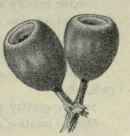
Fruit. - Ovoid-truncate, contracted at the top; rim incurved and later depressed; valves small, not or only slightly exserted; about 9 lines long and 8 lines in diameter.
As a carpological specimen it stands alone in form amongst Eucalyptus fruits.
Habitat. - Western Australia.
ESSENTIAL OIL.- Material was received for distillation from Western Australia in June, 1904. Two consignments were forwarded, one collected on the Darling Ranges, the other from the sandy flat country around Perth. The first consisted of leaves from older trees, and was a fair average sample, the other was composed principally of abnormal leaves. Although necessarily a great diversity in material was thus shown, as well as a difference in environment, yet the oils were in very close agreement, both in their chemical and physical properties. A larger amount of the lower-boiling terpenes was present in the oil from the abnormal leaves than in that from the older leaves, although the constituents were the same in both samples. This decrease in the amount of the characteristic low-boiling terpene in the older leaves is usual with most Eucalyptus species, and numerous instances of this fact are recorded throughout this work. We have shown also that the characteristic constituents for the oils of any species are common to both young and old leaves, the variation being in the amount.
The crude oils were red in colour, and had an odour indicating aroma-dendral. The oil from the "Jarrah" is closely associated with those of such species as the type E. tereticornis and E. punctata var. didyma, and there is strong evidence to support the idea that this class of trees is more closely associated with those Eucalypts known as "Boxes" than to any other group. Phellan-drene could not be detected, nor was it to be expected in this class of Eucalyptus trees. Pinene was present in small amount, while cymene was a pronounced constituent. The amount of cineol was less than 10 per cent, in the first fraction,
The sesquiterpene was also present. The higher-boiling portion came over as a deep-blue oil; this peculiarity has often been noticed with the oils of certain Eucalyptus species, particularly in the portion distilling at about 250-2800 C. The aroma-dendral was extracted from the mixed third fractions in the usual way, its oxime prepared, and its other characteristics determined.
When the results obtained with these two samples of oil are tabulated, it is seen how closely they agree.
Darling Range Sample. | Perth Sample. | |||||
Amount distilling between | 169-183° C....... | 57 | per cent. | 65 | per cent. | |
" | " | 183-2140 C....... | 21 | " | 18 | " |
" | " | 214-245° c....... | 10 | " | 8 | " |
" | " | 245-252° c....... | 4 | " | .... | |
First fraction: - | ||||||
Specific gravity at 150 C. ...... | 0.8793 | 0.8705. | ||||
Optical rotation aD ... ......... | - 7.1° | - 8.2° | ||||
Refractive index at 200 C.......... | 1.4864 | 1.4838 | ||||
Second fraction: - | ||||||
Specific gravity at 15° C. ......... | 0.8974 | 0.8792 | ||||
Optical rotation aD ................... | 6.7° | 9.2° | ||||
Third fraction: - | ||||||
Specific gravity at 15° C. ... ...... | 0.9437 | 0.9437 | ||||
Optical rotation aD ...... ...... | - 14.6° | - 16.8° | ||||
Crude oil: - | ||||||
Specific gravity at 150 C. ... | 0.9117 | 0.8889 | ||||
Optical rotation aD ............ | - 8.5° | - 10.4° | ||||
Refractive index at 200 C. ... ...... | 1.4889 | 1.4889 | ||||
Saponification number for esters and free acid | 13.1 | 10.3 | ||||
Solubility in alcohol ............ | 1 vol. 80 per cent. | 5 vols. 80 per cent. | ||||
Yield of oil ............... | 0.24 per cent. | 0.2 per cent. | ||||
The high lævo-rotation of the higher-boiling fractions was due to the aroma-dendral, and this influence was also shown in the crude oils.
The esters were entirely saponified in the cold with two hours' contact, giving an aromatic oil with a strong resemblance to geraniol; the acid was acetic. It is thus probable that the ester was geranyl-acetate.
The results obtained with these oils were published by us in the Pharmaceutical Journal, London, September, 1905.
Continue to:


My Books

