


121. Eucalyptus hemiphloia
Description
This section is from the book "A Research On The Eucalypts Especially In Regard To Their Essential Oils", by Richard T. Baker, Henry G. Smith. Also available from Amazon: A Research On The Eucalypts And Their Essential Oils.
121. Eucalyptus hemiphloia
(F.v.M., Fragm., ii, 62.) Box.
Systematic. - This tree is stated by some collectors to reach 150 feet in height, with a corresponding diameter, but we have never found it to exceed 80 to 90 feet, and it is on an average a fair-sized tree; bark persistent, grey extending to the base of the branches, which are smooth, or with a flaky bark. Leaves ovate-lanceolate, acuminate, sometimes up to 5 or 6 inches in length,
Plate LXIII
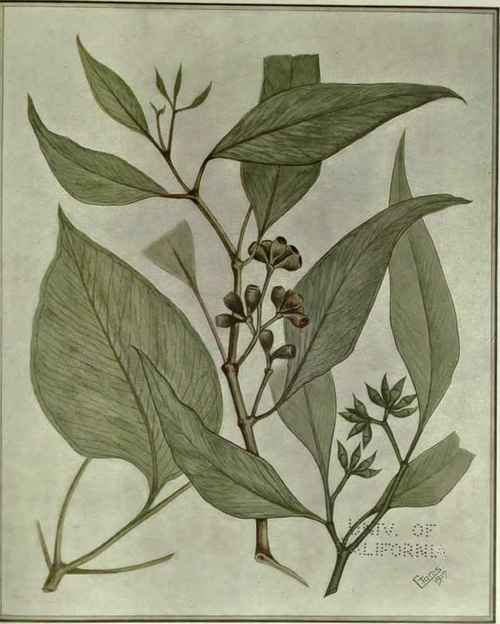
Eucalyptus Hemiphloia. F.v M "Box."
Plate LXIV.
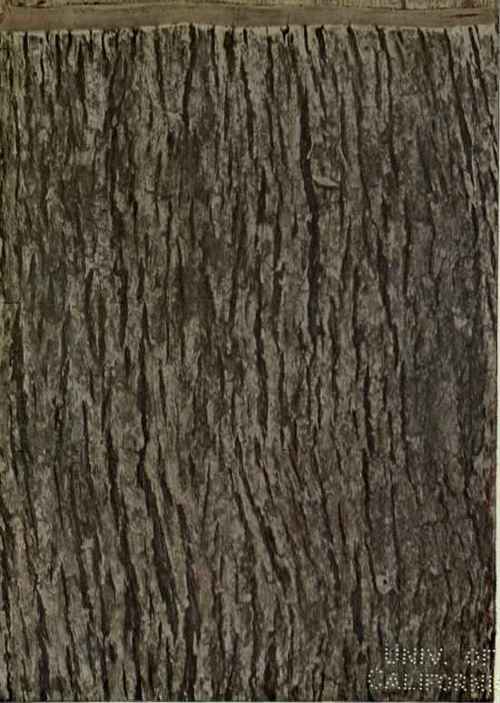
A Typical Box Bark
(Eucalyptus hemiphloia, F.v.M.)
This is a more compact, ridged bark than any of the other fibrous groups, a light grey in colour and the lattice pattern much smaller than in the "Stringybarks," the furrows moderately deep.
The oils of Eucalypts with barks of this character all centain pinene, cineol and the aldehyde aromadendral. Cymene also appears to be a constant constituent, and phellandrene can sometimes be detected.
Plate LXV
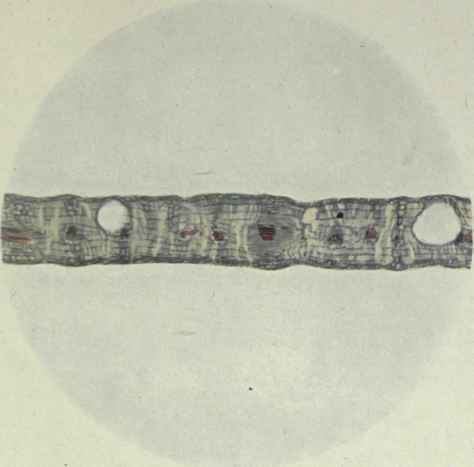
A cross section showing a portion of a rather thin leaf with two oil glands in the held of vision. Several columns of supporting tissue are seen and the few bundles (red) are the veins of the leaf. There is little differentiation between the spongy tissue and palisade parenchyma, whilst the epidermis is thin and composed of irregularly-shaped cells.
Eucalyptus Hemiphloia, F.v M
Greyish on both sides; veins not prominent, lateral ones oblique, the intra-marginal vein removed from the edge. Flowers mostly in umbels, forming terminal panicles. Calyx tube tapering into a short, angled pedicel; operculum conical, and as long as the calyx tube.
Fruit. - Petiolate or sessile, cylindrical or urn-shaped; rim thin; valves quite enclosed; 3 to 4 lines long and 2 lines in diameter.
The nearest in shape to this fruit is that of E. corynocalyx.
Habitat. - Distributed throughout the whole coastal area, and well into the tableland of New South Wales; South Australia; Victoria; Queensland.

REMARKS. E, hemiphloia is the common "Box" of the Coast and Dividing Range, and is distinct from any of the "Box " trees of the interior. The timber is pale-coloured, hard, but not highly valued. This tree can be distinguished from E. albens by its smaller fruit and smaller leaves, and an absence of glaucousness on its branchlets, leaves, and buds. The fruits are characteristic, and differentiate it from E. conica, H.D. & J.H.M., and E. Woollsiana, R.T.B.
ESSENTIAL OIL. -Leaves and terminal branchlets for. distillation were obtained from Belmore, N.S.W., in September, 1900. The yield of oil was 0.58 per cent. The crude oil was reddish-brown in colour, and had a somewhat rank odour, with a secondary one of aromadendral. It contained some pinene, but phellandrene was absent at this time of the year. Cineol was present, but only about 15 per cent, in the crude oil. Aromadendral occurs in quantity, and it was from this oil that the pure substance was first prepared for research. The esters were not pronounced. Little difference in the constitution of the oils from this species, E. albens, and E. Woollsiana was observed.
The crude oil had specific gravity at 150 C. = 0.9117; rotation aD - 6.85°; refractive index at 20° = 1.4853, and was soluble in 2 volumes 70 per cent, alcohol. The saponification number for the esters and free acid was 5.8.
On rectification, 2 per cent, distilled below 168° C. (corr.). Between 168-1830, 73 per cent, distilled; between 183-2140, 13 per cent, came over, and between 214-230°, 6 per cent, distilled. These fractions gave the following results: -
First fraction, sp. gr. at 150 C. | = | 0.9041; | rotation aD | - | 3.2°. | |||
Second | " | " | " | = | 0.9122; | ' ' | - | 10.3°. |
Third | " | " | " | = | 0.9424; | " | - | 24.9°. |
The cineol, determined by the phosphoric acid method in the first fraction, was 24 per cent., indicating about 18 per cent, in the crude oil (O.M.).
Material had previously been obtained from Emu Plains, N.S.W., in September, 1899; the oil was practically indentical with the above. It was, in fact, after the investigation of this sample that it was decided to obtain sufficient oil of this species for the preparation of aromadendral, in order that its chemistry might be determined.
The above samples were mixed together and stored in the dark, and in September, 1919, the oil was again analysed. Not much alteration had taken place in the oil during the nineteen years it had been kept, except that it had perhaps increased a little in cineol. 74 per cent, distilled below 1900 C. The crude oil and the rectified portion gave the following results: -
Crude oil, sp. gr. at 150 C. | = | 0.9166; rotation aD - 5.5°; refractive index at 200 = 1.4859. | |
Rectified portion | " | = | 0.8933; rotation aD - 7.5°; refractive index at 200 = 1.4796. |
The cineol was determined by the resorcinol method in the rectified portion and calculated for the crude oil; the result was 31 per cent. Only about 20 per cent, of cineol was present in the fraction as indicated by phosphoric acid, or about 15 per cent, in the crude oil. This result is typical of the oils of the "Box" group, and shows that constituents other than cineol are absorbed by resorcinol.
In March, 1920, fresh material for distillation was collected at Cabramatta, near Sydney. The yield and general characters of the oil were in fair agreement with those previously obtained from this species, with the exception that phellandrene was present at this time of the year, and consequently the lævo-rotation was higher. Cymene was also detected and its chemistry determined, as was also that of the pinene, which was slightly lævo-rotatory. Cineol did not exceed 10 per cent, in the crude oil. A considerable amount of alcoholic bodies was present, as the saponification number after acetylation was 70.5. For the determination of the aromatic aldehydes see the article on "The cyclic (aromatic) aldehydes occurring in Eucalyptus oils."
Continue to:


My Books

