


162. Eucalyptus gomphocephala
Description
This section is from the book "A Research On The Eucalypts Especially In Regard To Their Essential Oils", by Richard T. Baker, Henry G. Smith. Also available from Amazon: A Research On The Eucalypts And Their Essential Oils.
162. Eucalyptus gomphocephala
. (I).C, in Prod., iii, 220, 1828.)
Tuart.
Systematic. A large tree, up to 150 feet in height, and 20 feet in girth, with a smooth or rough "Box-like" persistent bark. Abnormal leaves ovate, lanceolate, petiolate. Normal leaves ovate-lanceolate to lanceolate or sometimes narrow lanceolate, falcate acuminate, mostly under 6 inches in length, shining; venation not distinct in the older leaves, intramarginal vein sometimes well removed but often quite close to the edge, lateral veins fine, at about 450 to the mid-rib. Peduncles axillary or lateral, thick, broad and flat, 6 to 9 lines long, bearing two to six flowers. Buds sessile or shortly pedicellate; calyx tube obovoid 4 to 5 fines long; operculum hemispherical to conoidal, usually bluntly pointed much broader than the tube.
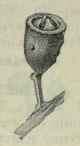
Fruit. - Sessile, bell-shaped or cylindrical, sometimes slightly flanged; rim broad, slightly countersunk to convex; valves exserted; 7 to 8 lines in length and 6 lines broad
Mueller's figure stands quite alone in shape in his "Eucalyptographia." The fruit figured here is the most common form. It resembles somewhat E. obusta or E. patentinervis without a pedicel.
Habitat. - Coastal limestone belts between Perth and Busselton, Western Australia.
ESSENTIAL OIL. - Material of this species was forwarded from Western Australia for distillation in May, 1904. It was obtained from trees growing in the sandy flat country around Perth. The yield of oil was small, less than two ounces of oil being obtained from over 400 pounds of material, collected as would be done for commercial distillation, so that the yield did not exceed 0.03 per cent. Such a small amount of oil did not permit; of a complete investigation; it is evident however, that this species of Eucalyptus has no value as an oil-producing tree as the constituents are of no special value.
The crude oil was reddish in colour, was quite mobile, and had a rank unpleasant odour. It was largely a terpene oil, as is suggested from the low specific gravity and insolubility in alcohol. An acetic acid ester was present, and this was almost entirely saponified in the cold with two hours' contact. The alcohol was probably geraniol, as the oil after saponification had an aromatic odour suggesting that substance. Cineol could not be detected. Phellandrene was present, as was also pinene, and probably terpinene also. The phellandrene nitrosite was prepared and this melted at 1120 C.
The crude oil had specific gravity at I5°C. = 0.8759; rotation aD - 10.2°; refractive index at 20° = 1.4758, and was insoluble in 10 volumes 80 per cent. alcohol. The saponification number for the esters and free acid was 257.
It would be interesting to determine whether the abnormal leaves contain a more abundant supply of oil than the mature leaves, as it is not an infrequent occurrence with some Eucalyptus species for the secretion of the oil to practically cease in the old leaves. This is the only species we have received from Western Australia the oil of which contained phellandrene.
Continue to:


My Books

