


31. Eucalyptus megacarpa
Description
This section is from the book "A Research On The Eucalypts Especially In Regard To Their Essential Oils", by Richard T. Baker, Henry G. Smith. Also available from Amazon: A Research On The Eucalypts And Their Essential Oils.
31. Eucalyptus megacarpa
(F.v.M., Fragm., ii, 70.) Blue Gum. (The " Blue Gum " of Donnybrook, or the " Bullich " of the Jarrah Belt, W.A.)
Systematic. - A medium-sized tree, bark smooch when fresh, but becoming rough on exposure. Abnormal leaves elliptical ovate, about 4 inches long and 2 inches wide, shortly petiolate. Normal leaves lanceolate, 4 to 6 inches long, falcate, thick, shining; venation not conspicuous, lateral veins oblique and fine, intramarginal vein somewhat removed from the edge. Peduncles axillary or lateral, short, thick, flat, each bearing one to three sessile flowers. Calyx tube broad, turbinate, under 6 lines long, slightly longer than the conical or hemispherical, short pointed operculum.
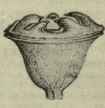
Fruit. - Hemispherical, large, ribbed, or almost smooth; rim narrow, slightly convex, continuous with the thick, conical, obtuse, incurved valves; 3/4 to 1 inch in diameter.
They have some resemblance to E. globulus in general shape and surface, but not in the disposition of the valves.
Habitat. - Western Australia.
ESSENTIAL OIL. - A sample of the oil of this species was forwarded to us for investigation by Mr. C. E. Lane-Poole, the Conservator of Forests of Western Australia. The oil had been distilled by Mr. Braddock of that State, who obtained a yield of 0.5 per cent.
The crude oil was mobile, of a light amber colour, with a terpene-like odour, and a secondary aromatic one. It contained a considerable quantity of pinene, but phellandrene was absent. Both limonene and terpinene were present, as was also cineol. The ester was apparently largely geranyl-acetate.
The crude oil had specific gravity at 15o C. = 0.8852 ; rotation aD - 31.2° ; refractive index at 20o = 1.4719; and was soluble in 10 volumes 80 per cent. alcohol. The saponification number for the esters and free acid was 7.5.
On rectification, 1 per cent, distilled below 160o C. (corr.). Between 160-172o, 61 per cent, distilled; between 172-193o, 28 per cent. distilled, leaving 10 per cent. of residue. The fractions and residue gave the following results :•-
First traction, sp. gr. at 15o C. | = | 0.8740 ; rotation aD - 33.2o ; refractive index at 20o = 1.4671. | |||
Second | " | " | " | = | 0.8837 ; rotation aD- 35.0° ; refractive index at 20o = 1.4710. |
Residue | " | " | " | = | 0.9521; rotation aD - 3.0°; refractive index at 20° = 1.4988. |
The lower boiling portion of the first fraction gave a nitrosochloride melting at 104o C, so that pinene was present in quantity.
The second fraction contained limonene, dipentene, and terpinene.
The saponification number for the residue was 15.1, and in the cold with two hours' contact it was 9.6. The odour of the cold saponified oil was that of geraniol, so that the indication is 3.36 per cent. of geranyl-acetate in that portion.
The saponification number for the first fraction was 8.1, so that a low boiling ester, probably butyl-butyrate, was present.
The cineol was determined by the resorcinol method in the portion distilling below 193o; when calculated for the crude oil, the result was 30 per cent. As the low boiling esters were also absorbed this is somewhat in excess of the real amount, and phosphoric acid did not indicate more than about 15 per cent. in the crude oil.
See also the article in this work, "On the occurrence of Terpinene in Eucalyptus Oils."
Continue to:


My Books

