


57. Eucalyptus camphora
Description
This section is from the book "A Research On The Eucalypts Especially In Regard To Their Essential Oils", by Richard T. Baker, Henry G. Smith. Also available from Amazon: A Research On The Eucalypts And Their Essential Oils.
57. Eucalyptus camphora
(R.T.B., Proc. Linn. Soc, N.S.W., 1900, p. 298, t. XXII.) Sallow or Swamp Gum.
Systematic. - A small tree, about 20 to 40 feet high in northern specimens, but a fair sized tree in the south. Abnormal leaves ovate, obtuse, under 6 inches long, 3 1/2 inches broad, on angular petioles of 1/2 inch long, coriaceous, glaucous. Normal leaves ovate-elliptical, abruptly acuminate, under 4 inches long, or lanceolate, acuminate and 6 inches long, thinly coriaceous, glaucous; venation distinct, particularly in young leaves, intramarginal vein removed from the edge. Peduncles few, axillary, flattened, bearing five or six short pedicellate or sessile buds. Calyx turbinate, inclining to hemispherical, 1 line long, 1 line broad; operculum acuminate, about 2 lines long.
Fruit. - Small, turbinate; rim flat; valves exserted; 3 lines long and 2 lines in diameter.
The fruits with care czn generally be distinguished from E. paludosa (which they resemble in shape), by their smaller size.
Habitat. - It was discovered (R.T.B.) at Ganguddy Creek, Kelgoola, Rylstone, in 1895, afterwards in 1897 at Narango and since recorded from the South Coast, N.S.W., well into Victoria.

Plate XXIV.
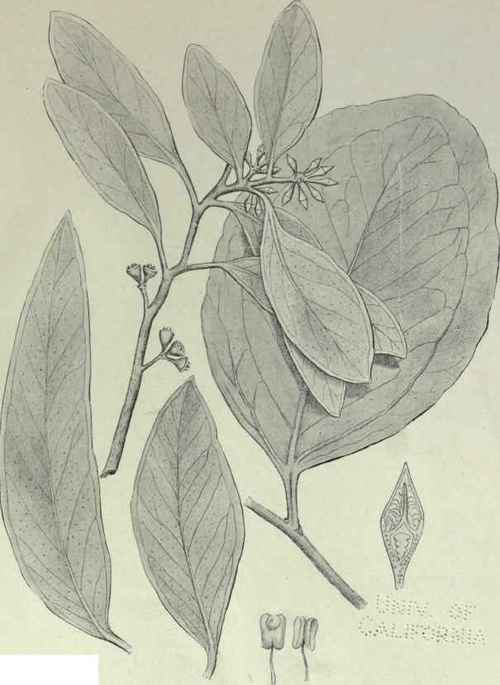
R.T.B.. del, ad nat
Eucalyptus Camphora. R.T.B. Sallow or Swamp Gum
REMARKS. It is an umbrageous tree, attaining a height from 30 to 100 feet, and a diameter up to 3 feet, but usually rather crooked and essentially a swamp or wet ground species. It must not be confused with other species such as E. ovata, Labill and E. Gunnii; the former is a Western Australian species, and the latter is fully shown by us in this and other publications to be also distinct. From E. paludosa, R.T.B., it is easily distinguished, especially so in older trees, the leaves being broader and more oval, and the apex quite blunt, sometimes obcordate, whilst the timbers readily differentiate the species,
ESSENTIAL OIL. - Leaves and terminal branchlets for distillation were obtained from Heydon's Bog, Delegate, N.S.W., in February, 1899. The yield of oil was 1.34 per cent. The crude oil was amber coloured, and had an odour resembling those belonging to the cineol-pinene class, but with a pronounced odour of volatile aldehydes. Eudesmol was present in considerable quantity. The oil was rich in cineol, contained pinene, but phellandrene was absent. At one time a good deal of oil was distilled commercially from this species in New South Wales.
The crude oil had specific gravity at 150 C. = 0.9071; rotation aD + 1.3°; refractive index at 200 = 1.4676; and was soluble in 1 1/2 volumes 70 per cent, alcohol. The saponification number for the esters and free acid was 4.4.
On rectification a few drops came over below 1600 C.; the thermometer then rose rapidly to 1700 (corr.). Between 170-1900, 91 per cent, distilled, the remainder consisted almost entirely of eudesmol.
The rectified oil had sp. gr. at 15° = 0.9065; rotation aD + 1.45°. The cineol determined by the phosphoric acid method was 54 per cent. (O.M.), indicating about 50 per cent, in the original oil.
Material of this species was also obtained from Rylstone, N.S.W., in September, 1898. The oil at this time of the year was found to contain such an abundance of eudesmol, that the fraction containing it solidified in the receiver. The oil was less rich in cineol than the Delegate sample, illustrating the influence the time of the year, and the eudesmol content, appear to have on the formation of cineol. The specific gravity of the crude oil at 150 = 0.9167. On rectification 61 per cent, distilled below 1830. This fraction had sp. gr. at 150 = 0.8967; and rotation aD + 0.75°, and a determination for cineol by the phosphoric acid method gave 33 per cent. (O.M.). No less than 18 per cent, distilled between 270-283°, which fraction consisted almost entirely of eudesmol.
Continue to:


My Books

