


92. Eucalyptus elceophora
Description
This section is from the book "A Research On The Eucalypts Especially In Regard To Their Essential Oils", by Richard T. Baker, Henry G. Smith. Also available from Amazon: A Research On The Eucalypts And Their Essential Oils.
92. Eucalyptus elceophora
(F.v.M., Frag., iv., 1863-64, p. 52.) Bundy or Half Box.
Systematic. - A rather low stunted tree with a somewhat fibrous bark, resembling that of E. Bridgesiana. Abnormal leaves vary much in size and shape, being sometimes orbicular, or even broader than long, and sessile, 6 inches broad and 4 inches long, or when petiolate they are ovate, cordate, coriaceous, acuminate, or obtuse, not shining, mealy, coriaceous; in the sessile leaves the venation is very strongly marked, the circumferential vein sometimes 1/2 inch from the edge. The venation in the petiolate form of the young leaves is only faintly marked, the intramarginal vein being removed from the edge; a dull green on both sides, mealy or glaucous, 3 to 4 inches long. This latter form of leaf is mostly found on the square abnormal branchlets. The normal leaves are lanceolate in shape, acuminate, not shining, lateral veins fine, numerous; the intramarginal vein close to or not far removed from the edge. Peduncles axillary, 3 lines long, thick, flattened, bearing five to seven flowers. Calyx cylindrical or angular, under 2 lines long; operculum short, obtuse.
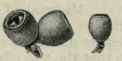
Fruit. - Sessile, almost hemispherical, slightly ribbed at the base; rim narrow, with a groove below it; valves sunk or just exserted; 4 lines long and 3 to 4 lines in diameter.
In shape these fruits are almost a facsimile of E. Gunnii, E. pulverulenta, E. cinerea, or E. unialata.
Habitat. - Victoria, and throughout the central districts of New South Wales.
REMARKS. - -This tree as E. elæophora, F.v.M., was described by Baron von Mueller in his Fragmenta Phytographice Australia, Vol. IV, p. 52 (1863-4), under the impression that it was distinct from his original E. goniocalyx, described some years previously (1859). Bentham. however, in his Flora Australiensis, Vol. Ill, p. 230, places E. elæophora with E. goniocalyx, and Baron von Mueller in his Eucalyplographia concurs in this synonym. Bentham's results were founded on herbarium specimens, and as recent experience has shown that Eucalypts cannot be determined on such material alone, one can readily understand E. clæophora being regarded as a variety of E. goniocalyx. Mueller's original descriptions (loc. cit.) of the two species in our opinion, show clearly that two distinct trees are referred to, and it is therefore rather difficult to understand why he accepted Bentham's diagnosis, as he probably found a difficulty in reconciling it with his previous work, for in combining the two under his description of E. goniocalyx in his Eucalyplographia, he states, inter alia, "as regards the nature of the bark, it fluctuates between, the groups hemiphloiæ and leiophloiæ, in the latter case the tree passes among the woodmen as ' Blue ' and ' White Gum,' in the other case, as Grey' or 'Bastard Box.' .... the above-quoted synonym (E. elæophora) pertains to the variety with more persistent bark." The "Grey" or "Bastard Box," is, therefore, his E. elæophora, and as its timber is almost worthless, the two trees from this one point alone cannot be placed under the same species, particularly from an economic point of view. The bark distinguishes it also from E. goniocalyx, as well as the buds, fruits, leaves, and oil. Bentham was probably led to unite the species owing to the similarity of calyx, anthers, and fruits (partly); but Mueller's concurrence in the suppression of his species was probably owing to his want of knowledge of the trees in their native habitat, for had he so seen the trees, one could hardly think that he would have approved of Bentham's arrangement. This tree was restored to specific rank (Proc. Linn. Soc, N.S.W., 19000), by Messrs. Deane and Maiden, under the name of E. Cambagei. but has since been suppressed, and given its original rank of E. elæophora, by Maiden, Crit. Rev.. Vol. II, p. 275. It has affinities with E. Bridgesiana, R.T.B., having a light-coloured, open-grained timber, with a "Box" bark.
ESSENTIAL OIL. - Leaves and terminal branchlets for distillation were obtained from Bungendore, N.S.W., in March, 1899. The yield of oil was 0.84 per cent. The crude oil was reddish-brown in colour, and had an odour resembling those of the cineol-pinene oils generally. It was very rich in cineol. Pinene was the principal terpene, and phellandrene was absent. It contained eudesmol in small amount. After some time had elapsed the crude oil deposited a powdery substance, as do so many of the crude oils of species belonging to the cineol-pinene class. All our samples of oil from this species deposited this substance, so that the constituent from which it is derived is always present. The rectified oil was yellowish in tint, and this is generally found to be the case with those belonging to this group; this yellow-tinted product is particularly noticeable with oils obtained from species belonging to the "Boxes."Aromadendral was isolated from the oil of the Bathurst sample, and appears to be a constant constituent in the higher boiling portion of the oil of this species, which is thus shown to be closely associated with those Eucalypts known as "Boxes."
The crude oil had specific gravity at 150 C. = 0.9198; rotation aD + 3.35°; refractive index at 20° = 1.4663, and was soluble in 1 1/4 volumes 70 per cent. alcohol. The saponification number for the esters and free acid was 87.
On rectification, 2 per cent. distilled below 1680 C. (corr.). Between 168-1830, 85 per cent. distilled. between 183 1940, 5 per cent. distilled. These fractions gave the following results: -
First fraction, sp. gr. at 150 C. | = | 0.9168; | rotation aD | + | 3.55°. | ||||
Second | " | " | " | = | 0.9281; | " | not taken. | ||
The cineol, determined by the phosphoric acid method in the rectified portion, was 65 per cent., or about 58 per cent. in the crude oil (O.M.).
Material of this species for distillation was also obtained from Tallong (Barber's Creek), N.S.W., in July, 1898. The yield of oil was 0.83 per cent. In no respect did it differ materially in character or constituents from the above sample, so that the two oils may be considered of equal value. The oil was redistilled and the fraction separated at 1830 C. The specific gravity of the crude oil was 0.9208; and the optical rotation aB + 5.7°. The redistilled portion had specific gravity at 150 C. = 0.9154, and rotation aB + 5.5°.
The cineol, determined by the phosphoric acid methed in the rectified oil, was 66 per cent. (O.M.).
Material for distillation was also obtained from Bathursl:, N.S.W., in March, 1901. The oil differed in no respect from those described above. The specific gravity of the crude oil was 0.9191, and the optical rotation aD + 3.1°.
The cineol, determined by the phosphoric acid method in the crude oil, was 54 per cent. (O.M.). The yield of oil was 0.74 per cent.
Material for distillation was also obtained from near Bathurst, N.S.W., in June, 1899. The oil was practically identical with those described above, with the exception that aromadendral was present in slightly larger amount, thus increasing the specific gravity of the oil somewhat, and causing it to be slightly lævo-rotatory. The constituents present were, however, in agreement, and the oil was equally rich in cineol. The yield of oil was 0.5 per cent. The specific gravity of the crude oil = 0.9266. The specific gravity of the rectified oil was 0.922, and the rotation aD - 0.38°. The saponification number for the esters and free acid was 8.2.
The cineol, determined by the phosphoric acid method in the rectified oil, was 61 per cent. (O.M.).
The above samples were mixed together, stored in the dark, and in September, 1919, the oil was again analysed. The specific gravity had increased somewhat during the 20 years it had been kept, and the cineol had also increased in amount. This is well shown by the constants obtained with the rectified oil. The crude oil and the rectified portion gave the following results. 84 per cent, distilled below 100° C.: -
Crude oil, sp. gr. at 150 C. | = | 0.9518; rotation aD + 4.9°; refractive index at 200 = 1.4667. | ||
Rectified portion | " | " | = | 0.9267; rotation aD + 3.0°; refractive index at 200 = 1.4596. |
The cineoi was determined by the resorcinol method in the rectified portion and calculated for the crude oil; the result was 79 per cent. By the rapid phosphoric acid method it was 66 per cent., when calculated for the crude oil. Terpineol was detected in the rectified portion.
We have described somewhat fully the various samples of oil obtained from this species, as the localities enumerated cover a large area, and the time extends over some years. The results show how closely related are the chemical constituents of the products of a particular species of Eucalyptus, irrespective of location or environment.
Continue to:


My Books

