


Sprains With Gross Nerve Injury
Description
This section is from the book "Lectures On The Use Of Massage", by William H. Bennett. Also available from Amazon: Lectures On The Use Of Massage.
Sprains With Gross Nerve Injury
Of all cases of sprain, these are in some respects the most important, because of the difficulty in their treatment and the resulting imperfect cure which so commonly follows, although it must be admitted that the defective recovery is not generally attributed to its real cause. As is the case with sprains with fracture, many of the imperfect results are due to indifferent diagnosis, the nerve lesion having escaped notice in consequence of the slightness of its symptoms at the time of injury. Hence, as I have already said, the importance of a definite search for evidence of nerve damage in cases of sprain cannot be over-emphasised. In the treatment of these cases, when the evidence of nerve lesion is pain along the line of distribution of the nerve, rest and rest only will bring about a complete and permanent cure. This rest, if it is to be successful, must be continued until all symptoms of nerve pain have passed away. Herein lies the difficulty in treatment, for it is next to impossible to induce some patients to realise the importance of resting the part concerned long enough to ensure immunity from the persistent pain which is prone to follow in these cases. Massage does nothing but harm in the early stages of this type of case, but if the condition becomes chronic from neglect of treatment in the early stages, it may be of use, especially if associated with static electricity; and the exacerbation of pain in chronic cases is frequently greatly relieved by the repeated application of the fine point of the thermocautery along the line of pain.
Plate VII.
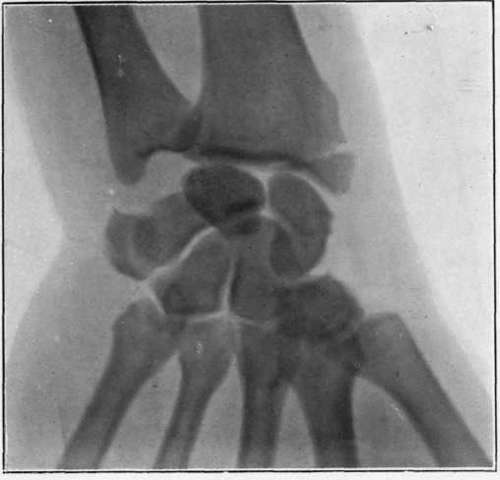
Fig. I. - ' Motor sprain ' of wrist. Separation of styloid process of radius, caused by attempt at starting the engine of a motor car. Fracture discovered by use of x-rays some time after the injury.
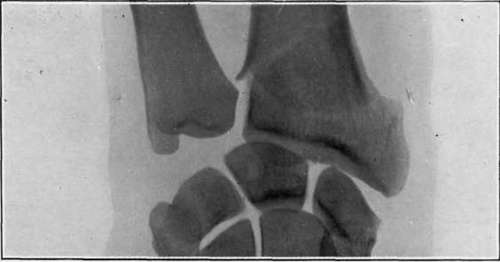
Fig. II. - 'Motor sprain.' Comminuted fracture of lower end of radius, caused in the same way as fig. I. There was no deformity; the fracture had not been detected until shown by x-rays three months after the injury.
In cases where numbness is the indication of nerve lesion the treatment is altogether different, for if this symptom has not disappeared in 24 hours the only hope of cure lies in the skilful use of massage supplemented after two or three days by galvanism. If the affected part be a limb, exercise should be encouraged, and in any part flying blisters over the seat of the lesion may be safely used, since in a certain number of cases they do good, and in none does harm arise from their employment. It is singular how readily areas of numbness may sometimes escape the notice of both surgeon and patient. In a case which came under my observation a patient having 'sprained' his leg was entirely unaware of any loss of sensation in the foot until, in attempting to get some warmth into the part, he found he was charring his toe by unconsciously holding it in contact with the bar of the grate.
Continue to:


My Books

