


Unavoidable Consequences Of Sprains
Description
This section is from the book "Lectures On The Use Of Massage", by William H. Bennett. Also available from Amazon: Lectures On The Use Of Massage.
Unavoidable Consequences Of Sprains
Osteo-Arthritis
The relation of osteo-arthritis to injury cannot be said to be much understood; it is, however, quite certain that its first manifestation frequently follows upon some comparatively slight injury to a joint, especially if this is followed by effusion. The subject generally is too large for discussion here, but it is, I think, undeniable, if my own experience is of any value, that excessive immobilisation of joints after injury tends to the development of this condition. In other words, the chances of osteo-arthritis developing after injury is much greater when unnecessary rest has been used than when, by massage and rational movements, the parts have been kept supple from the commencement.
Local Paresis
Gross nerve lesion may, of course, result in permanent loss of power, in spite of the most skilful treatment; but it is often of much moment that the practitioner should be able to warn a patient of the possibility of results of this kind; hence, as has been already indicated, the desirability of ascertaining immediately after the injury whether nerve complication does or does not exist is a matter of some urgency.
Traumatic Myositis Ossificans
This is, perhaps, the rarest, and at the same time the most interesting of the remote consequences of sprains. Sprains of muscles, involving as they may do the points of attachment to the bone, may be followed, especially in the case of the quadratus femoris, by gradual ossification, completely or in part. The process is slow and little, if at all, painful, such pain as may be felt being of the nature of a dull aching or feeling of weight. The joint controlled by the ossifying muscle becomes increasingly restricted in its movements. For example, in myositis ossificans of the quadratus femoris flexion at the knee becomes slowly less and less, although it is rarely that flexion to a right angle cannot be ultimately accomplished. The muscles involved become hard and seem to be exaggerated in size; there is little or no tenderness, but the limb becomes more and more heavy as the disease goes on. The liability to this condition seems to be too little understood.
Plate IX is a skiagram of a portion of the thigh of a woman about 24 years of age, by whom I was consulted in consequence of amputation having been advised on account of sarcoma. In another case which came under my notice amputation had been suggested by a very experienced surgeon on the same grounds. Again, within the last six months a naval officer was referred to me on account of a large mass involving the middle of the thigh after an injury, which had been regarded as malignant disease. In this case as in the others with which I have met, the x-rays showed superimposed layers of calcification arranged in accordance with the muscle structure as shown in Plate IX.
With regard to the treatment of this condition it seems certain that, once it has actually commenced, rest is essential until it has ceased to increase; massage and movements, passive or voluntary, during its progress, undoubtedly stimulate it to increase. Operation in some of these cases has been adopted, masses of bone-like material having been removed, but unless the periosteum with which some of these masses are connected is also completely-removed, regrowth with increased vigour follows. Operation is, in fact, generally harmful, and should be rejected. Rest having been used until the tendency to increase in the condition has ceased, massage and exercise should follow, with a view to obtaining as much usefulness as possible in such portions of the muscle as have remained intact. The alteration in the bulk of the muscle remains permanently, the normal state is never recovered. The comparative painlessness of the condition should make it difficult to confuse it with periostitis, the lesion for which it is generally mistaken.
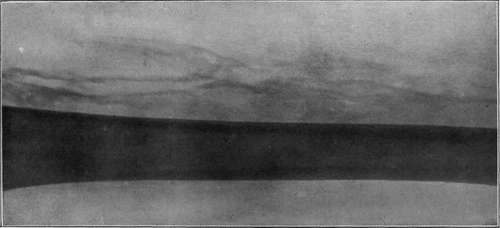
Plate X. Myositis ossificans of quadratus fermoris following sprain of the thigh. The photograph was taken fifteen months after the injury.
The disposition of the layers of calcification is characteristic.
Plate X shows traumatic myositis ossificans after a sprain of the elbow - the possibility of fracture having been originally eliminated by the x-rays. Massage and exercise were tried in this case, with the result of steadily increasing the bulk of the mass; subsequently complete rest for six months caused a diminution to about one-half of the previous size.
The relation of tuberculosis of joints and of tendon sheath to sprain is of much interest, but its discussion is outside the limits of the present lecture.
Continue to:


My Books

