


Chapter VI. Will You Enjoy Your Drive?
Description
This section is from the book "How Do You Sleep?", by L. E. Eeman. Also available from Amazon: How Do You Sleep.
Chapter VI. Will You Enjoy Your Drive?
Your brakes are off, your petrol tank is full, your engine is running, you know how to drive, you know where you are going, and you are about to move off.
But are you going to enjoy your drive?
You know from experience that a long drive through dull and uninteresting country is much more tiring than one in which the landscape constantly offers new joys to the eye. You have had countless other opportunities of observing the fact that sensory enjoyment, within given limits of moderation, far from causing you fatigue, fills you with energy and buoyancy.
You must conclude that indulged in moderation, the enjoyment of your five senses, in some obscure way, puts more energy into you than it takes out of you.
Just as the performance of any physical exercise, such as running, necessitates a flow of energy from your brain down your motor nerves to your legs, thereby tending to deplete your brain, so does the enjoyment of any sensory experience, such as admiring a lovely bunch of roses, involve a flow of energy from your eye, up your sensory nerves, to your brain, thereby tending to recharge your brain.
But, whilst doing your Second Series of Exercises you must have noticed on many occasions that what is true of the actual performance of any physical exercise, such as running, remains true of the thought of the performance of the same exercise, and that in fact when you think of running, when you imagine that you are running, you must promote a flow of energy from your brain down the vasomotor nerves to your legs, because they feel warmer and more comfortably alive.
It is logical and reasonable to expect that the converse is equally true, and practice will confirm logic and convince you that the thought of the enjoyment of any sensory experience, such as admiring a lovely bunch of roses, promotes a flow of energy from your eye, up your sensory nerves to your brain, thereby tending to recharge your brain.
Practice, coupled with careful observation, will show you that the thought of the enjoyment of any sensory experience not only promotes a flow of energy from your sensory organs, up your sensory nerves, to your brain, but that the thought of each individual sensory experience, according to its nature, tends to increase the vital activity, not of your body as a whole, but of one specialized region of it.
This means that if a particular part of your organism needs toning up, and you have discovered the particular sensory experience, the thought of which stimulates that part, you will be able to tone it up by mentally enjoying that particular sensory experience before going to sleep.
For instance, if you discover experimentally that the thought of admiring a bunch of poppies in sunlight increases the expansion of your chest, and that the thought of enjoying the singing of a baritone accompanied by an organ in a cathedral internally stimulates the abdomen, you will be able by mentally enjoying these sensory experiences before sleep to make sure that more efficient work of repair shall be done during sleep in the regions affected.
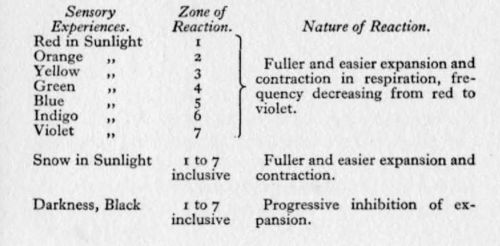
A list of sensory experiences and of the respective parts of the body which the mental enjoyment of them affects is given below. If you will but experiment for a few minutes with some of them, whilst in a state of complete relaxation, your results will conform to those in the list.
It is, however, possible that having obtained your experimental confirmation of the list, you may feel that the agreement observed is purely due to the action of suggestion on your mind. Your dilemma will be solved if you ask a friend to submit to some experiments, under your eye, in relaxation. Choose any sensory experience, ask your friend to imagine he is enjoying it, and observe whether the part of his body connected in the list with the sensory experience chosen, does or does not show increased activity.
The results obtained will be strictly proportional to the nature, quality, clearness, and definition of the images called up.
To make clear the localization in your body of the reaction to particular sensory experiences, the human trunk is divided into seven zones, numbered 1 to 7. (See figure 1).
List Of Sensory Experiences And Of The Most Common Location And Form Of The Reaction To Their Mental Enjoyment

Figure 1. Zones Of The Body
Sight
Sound

Taste

Tastes are generally combinations of the four primary tastes given above; hence the difficulty found by most experimenters in producing by thought clearly localized reactions.
Smell
Most experimenters find it difficult to separate colour from scent in the mind, e.g. the violet from its scent; hence the difficulty in producing localized scent reactions free from colour interference.
Touch
Thoughts of touch experiences produce the reactions one would normally expect from the experiences themselves, such as skin, circulation and respiration changes produced by a hot or cold shower, hot sunshine, or cold wind, massage, etc.
Example Of The Third Series Of Exercises (Sensory)
As you lie relaxed, go back in your mind to some sunny scene of the past. Imagine yourself enjoying the activities of your five senses in turn, carefully observe and memorize the changes in circulation, respiration, and wellbeing produced by each successive image.
Take first the sense of sight and go through the seven colours of the rainbow, red, orange, yellow, green, blue, indigo, and violet in bright sunlight. You may imagine each as a patch of colour, or in the form of a flower, or in any other shape that comes naturally to you, but always in good light.
Then take black and white in turn, again in those shapes most natural to you, such as the night, jet, coal, a tunnel, etc., for black, and a white wall or snow in sunshine, etc., for white.
Follow on with hearing and listen in your mind to various forms of music: singers; baritones, sopranos; instruments; organ, violin, etc.
Then take taste and mentally place in your mouth and chew, taste, and swallow, acid, sweet, bitter, and salt foods, such as lemon, sugar, chicory, and salt, and any fruit or other eatable you fancy.
Then pass on to smell experiences, and smell in turn various flowers and perfumes you like, inhaling them deeply.
Finish with touch images to your liking, such as massage, a hot or cold shower, etc.
Always endeavour to want and enjoy each experience as much as possible, and observe, register, and memorize each reaction produced.
Experiment with the whole series for a few days and you will find that with practice your needs will automatically suggest to you the one sensory experience most useful at the moment, very much as when looking through a menu at a restaurant the one dish which will best satisfy your needs at the time may make your mouth water.
When prolonged experiments have made it easy for you to say: " This is the one sensory experience that would do me the most good and give me the greatest pleasure if I could enjoy it now in real life," you may concentrate and meditate exclusively on this experience until your desire for it is satisfied and its contemplation produces only weak reactions.
Continue to:


My Books

