


What'll I do now? A Three-Week Plan
Description
This section is from the book "How To Help The Shut-In Child: 313 Hints For Homebound Children", by Margery D. McMullin. Also available from Amazon: How To Help The Shut-In Child: 313 Hints For Homebound Children.
What'll I do now? A Three-Week Plan
"What'll I do now? " is a question asked not only by children but by mothers as well. There comes a time when even the most resourceful mother has to think hard to find something new and entertaining for her child to do. Every day presents the same problem in a seemingly endless succession. Perhaps she feels that she should not take time from her housework to sit down and work out new ideas for each day. Perhaps she feels guilty about neglecting other children in the family if she spends too much time with the sick child.
Perhaps she is so anxious about the child's physical well-being that it is impossible for her to plan new recreations for him. On the rare occasions when she does sit down to "play" she finds her mind wandering off in a thousand directions. If her playtimes with the child are frequent, she may get bored and feel that her child is bored with her, even though he wants and demands her presence and attention.
If these problems confront you one of the best ways to meet them is the "planning ahead" system. Set aside at least one hour every day to spend with your child, and then make a plan in advance, covering a definite period of time, as to how you will use that hour, planning around a central idea and developing related activities.
You may have to let some housework go in order to spend this hour with your child; but make it quite plain that this is "his" time and do your level best to keep other things from interfering. If there are older children, the time that they are in school may give you the opportunity.
Making plans in advance will pay off in the end. It will help answer your question, "Now what do I do? " It is easier to think of new occupations if there is a general theme, because one activity will suggest another related one. Try to start the playtime each day on a completely different tack. It will be more interesting for both you and your child because you will have a sense of building something definite.
The following plan for three weeks of activity is built around the central idea of the family. The suggestions are not rigid ones. They are merely examples of continuity of activities for a child between, say, eight and twelve years, and they can be expanded, reduced, or otherwise adapted to suit a child of any age. They call for simple and inexpensive materials only, and they require a minimum of time for preparation.
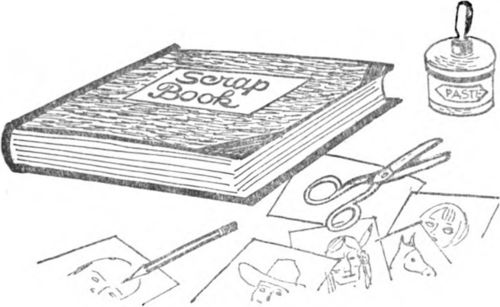
During the first week, the daily play periods are used to make a scrapbook about the family.
During the second week the child and you make all the plans for a family picnic, which is held in the child's room on the last day of the week. (If your child is not bedbound, of course the picnic can be held in any suitable room in the house. )
In the third week the "family scrapbook" idea is picked up again, when an imaginary trip is planned for each member of the family. This not only develops continuity with the activities of the first week but helps the child expand his knowledge of, and interest in, the world outside his home.
On the last day of each week other members of the family are formally invited, so that they can see the results of the weekly play periods. This gives additional stimulation and purpose to the program and promotes a feeling of "togetherness' with the more active members of the family.
But most children love to share "a secret. " Do not overlook the added fun and pleasure the child will have if the activities are kept mysteriously hidden from the rest of the family until the final day of each week.
For the scrapbook pictures you will need a great many old magazines - general magazines, women's magazines, nature magazines, sports magazines, even trade journals (such as those published by grocery-men's associations, hardware associations, etc. ) Every kind of magazine is useful so long as it is full of pictures accompanying the stories, articles, or advertisements. Travel booklets and folders are fine, too; so are advertising booklets of all kinds.
Undoubtedly you already have some old magazines on hand, but your own supply can be augmented by asking friends, relatives, and neighbors to contribute old magazines to you instead of throwing them away. If you still find that your collection is limited, write a letter to the editor of your local newspaper asking townspeople to send you magazines, or have an announcement made at your church or club. You may be deluged by the generous gifts that follow-but you'll have plenty of pictures to work with!
Continue to:


My Books

