


Cell Contents. Part 2
Description
This section is from the "Histology of Medicinal Plants" book, by William Mansfield. Also see Amazon: Histology of Medicinal Plants.
Cell Contents. Part 2
Outline
The outline of starch grains is made up of (1) rounded, (2) angled, and (3) rounded and angled surfaces.
Starch grains with rounded surfaces may be either spherical, as in Plate 74, Fig. 3, or oblong or elongated, as in Plate 71, Fig. 1.
Other starches with rounded surfaces are shown on Plates 72 and 73.
Angled outlined grains are common to cardamon seed, white pepper, cubebs, grains of paradise (Plate 76, Fig. 4), and to corn (Plate 70, Fig. 3).
The outlines of all compound grains are made up partly of plane and partly of curved surfaces.
Size
The size (greatest diameter) of starch varies greatly even in the same species, but for each plant there is a normal variation.
In spherical starch grains the size of the individual grains is invariable, but in elongated starch grains and in parts of compound grains the size will vary according to the part of the grain measured. In zedoary starch (Plate 71, Fig. 4), for instance, the size will vary according to whether the end, side, or surface of the starch grain is in focus.
The parts of compound grains often vary greatly in size. Such a variation is shown in Plate 75, Fig. 2.
Hilum
The hilum is the starting-point of the starch grain or the first part of the grain laid down by the amyloplast. The hilum will be central if formed in the middle of the amyloplast, and excentral if formed near the surface of the amyloplast. It has been shown that the developing starch grain with eccentric hilum usually extends the wall of the amyloplast if it does not actually break through the wall. Starch grains with excentral hilums are therefore longer than broad.
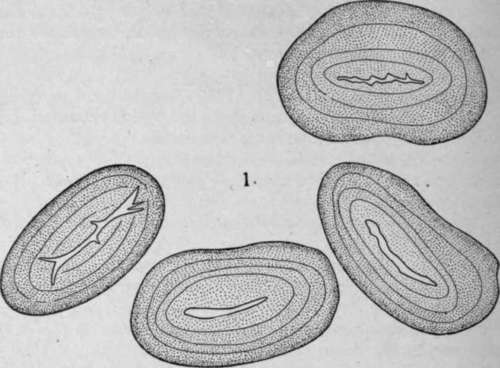


Plate 70. Starch.
1. Calabar bean (Physostigma venenosum, Balfour).
2. Marshmallow root (AlthoEa officinalis, L.).
3. Field corn (Zea mays, L.).

Plate 71. Starch.
1. Galanga root (Alpinia officinarum, Hance). 2. Kola nut (Cola vera, [K.] Schum.). 3. Geranium rhizome (Geranium maculatum, L.). 4. Zedoary root (Curcuma zedoaria, Rose.). 4-A. Surface view of starch grain. 4-B. Side view of starch grain. 4-C End view of starch grain.
In central hilum starch grains the grain is laid down around the hilum in the form of concentric layers. These layers are of variable density. The dense layers are formed when plenty of sugar is available, and the less dense layers are formed when little sugar is available. The unequal density of the different layers gives the striated appearance characteristic of so many starch grains.
In eccentric hilum starch grains the starch will be deposited in layers which are outside of and successively farther from the hilum,
The term hilum has come to have a broader meaning than formerly. Hilum includes at the present time not only the starting-point of the starch grain, but the fissures which form in the grain upon drying. In all cases these fissures originate in the starting-point, hilum, and in some cases extend for some distance from it. The hilum, when excentral, may occur in the broad end of the grain, galanga, and geranium (Plate 71, Figs. 1 and 3), or in the narrow end of the grain, zedoary (Plate 71,fig- 4).
Nature Of The Hilum
The hilum, whether central or excentral, may be rounded (Plate 75, Fig. 1); or simple cleft, which may be straight (Plate 71, Fig. 1); or curved cleft (Plate 71, Fig. 2); or the hilum may be a multiple cleft (Plate 74, Fig. 3).


Plate 72. Starch.
1. Orris root (Iris florentinia L.).
2. Stillingea root (Stillingea sylvatica, L.).
3. Calumba root (Jatcorhiza palmata, [Lam.] Miers.).


Plate 73. Starch.
1. Male fern {Dryopteris marginalis, [L.] A. Gray).
2. African ginger (Zingiber officinalis, Rose).
3. Yellow dock (Rumex crispus, L.).
4. Pleurisy root (Asclepias tuberosa, L.).
In studying starches use cold water as the mounting medium, because in cold water the form and structure are best shown, and because there is no chemical action on the starch. On the other hand, the form and structure will vary considerably if the starch is mounted in hot water or in solutions of alkalies or acids. The hilum appears colorless when in sharp focus, and black when out of focus.


Plate 74. Starch.
1. Kava-kava (Piper methysticum, Forst., f.).
2. Pokeroot (Phytolacca americana, L.).
3. Rhubarb (Rheum officinale, Baill.).
Starch grains, when boiled with water, swell up and finally disintegrate to form starch paste.
Starch paste turns blue upon the addition of a few drops of weak lugol solution. Upon heating, this blue solution is decolorized, but the color reappears upon cooling. If a strong solution of lugol is used in testing, the color will be bluish black.

Plate 75. Starch Grains.
1.. Bryonia (Bryonia alba, L.).
2. Belladonna root (Atropa belladonna, L.).
3. Valerian root (Valeriana officinalis, L.).
4. Colchicum root (Colchicum autumnale, L.).

Plate 76. Starch Masses.
1. Aggregate starch of cardamon seed {Elettaria cardamomum, Maton).
2. Aggregate starch of white pepper {Piper nigrum, L.).
3. Aggregate starch of cubebs {Piper cubeba, L.", f.).
4. Aggregate starch of grains of paradise {A momum meleguetta, Rosc.).
Continue to:


My Books

