


Favus. Tinea Favosa; Porrigo Favos
Description
This section is from the book "A Treatise On The Materia Medica And Therapeutics Of The Skin", by Henry G. Piffard. Also available from Amazon: A Treatise On The Materia Medica And Therapeutics Of The Skin.
Favus. Tinea Favosa; Porrigo Favos
Definition And Description
Favus is a parasitic affection of the skin, characterized by the development of pale yellowish crusts, in connection with the hairs and their follicles. It is more frequent on the scalp than elsewhere, but may be met with on any part of the body that is supplied with hair. It usually commences by the appearance of small white specks or points. These gradually increase in size, become yellower in color and umbilicated, forming small crusts, the umbilication being traversed by a hair, or if the hair be absent, will be found to correspond to the mouth of a hair-follicle. The crusts slowly augment and project somewhat above the level of the skin. If one of them be removed, it will be found to have somewhat the form of a concavo-convex lens, its upper surface having a marked depression or concavity surrounded by an elevated border. Its under surface is convex and the convexity will be found to correspond to a small depression in the skin from which it was removed. Other crusts appear in the neighborhood or scattered over different parts of the scalp, and gradually increase in size; contiguous ones join by mutual extension, so as to form a mass of considerable proportions mottled over with little depressions perforated by hairs. As the disease further advances, portions of the crusts drop off, carrying with them some of the hairs. Ultimately the crusts disappear, leaving a surface at first somewhat reddened but afterward white, dry, atrophied and cicatricial in aspect and deprived of hair. The progress of the disease is slow, and when uninterfered with by treatment, may last for ten or twenty years before it completes its course, which it will do when it has permanently destroyed all the hairs of the affected region. Favus of the scalp attacks children by preference, being but rarely found in adults as a recent affection. It is highly contagious and may be transferred directly from one to another, or by means of caps, brushes, etc. This affection is not confined exclusively to the human race, but in some instances appears to originate in the mouse.
Cats which catch mice diseased in this manner become infected from them, and children playing with the cats contract the disease in turn from the latter.
Favus is not limited to the scalp, but may appear upon any part of the body. When it occurs upon parts furnished with but fine and rudimentary hairs, as the general surface, it commences as a small, red, very slightly raised spot. This enlarges and becomes a little scaly until it has reach a diameter from half an inch to an inch. Upon this reddened patch one or more small white points, not larger than pin-heads, appear. These in-crease in size and develop into the characteristic sulphur-yellow umbili-cated crusts. This epidermic Favus appears to attack adults as freely as children.
Favus is usually accompanied with a certain amount of pruritus, rarely severe, which leads to scratching and the mechanical transfer of the disease from one part to another.
Diagnosis
When in the stage of full development, there is no difficulty in the diagnosis, the sulphur-yellow, dry and friable umbilicated crusts being sufficiently characteristic, and not counterfeited by any other affection. In the very earliest stages, before the appearance of the white specks, an absolute diagnosis is almost out of the question. When the specks appear, their examination with the microscope will immediately settle the matter. In favus of the general surface, the erythematous disk that first appears closely resembles trichophytosis, and it is only later when the white specks appear that the nature of the disease can be readily determined. Known sources of contagion will often assist in clearing up the matter.
Prognosis
The prognosis of favus, when it affects only the less hairy parts of the general surface, is always good. The disease can then be readily cured, and in a short time. When on the scalp, however, the case is different. In this region it proves exceedingly obstinate, and it is only by the most judicious and unremitting attention that the disease can be radically cured.
Etiology
Favus is caused by the lodgment and development of a mi-nute fungus upon the surface and in the hair-follicles. This fungus has re-ceived the name of Achorion schonleinii, after its discoverer. It consists of round or ovoid spores, about 1/1000 of an inch in diameter, together with tube-like structures called mycelium, some of which are simple, others branched; some contain spores and others are empty. In addition there is a considerable amount of fine granular matter. The appearances presented under the microscope are shown in Fig. 8.
The spores penetrate deeply into the hair-follicle, even to the bottom, where their further multiplication causes destruction of hair-root and finally of the papilla.
They sometimes invade the bulbous portion of the root itself, but rarely to any extent, and probably never involve the free portion of the shaft. When the growth has filled the follicle it appears at its orifice as the white speck already alluded to, and by further increase constitutes the substance of the typical crusts.
Treatment
There is an almost universal consensus of opinion as to the proper treatment It maybe premised, however, that prior to the year 1840, the disease was considered well-nigh incurable by the scientific

Fig. 8. - Achorion
Scholelnii dermatologists of the day. The best results were obtained in France by a couple of quacks, known as the Freres Mahon. Their procedure was, after cutting the hair quite short, to apply a large pitch-plaster to the scalp. When this became firmly attached to the hair it was forcibly removed, bringing most of the hair with it. Ointments were then applied and many cases were cured. The objections to this method, however, were serious. The violent tearing off of the plaster caused a great deal of pain, and sometimes small portions of the scalp were torn out, and more than one death resulted from the operation. When Schonlein, however, ascertained the true nature of the disease, the philosophy of the Mahon treatment became apparent. It only remained to apply it in a less cruel and more scientific manner. This may be accomplished as follows: Let the scalp be oiled twice a day for two or three days. Then with a small spatula remove all the superficial crusts. Some of them will be found quite adherent, but a dull-pointed knife-blade and a little patience, will be all that is required. If, now, a mercurial or sulphur ointment be applied, the disease will be prevented from showing itself on the surface, and will be, to all appearance, cured. If these applications, however, be discontinued under the supposition that the disease is in reality cured, a few weeks will suffice to dissipate this error, as the disease will reappear, and in a short time be in as bad a state as before treatment, due to the fact that the hair-follicles still contain the spores in abundance. It is necessary, therefore, to destroy them in situ, by the aid of such medicinal agents as will, by local contact, put a stop to their further development and growth. These medicinal agents are called parasiticides. In order to destroy the spores, it is necessary that the drug made use of shall gain entrance to the follicles, which it cannot do if they are blocked up with the hairs. Removal of the hairs then becomes necessary. This is effected by epilation, or removing the hairs one by one with a pair of suitably constructed forceps (Fig. 9).
If the disease is at all extensive, epilation of the entire surface at one sitting is impracticable. The best way is to proceed systematically and remove every hair from a limited area - say one or two square inches. When the patience of the surgeon or of the patient is exhausted, desist for the time and apply to the denuded spot a suitable ointment or lotion. • For this purpose nothing is more convenient than a one-half to one per cent. solution of bichloride of mercury in water. The follicles, deprived of their hairs, permit a ready entrance of the solution, which, coming directly in contact with the spores, destroys them, or perhaps simply kills the epithelium of the inner root-sheath, which, when exfoliated, carries with it the infiltrating fungus. On the following day another portion of the scalp is epilated and the lotion applied as before, to the portion just denuded and also to that previously operated on. This procedure is repeated day by day until the whole of the affected region has been deprived of hair. If, now, all the hairs have been extracted and the lotion has effectively destroyed the intrafollicular fungus, the disease is, of course, at an end.
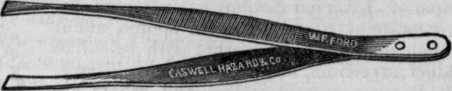
Fig. 9. - Epilation forceps.
Such a result, however, is rarely attained so easily, as many hairs will be broken in the attempt at extraction, and many spores will escape the action of the parasiticide. These, of course, would constitute new foci of disease. It is, therefore, necessary to continue the use of the parasiticide until the broken hairs have grown to a sufficient length to again permit of an attempt at their extraction. After a week or so, the epilation should be resumed, and repeated a third or fourth time if necessary. Finally, if the growing hairs appear to present a healthy aspect, treat-ment may be temporarily suspended. The patient, however, must be kept under close observation, and the first indications of relapse immediately taken in hand.
In Favus of the general surface, epilation and the elaborate treatment just mentioned are unnecessary, as the disease can be readily cured by much simpler means. If at the commencement, when the erythematous disks only are apparent, a few applications of the tincture of iodine will be sufficient to dissipate the disease. If later, when the crusts are present, these should be picked out with the point of a knife and the iodine freely applied. After sufficient has been used to secure thorough desquamation of the epidermis, it will usually be found that the disease has been cured.
In many, if not most cases of Favus, it will be found that the general health is below par. Under these circumstances, constitutional treatment will be advisable. The drugs most frequently indicated are cod-liver oil and iron.
Besides the drugs mentioned, the following may be considered: Cal-cii Sulphidum, 35; Hydrarg. Nitras, 16; Hydrarg. Oxid. Rub., 67; Manganesii Oxid. Nig., 75; and Plumbi Iodidum, 89.
Continue to:


My Books

