


Syphilis. Part 6
Description
This section is from the book "A Treatise On The Materia Medica And Therapeutics Of The Skin", by Henry G. Piffard. Also available from Amazon: A Treatise On The Materia Medica And Therapeutics Of The Skin.
Syphilis. Part 6
Syphilis Of The Anus
The anal region in both sexes is liable to be affected. Primarily it may become the seat of chancre, and secondarily, of various forms of mucous patch, and particularly of the exuberant form or condyloma. Ulcerations and ulcerated fissures are also met with. Syphilis of the mouth. - Chancres may occur upon the lips, tongue, internal surface of the cheeks, soft palate, and tonsils. Upon the lips they usually present very decided induration.
The secondary lesions of the buccal cavity consist of mucous patches and ulcerations. The former present either the form of flat, scarcely elevated opaline patches or milk spots, and are met with upon the mucous surfaces of the lips, the inside of the cheeks, and the tongue, especially along its edges and under surface. More distinctly elevated and slightly eroded patches are met with in the same regions, and also upon the roof of the mouth, the tonsils, and soft palate. Later in the disease distinct ulcerations may appear upon the tongue, tonsils, and palate. These sometimes result in very considerable destruction of the parts affected, the tonsils being eaten away, and the soft palate more or less completely destroyed, Still later wo sometimes find ulcerations in the roof of the mouth leading to necrosed bone.
The examination of the mouth will be greatly facilitated by the use of an instrument of the form shown in Fig. 30. It should be from five to six inches in length.
Syphilis Of The Nose
In the earlier periods we may find a catarrhal condition of the nasal passages, with or without mucous patches. Later, erosions or deep ulcers may occur with involvement of the perichondrium and periosteum, and result in necrosis of the cartilages and bones. These lesions are usually accompanied with more or less suppuration, and with extreme fetor of the breath. To this condition the name ozoena is applied. The diseased processes may continue until the cartilaginous portion of the septum nasi, the vomer, and other bones perish by necrosis. When this occurs the necessary result will be flattening of the nose and very considerable deformity.
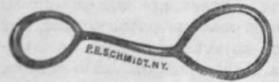
Fig. .0. - Oral speculum.
Syphilis Of The Larynx
The mucous membrane of this organ and of neighboring parts may become the seat of a diffuse but superficial congestion, not attended with any special inconvenience, except slight hoarseness. More frequently, however, the disease invades the upper portion of the larynx, above the vocal cords. The membrane becomes thickened, with decided hoarseness and even aphonia. Ulcers too, of various size and depth, may form, accompanied with similar conditions of the epiglottis. Late in the disease these ulcerations may destroy the epiglottis completely, besides severely injuring the false and true vocal cords and parts beneath them. When the ulcerations heal they may greatly deform the organ, and seriously interfere with its usefulness.
Syphilis Of The Eyes
The most frequent and important syphilitic affection of the eyes is iritis. It is characterized by circumorbital pain, by injection of the sclerotic around the cornea, by change in the color of the iris, and by immobility of the pupil under the stimulus of light. Fibrinous exudation occurs at the margin of the pupil and upon the posterior aspect of the iris. The exudation is often poured out in sufficient quantity to extend to the capsule of the lens, uniting it to the iris with adhesions, which if neglected may become permanent. Iritis usually occurs early in the disease, and frequently in connection with other secondary manifestations. The choroid and retina are sometimes though rarely affected.
Syphilitic Affections Of The Bones
More or less severe pain, usually referred to the bones, may occur during the earlier months of secondary syphilis; more frequently, however, it is a later trouble belonging to the tertiary period. The superficial bones are specially affected, and the pain is most severe at night. The parts affected are tender on pressure, and here and there circumscribed swellings are apparent. These are due to periostitis, with lifting of the periosteum by infiltration between it and the bone. The swellings, at first soft and elastic, may undergo complete resolution, or may become exceedingly hard in consequence of the deposition of new bony material, and are then called nodes. In some cases suppuration occurs, with the formation of abscesses which break and expose the bone, which latter may have already become partially necrosed. The long and flat bones lying just beneath the skin, as the tibia?, clavicles, sternum, and skull bones, are most liable to be affected. Besides these, necrosis of the bones of the nose, as already noticed, is apt to occur in late disease.
Syphilis Of The Liver And Kidney
Syphilitic disease of the liver generally develops under the form of gummy tumors. Gummata of the liver may vary in size from a small seed to that of a pigeon's egg, and usually consist of a condensed connective-tissue capsule containing cheesy or softened masses. They may exist singly or in great numbers. If gummata of the liver disappear, it is by softening and absorption, as they rarely if ever open on the surface of the organ. Amyloid degeneration sometimes occurs late in the disease, usually associated with a similar condition of the kidneys. The kidneys may also become the seats of gummy tumors and of diffuse infiltration.
Syphilis Of The Nervous System
The brain, spinal cord, and nerves are liable to syphilitic invasion in the later periods of the disease. The brain not unfrequently becomes the seat of gummy tumors, usually developed in connection with the membranes. They may be single or multiple, and produce varying kinds and degrees of functional disturbance, dependent upon their number, size, and situation. The principal symptoms are pain. sleeplessness, disturbed intellect, paralyses, aphasia, epileptiform convulsions, coma, etc. Death is the usual termination. Besides the gummy tumors located in the brain-tissue, other no less important changes occur in the arteries at the base of the organ. These vessels become the seat of syphilitic new growths which, to a greater or less extent, occlude their lumen. The symptoms that result are such as we would expect to encounter as a consequence of diminished local nutrition.
Continue to:


My Books

