


Digestion In The Stomach
Description
This section is from the book "Diet In Sickness And In Health", by Mrs. Ernest Hart. Also available from Amazon: Diet in Sickness and in Health.
Digestion In The Stomach
The stomach is a large, hollow, bag-like organ, larger at one end than the other, and furnished with strong muscular walls which can contract in every direction. It is lined inside with a highly organised mucous membrane. This mucous membrane consists of follicles or glove-like depressions, some of which are simple, others divided or branched. The glands of the stomach are of two kinds, - mucous glands, which are lined with large, clear, rounded cells, that almost entirely fill up the central opening of the tube, and peptic glands, which contain large spheroidal and finely granular cells. (See Fig. 1.) It is these cells which are supposed to be principally concerned in the secretion of pepsine. The result of the action of the two kinds of glands in the stomach is that a mucous fluid containing pepsine, and called the gastric juice, is abundantly poured out at the moment of digestion. By means of the slow, continuous, and churning action of the stomach, the food is constantly rolled from one end to the other and becomes thoroughly mixed into a fluid pulp or juice. Unlike all the other digestive fluids the gastric juice is acid. It must be remembered, and it will be found to be very important to bear in mind, when considering later the question of dyspepsia and its treatment by diet, that there are three chief ingredients of the gastric juice, namely, pepsine, free acid, and mucus, all of which are necessary in the process of gastric digestion.
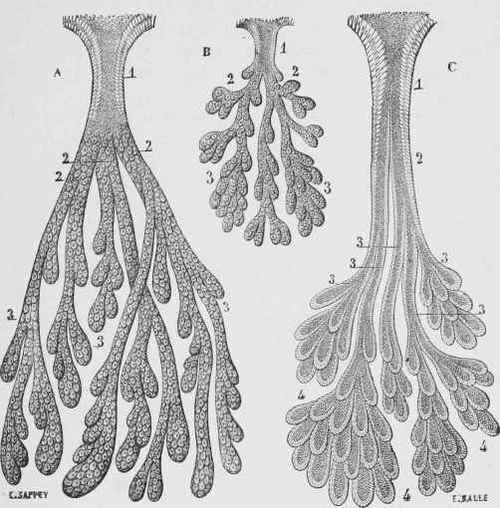
Fig. 9. - The Gastric Glands of Man.
A. Peptic gland of the middle part of the stomach. 1. Its excretory duct. 2, 2, 2. Its three principal branches. 3, 3, 3. Its secondary divisions, in the course of which are numerous culs-de-sac all of which are filled with spherical cells.
B. Peptic gland of the splenic end of the stomach. 1. Its extremely short duct. 2, 2. Its two principal branches. 3, 3. Numerous culs-de-sac in which they terminate.
C. Mucous gland of the pyloric end of the stomach. 1. Its duct. 2, 2. Its two main divisions. 3, 3, 3. Its secondary divisions. 4, 4. Small racemose glands at their termination.
The peculiar quality of the pepsine is that it has the power of digesting and dissolving substances of an albuminous nature; the mucus seems to dilute the pepsine, and to prevent it from acting too violently, even on the coats of the stomach itself, and the free acid - which is hydrochloric acid - is necessary in order to enable the pepsine to act, for it is only in the presence of a free acid that pepsine is operative. Hydrochloric acid has also an antiseptic action, and it stops abnormal fermentation by destroying the numerous bacilli and minute organisms which are swallowed with the food, which if not destroyed would flourish in the stomach and give rise to active fermentation.
Continue to:


My Books

