


Digestion Of Fat
Description
This section is from the book "Diet In Sickness And In Health", by Mrs. Ernest Hart. Also available from Amazon: Diet in Sickness and in Health.
Digestion Of Fat
We have now seen how albumen, starch and sugar are digested; but there remains the digestion of one other large and important element of the food to be described, namely, fat. Fat is not acted upon either by the saliva or by the gastric juices, but the instant it comes into contact with the pancreatic juice in the duodenum it undergoes what is called emulsification. Milk is the type of emulsified fat. If a drop of milk be examined under the microscope it will be found to consist of an immense number of very minute oil globules held in suspension in an albuminous fluid. In "setting the milk " these oil globules, being lighter than the rest of the fluid, rise and form the layer of cream. By the process of churning they are still further separated from the albuminous and other constituents of milk, and form a pure oily substance called butter. In order that the fat foods may be brought into a condition similar to that of milk, in which they can only be absorbed by the lacteals of the intestine, they must be emulsified or broken up into minute oil globules. This is effected by the action of the pancreatic juice, and fat once so emulsified remains in this condition. The digested food in the duodenum is called "chyle," and its reaction is alkaline.

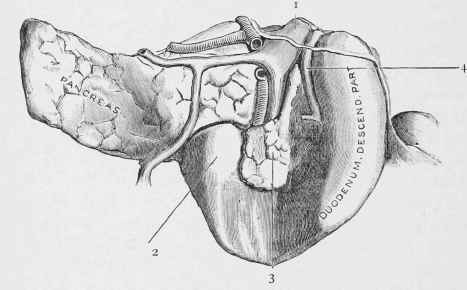
Fig. 2. - The Duodenum from in front.
Fig. 3. - The. Duodenum from behind.
Fig. 2. - 1. Superior layer of transverse meso-colon. 2. Second part of duodenum. 3. Inferior layer of transverse meso-colon. 4. Third part of duodenum. 5. Superior mesenteric vessels. 6. Fourth part of duodenum.
Fig. 3. - 1. The portal vein. 2. Fourth part of duodenum. 3. Head of pancreas. 4. Common bile duct.
Continue to:


My Books

