


A. Salivary Digestion
Description
This section is from the book "Nutrition And Dietetics", by Winfield S. Hall. Also available from Amazon: Nutrition And Dietetics.
A. Salivary Digestion
This term is applied to that part of the general digestive process brought about by the saliva or the secretion of the salivary glands of the mouth. This process naturally begins in the mouth, but it does not end with the passage of the food out of the mouth cavity. It continues in the stomach until the accumulation of acid gastric juice has reached such a point as to cause a marked acidity of the general stomach contents. The saliva on chemical analysis is shown to consist of about ninety-nine and a half per cent water, one half per cent solids. Among the solids the most important one is the enzyme or ferment ptyalin, which is the active digestive factor of the saliva. Other substances found among the solids are sodium chlorid, sodium carbonate, mucus, epithelium. Of these the last named is purely incidental and the mucus serves an important purpose in lubricating the masticated food; the sodium carbonate serves to insure the alkalinity of the mass. It is present in such small quantities that the saliva shows this reaction very faintly. Sodium chlorid is a constituent of all the body secretions. While the saliva is secreted more or less continuously into the mouth cavity, its secretion is very much more copious when food is being masticated. At other times the evident purpose of the saliva is to keep the mucous membranes of the mouth cavity moist.
The introduction of foods into the mouth is accompanied by a more or less profuse secretion of the saliva as the mastication proceeds. The sight or smell of savory foods may create an increased flow of saliva; even the thought of such food frequently causes the mouth to "water." This flow of saliva in response to the thought, sight, smell, or taste of food is accomplished through the agency of the nervous system. The nerves of the salivary glands, having their origin in the medulla, bring messages from the central nervous system to the glands, causing them to increase their secretion in response to these various sensory impressions received. The amount of the salivary secretions is strongly modified by the appetite, as it is the appetizing foods or even the thought of some much-relished food which causes the mouth to water. The stronger the relish for food the more profuse the secretion; the longer the appetizing morsels are held in the mouth and enjoyed, as they are masticated, the finer will be the division of food - that is, the more perfect the mastication and mixture with saliva, the more perfect will be the first step in the general process of digestion.
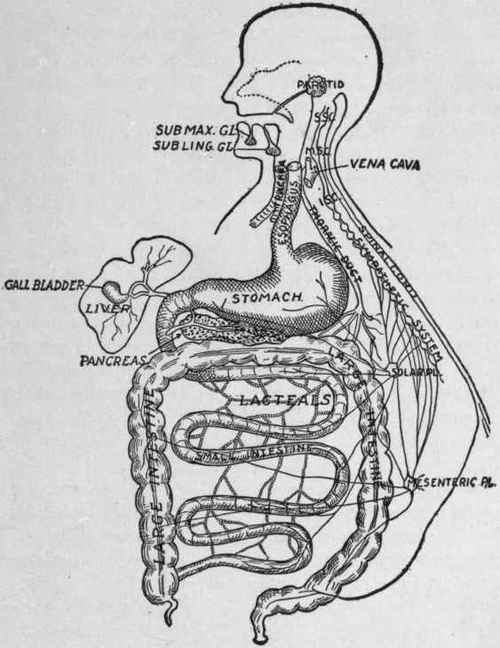
Fig. 3. - Diagram of the Digestive System. Showing alimentary canal, associated glands, lacteals, and nerves.
This first step in the general process of digestion is produced by the ptyalin of the saliva, and consists in the digestion of the starches. The carbohydrates are the only foods whose digestion begins in the mouth. The sugars are simply dissolved in the water of the saliva. The starches are the only foods which undergo a chemical change in the mouth. This chemical change consists in the breaking up of complex starch molecules into less complex dextrin molecules as the first step. The next step is the breaking up of dextrins into the still simpler sugar, maltose. The steps of salivary digestion then are: starch, dextrin, maltose; and the end product of salivary digestion is maltose.
All digestive processes are very greatly facilitated by the fine division of the food. This fine division of the food is accomplished through two processes, both of which are under the control of the individual. First, the cooking of the food should be thorough in the case of starchy foods and those meats which contain a considerable proportion of connective tissue. Second, the mastication should be carried to the point of reducing the foods to smooth creamy consistency. However, while the starchy foods alone are actually changed chemically in the mouth, the other food preparations that are digested in the stomach and intestines are greatly hastened in digestion by this complete mastication. Frequent emphasis has been put upon this in previous chapters, yet it is so all-important that the writer feels justified in emphasizing it as the most essential factor in the nutrition of the body. It is important, first, because it greatly facilitates the rate and thoroughness of digestion of all the foods. Second, because it forestalls overeating, thus protecting the individual against headache, sluggishness, and accumulation of adipose tissue. Third, through food economy, there is saving and economy in the expenditure of money, time, and energy.
Continue to:


My Books

