


Chapter VI. The Absorption Of Food
Description
This section is from the book "Nutrition And Dietetics", by Winfield S. Hall. Also available from Amazon: Nutrition And Dietetics.
Chapter VI. The Absorption Of Food
As indicated in a preceding chapter, the digestive process seems to have for its end the preparation of food for absorption. The insoluble and indiffusible solids of the food must be made both soluble and diffusible and must be dissolved and diluted to thin limpid liquid consistency. In this condition they enter the jejunum and ileum of the small intestine. In these segments of the small intestine the wall of the intestine is so modified as especially to adapt it for the process of absorption. At short intervals along the course of the intestine - that is, every inch or so - the mucous coat of the intestine is thrown up into a transverse fold that extends nearly around the whole circumference of the intestine, closing off a considerable portion of the lumen. These transverse folds of the intestinal mucous membrane are called valvulce conniventes. Their evident purpose is to retard the flow of the intestinal contents along the intestinal tract, holding it back for a time to give opportunity for absorption. Incidentally, these folds greatly increase the absorbing surface of the intestinal wall.
The organ of absorption is the villus. Villi are minute fingerlike projections that stand out upon the surface of the mucous membrane somewhat like the nap on plush. They are composed, like the general mucous membrane of the intestines, of a layer of columnar epithelial cells, resting upon a basement membrane, and this upon a delicately meshed submucosa, within whose meshes there is a rich blood supply within capillary loops. In the midst of the villus is a sac-like lymph radical, a branch from the intestinal lymphatic system.
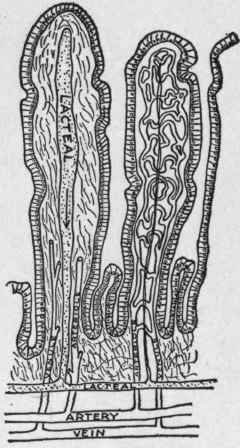
Fig. 5. - Villi, showing lacte-als and blood supply.
We thus find in the villus representatives of the two branches of the circulatory system, the blood-vessels and the lymphatics. All absorbed foods pass into one or the other of these two parts of the circulatory system. The villus is called the organ of absorption because its sole work is absorption. However, not all of the absorption is accomplished by the villi. A small amount of food material is absorbed from the walls of the stomach, and a considerable amount, particularly of the watery element, absorbed from the large intestine. Upon neither of these surfaces are villi found.
Continue to:


My Books

