


Class 3. Roots And Tubers
Description
This section is from the book "Nutrition And Dietetics", by Winfield S. Hall. Also available from Amazon: Nutrition And Dietetics.
Class 3. Roots And Tubers
This class of foods represents a division of the vegetables, while the class green vegetables represents another portion. The division into these two classes, roots and tubers and green vegetables, is a practical one from a dietetic standpoint, and is justified by the fact that the roots and tubers are less perishable, and are in the market practically the year round, while the green vegetables are, like the fruits, very perishable, and are marketed "in season" like many of the fruits.
While it is true that the great metropolitan markets carry radishes and green onions, spinach, lettuce, and various other perishable vegetables, these foods are brought from the far South in February, from the Middle States in midsummer, and from Northera gardens in the early autumn, while the greenhouses produce the same things in midwinter, so that some of these garden products can be procured every month in the year. In rural districts and those towns and cities not in daily communication with the various trade centers these perishable vegetables are procurable "in season" only, the "season" of any particular section being the time of the year when the vegetable or fruit in question is marketable in that section.
Table I. - Roots And Tubers
Food Materials. | Water. Per Cent. | Protein. Per Cent. | Fat. Per Cent. | Carbohydrates. Per Cent. | Ash. Per Cent. | Food Value per Pound. Calories. |
Potatoes (white)... | 75.0 | 2.1 | 0.2 | 22.0 | 0.7 | 295 |
Sweet Potatoes..... | 69.4 | 1.5 | 0.3 | 26.2 | 2.6 | 440 |
Beets.................... | 87.0 | 1.4 | 0.1 | 7.3 | 0.7 | 160 |
Parsnips............... | 64.4 | 1.3 | 0.4 | 10.8 | 1.1 | 230 |
Turnips................ | 92.7 | 0.9 | 0.1 | 5.7 | 0.6 | 120 |
Onions................. | 86.0 | 1.9 | 0.1 | 11.3 | 0.7 | 225 |
Roots and tubers, then, are vegetables in season the year round and comprise white potatoes, sweet potatoes, onions, beets, turnips, carrots, parsnips. So important an article of diet is the potato that there are few tables in Europe and America where this vegetable does not appear at least once in a day, while its appearance at all three meals is not at all unusual. The white potato shows on chemical analysis 75 per cent of water, 2.1 per cent protein, 0.2 per cent fat, 3.2 per cent sugar, 18.8 per cent starch, and 0.7 per cent mineral salts. From this analysis it will be seen that the carbonaceous foods make up a little over twenty-two of the twenty-five per cent of solids. So, while there is present in the potato about two per cent proteins, we classify this vegetable as a carbonaceous food. This classification is further justified from the fact that we look upon it as an important source of starch for the menu, while it is wholly ignored as a source for proteins. It may be stated in passing that the proteins of the potato exist almost wholly in the two or three layers of cells immediately underneath the thin brownish epidermis. If in the preparation of the potato it is peeled in the ordinary way, these outer layers of cells are removed along with the skin, and thus a large part of the protein is lost. Furthermore, there is lost that substance, whatever it may be, that gives to the potato its distinctive flavor, so that if it is peeled before being cooked it is practically flavorless. This may, however, be of no especial disadvantage, inasmuch as it is usually eaten with meat, perhaps with meat gravy, which supplies it a sufficient and pleasing flavor. If, however, one wishes to retain the natural flavor of the potato, as well as the highly nourishing protein, he should cook the potato without removing the skin. If the potato is boiled with its jacket on this may be quickly and easily removed before serving. If it is baked with the jacket on, the jacket may be eaten.
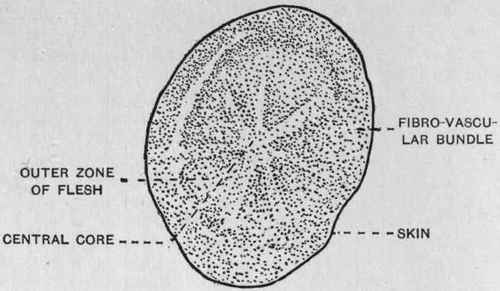
Fig. 1. - Cross-section of a Potato.
The sweet potato is so called because the amount of sugar present is sufficient to give it a distinctly sweet taste. The chemical analysis (water, 69.4 per cent; protein, 1.5 per cent; fats, 0.3 per cent; sugar, 10.2 per cent; starch, 16 per cent; salts, 2.6 per cent) shows the sweet potato to have a larger amount of nourishment in a given weight than the white potato, and a relatively smaller amount of water. They are so nearly like the white potato, however, in their dietetic value that one should observe the general rule of serving only one of these vegetables in a menu - that is, if one has sweet potatoes, he should not also have white potatoes. In other words, the sweet potato should never be taken as a second vegetable combined with white potato. But when we have either of these, we should add to the dinner menu a side dish of some other vegetable, as onions, beets, turnips, cabbage, cauliflower, spinach, asparagus.
Onions show on chemical analysis: Water, 86 per cent; proteins, 1.9 per cent; fats, 0.1 per cent; sugar, 2.8 per cent; salts, 0.7 per cent; extractives, 8 per cent - only 14 per cent of solids, of which only about 4 per cent represent nourishment, while the remaining 10 per cent is made up of cellulose, mineral salts, and "extractives." It is evident that the onion is not eaten for the sugar, nor for the trace of protein which it contains. Among the so-called "extractives" there is a volatile oil which gives the onion its individual flavor. This flavoring material possesses the unique quality of imparting its character, more or less modified and refined when used judiciously, to foods with which it is mixed. The use of smaller or larger quantities of onions has come to be almost universal throughout Europe and America as a food adjunct or flavoring material. The tender young onion from the garden is eaten direct, and serves as a pleasing relish in the warm days of the later spring and early summer, when the whole world turns to the out of doors to get something green and fresh and appetizing. Sliced onion makes an important addition to several of the vegetable salads. Boiled onions served with melted butter or cream sauce make a delicious side dish of vegetables, appropriate any time between October 1st and the following spring.
In the preparation of onions in the kitchen, if the volatile oil annoys one by causing the eyes to water, this annoyance may be avoided by peeling and cutting the onions under water, the water over the onion stopping the escape of the volatile material.
Beets (water, 87 per cent; proteins, 1.4 per cent; fat, 0.1 per cent; sugar, 7.3 per cent; ash, 0.7 per cent; extractives and cellulose, 3.5 per cent). These vegetables possess considerable nutritive power, the nutrient being saccharose. Beets are eaten quite extensively in midsummer as greens, the rich, dark leaf of the beet making greens quite as palatable as spinach or chard. Beet tops may be used in this way even up to the time when the beet root is of sufficient size so that one can substitute the young boiled beets for the beet greens. When young beets are served boiled, it is customary to serve them with butter. As the season advances and they reach their maturity, it is customary to slice the boiled beets, put them in vinegar, serving them as beet pickles.
Carrots
Carrots are found in the market early in the summer and throughout the autumn and winter months. Their food value consists especially in their carbohydrates, eight per cent, mostly sugar. As an article of diet during the winter the carrot is quite as important as the beet. It contains a much larger proportion of cellulose than the beet, and is therefore more difficult of digestion. However, if thoroughly cooked and sufficiently masticated, it makes a good side dish of vegetables at a dinner. In its preparation it is usually boiled, and because of its rather distinctive flavor it is frequently added to stews, braises, boiled dinners, etc. As a side dish it may be served either with cream dressing or butter.
Turnips
The turnip contains over ninety per cent of water and about five per cent carbohydrates, mostly sugar. It is, therefore, not to be recommended as an important source of nourishment. The extractives (two per cent) give it the flavoring material which accounts for the use of the turnip in the dietary. It is found in the market from later summer to the following spring. When thoroughly cooked by boiling it makes a side dish of vegetables which is likely to excite by its strong flavor a keen relish for the dinner. The addition of such highly flavored side dishes is strongly to be recommended, particularly if they are chosen and prepared so skillfully as to have this greatly desired effect - namely, of exciting keen relish and whetting the appetite. As we shall find in our later studies, the processes of digestion proceed much more rapidly, and are accomplished much more completely, if the food is relished. We thus have ample justification for the introduction into the menus of anything which excites the appetite, even though that appetite exciter or relish stimulator may possess in itself little or no nutriment.
Young turnips when taken fresh from the garden in later summer or early autumn may be boiled and served either in cream sauce or with butter. They should be peeled before boiling, because the removal of the skin gives them a somewhat more delicate flavor and texture. During the winter it is customary in serving either the white turnips or the rutabaga, to peel, boil, and serve them mashed. Turnips, like carrots, are well adapted as adjuncts to stews, braises, and boiled dinners.
Parsnips
The parsnip is similar to the carrot in some respects but has a smaller proportion of water and a much larger amount of sugar and starch. The parsnip appears in market usually about Thanksgiving time and may be found there any time during the winter and spring months. The reason for its late appearance in fall is due to the fact that it requires frost to develop its best flavor, some gardeners preferably leaving their parsnips in the ground until spring, contending that the cold of the winter is required to develop their finest flavor. The parsnip possesses strong individual flavor, which adapts it quite as well as the turnip and the carrot for an appetite-producing side dish. In its preparation it should be thoroughly boiled and served either with a cream sauce or with butter. A popular and pleasing way of serving parsnips is to fry them after they have been boiled, the frying apparently developing the finest flavor of the vegetable.
Continue to:


My Books

