


Standard Diet In Health. Part 2
Description
This section is from the book "Golden Rules Of Dietetics", by A L Benedict. Also available from Amazon: Golden Rules of Dietetics.
Standard Diet In Health. Part 2
If the protein is high, meats, etc., must be diminished, and if it is necessary to increase the calories, the non-protein fatty and carbohydrate food stuffs may be increased. Other modifications will suggest themselves from an inspection of the diet sheet, after calculating the protein, fat and carbohydrate in grams and the calories. Appropriate sample dietaries are given in Chapter XVIII (Diet Lists). All of these have been elaborated on the "cut and try" plan.
For example, the following diet list is furnished by the patient:
Breakfast: | 1 shredded wheat biscuit. |
1 banana. | |
1 orange. | |
2 eggs. | |
2 lumps of sugar. | |
150 c.c. of cream used on biscuit and in coffee. |
Luncheon: | 2 lamb chops. |
1 small boiled potato (50 grams). | |
2 slices of bread (50 grams). | |
2 servings of butter (30 grams). | |
2 lumps of sugar. | |
200 c.c. of milk in cocoa (cocoa not counted). | |
100 c.c. fruit sauce (counted as 20% sugar, protein and fat negligible). |
Dinner. Bouillon (Practically No Nourishment)
5 small crackers (5.5 grams each, on average). 100 grams roast beef. 1 large potato (100 grams). 100 c.c. stewed peas. 100 c.c. ice cream, l piece sponge cake (50 grams). 4 lumps of sugar and 100 c.c. cream in two cups of coffee. This diet sheet is summed up by the physician as follows:
Amount Grams. | Protein % Grams. | Fat % Grams. | Carbohydrate % Grams. | |
Shredded wheat biscuit.. | 30. | 10% 3.G. | 2% 0. 6G | . 75% 22G. |
1 banana net weight.... | 45. | 5. | .. | 20. |
1 orange net weight..... | 150. | 2% 3. | .. | 10% 15. |
2 eggs... | ... | 17. | 10. | .... |
Sugar in beverages, 8 lumps............... | 48. | .. | .. | 98% 47. |
Cream................ | 250. c.c. | 3.5% 9. | 25% 62. | 3.5% 9. |
Lamb chops, net weight.. | 40. | 15% 6. | 30% 12. | .... |
Potato................ | 150. | 2% 3. | .... | 20% 30. |
Bread................. | 50. | 8% 4. | 1.5% 2. | 50% 25. |
Butter................ | 30. | .... | 90% 27. | .... |
Milk.................. | 200 c.c. | 4% 8. | 4% 8. | 4% 8. |
Fruit sauce... | 100 c.c. | .... | 20% 20. | |
Crackers... | 27.5 | 10% 3. | 9% 3. | 70% 20. |
Roast beef... | 100. | 20% 20. | 1% 1. | .... |
Stewed peas... | 100 c.c. | 5% 5. | 4% 4. | 10% 10. |
Ice cream... | 100 c.c. | 4% 4. | 13% 13. | 33% 33. |
Sponge cake.... | 50. | 6% 3. | 11% 5. | 05% 32. |
Total Grams.. | 93. | 148. | 291. | |
Calories... | 455.7 | 1386.4 | 1193.1 | |
Totalcalories, 3035.2. | ||||
It is obvious that the above patient is over-eating to the extent of about 500 - 700 calories, that he is eating more protein than is necessary, though not an excessive amount, that he is eating 1 1/4 to twice as much fat as he should, and, counting as sugar, the carbohydrate from the orange, the lump sugar, the fruit
(Note that in making the above estimates, fractions are commonly disregarded.)
GRAMS. | PROTEIN | PAT. | CARB. | |
Eggs 13......................... | .. 550 | 110 | 65 | • • |
Cookies 1 lb..................... | . . 454 | 32 | 45 | 328 |
Apple sauce 6 oz., 5 nickels........ | . . 189 | • • • | 1 | 70 |
Apple pie 10 oz., 6 nickels......... | . . 313 | 9 | 31 | 135 |
Berries, 17 nickels................ | .. 85 | 1 | 1 | 7 |
Cucumbers, 25 nickels............ | . . 125 | 1 | • • • | 3 |
Corn 5 oz., 1 nickel............... | . . 147 | 4 | 1 | 28 |
Cheese 6 oz., 6 nickels............ | .. 200 | 50 | 66 | • • . • |
Rice pudding 4 oz., 3 nickels...... | . . 128 | 4 | • • • | 31 |
Biscuits, 60 nickels............... | 300 | 27 | 30 | 165 |
7512 |
Milk 11 pints........... | 5204 c.c. | 208 | 208 | 208 |
Water 4 pints.......... | .. 1792 | |||
Tea 8 pints............. | .. 3585 | |||
Coffee 1 pint........... | . . 473 | |||
Cocoa 1/4 pint (est. as 15 cocoa powder, milk ready counted)....... | .237 | 3 | 4 | 7 |
Root beer 1 pint........ | 473 | » • • • • • | • • • • | 25 |
Totals for week....... | 7)11746 | 7)679 | 1119 | 2055 |
• Avg. totals for one day. | .. 1680 | 97 | 159 | 294 |
Calories (total, 3159). . | . . | 475 | 1479 | 1205 |
This patient had been treated for the uric acid diathesis, although there was no excess of uric acid and not even a deposit of urates in the urine to suggest such a diagnosis. The diet, which is stated by the patient to be a fair average, is obviously not high in purins. The urine contained an average, on two examinations, of 26 grams of urea, corresponding to about 12.5 grams of nitrogen. The protein eaten contained about 15 grams, or, at most, 16 grams in the diet including the caffeine, etc., of tea and cocoa. Adding 1/7 of the urinary nitrogen to account for the faecal catabolic nitrogen, we have about 14.3 grams of nitrogen accounted for, representing a waste of almost exactly 1/10 of the total, which is to be expected.
On inspecting the diet sheet, it is apparent that the patient takes too little water, both as such and in the aggregate. He is taking rather too much tea and coffee, and, considering the totals of nutrients, too much milk. It would be well to reduce his tea and coffee to a total of 4 or 5 pints a week, the milk to 7 or 8 pints (say 500 c.c. a day), and to increase the water so as to make a total ingestion of liquids of at least 14,000 c.c. a week.
The above mentioned reduction of milk reduces the corresponding nutrients to 140 each instead of 208 each, for the week. This alone, reduces the daily average of protein to about 87 grams, which is high according to Chittenden, but not according to most authorities, the patient being a good sized man, engaged in professional work, and weighing about 80 kilograms. The reduction of milk also reduces the total daily calories by about 180, or to about 2980. The use of butter is plainly excessive and should be at least divided by two. In this way, the total daily consumption of fat can be reduced to about 115 grams and the calories to about 2440. Most persons would do well to eat about 50 grams of sugar a day, which would raise the calories to 2645. We might also eliminate the cheese, though its moderate use is not harmful, or reduce the eggs. In this way the proteins and total calories could be still further reduced so as to approach the minimum active standard. However, there is, in the present case, no indication to do so at the cost of an unsatisfied appetite.
Entirely avoided, and all instrumental methods of calculation, unless long numbers are involved, are rather fallacious as savers of time and insurance against errors.
Starting with the patient's or nurse's diet list, in which the amounts of different food stuffs are stated for each meal, the indicator is set at zero on the scale bar and the number of grams or c.c. of each food stuff is indicated by printing the name of the food stuff with the initial at zero, and then at a point corresponding to the number of grams. The ordinary typewriter allows a measurement of about 75 on one line. If large numbers are involved, it is more convenient to measure them off by fifties. Capital letters are usually more accurately measured than small letters because the former have more definite vertical lines. Or, if preferred, periods may be used to mark the beginning and end of the line and the name of the food stuff may be printed anywhere along it, as most convenient.
For example, suppose that the patient takes 30 grams of bread as toast, at breakfast, 50 at luncheon and 85 at dinner, this may be indicated as follows:
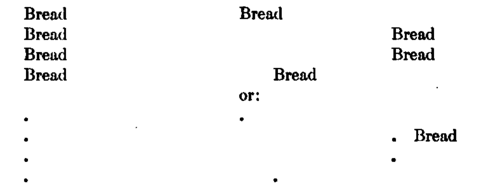
The totals are mechanically added by a pair of dividers, swinging them back and forth in passing from one line to another and spreading from the fixed leg, as usual in such operations. Of course where such simple numbers are involved, the mechanic method is unnecessary and is more troublesome than simple arithmetic. The totals are marked off on a ruler, divided accord-to the scale bar which usually represents 1-10 of an inch for each letter space. Obviously, measurements should always be made from and to the same part of the initial letter, unless periods are preferred. Generally speaking, this first step in the mechanic calculation should he omitted altogether, the patient or nurse stating on the diet sheet the number of grains of each food stuff used for the entire day.
Having the daily totals for each food stuff and an analytic table before the eye, the estimation of proteins, fats and carbohydrates is made as follows, the sample diet being simple, fairly cheap, and sufficient for a person at light exercise. Crackers, 6x25 grams, 150 grams, 10% protein, 9% fat, 70% carbohydrate
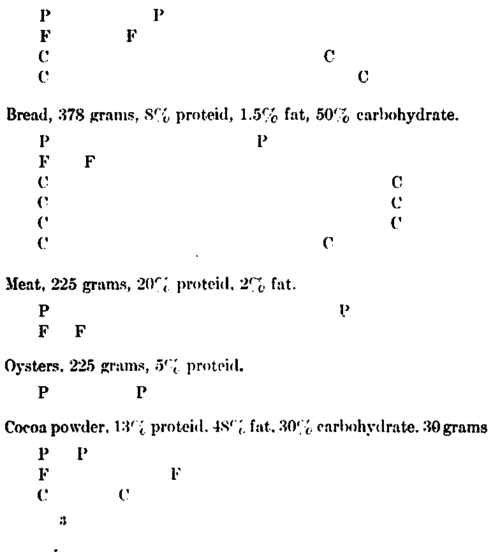
Milk, 150 c.c, 3.5% protein, 4% fat, 4% carbohydrate.
P P F F
C C
Sugar, 60 grams, 98% pure carbohydrate.
C C
Butter, 28 grams, 90% pure fat.
F F
Note
Owing to the difference in size of type and length of line, it is impossible to reproduce the typewriter estimation exactly.
Continue to:


My Books

