


The Muscles Of Mastication
Description
This section is from the book "The A. B. - Z. Of Our Own Nutrition", by Horace Fletcher. Also available from Amazon: The A. B.-Z. Of Our Own Nutrition.
The Muscles Of Mastication
Let me at the outset draw attention to certain anatomical points, in connection with the muscles of mastication. These are (a) their massiveness; (b) the very close relation of the pterygoids to the naso-pharynx; and (c) the outward direction of the pterygoids.
(a) It is not until one studies the muscles of mastication closely that one comes to realise their massiveness. Their large size, in relation to the bony structures in connection with them, is well shown in a vertical transverse section of the head carried through the ascending ramus of the mandible1 (see Fig. 1). It is evident that the functional activity of so large a mass of muscle tissue cannot but exercise considerable influence on the nutrition of the neighbouring parts.
(b) The pterygoid muscles, springing as they do from the internal pterygoid plates, must necessarily be in close relation with the nasopharynx, especially the internal pair, which take their origin from the internal aspect of the internal plates. I would further point out that the external pair, although they diverge from the nasopharynx on their way to the mandibular condyles, yet remain on a level with that cavity. This close relation of the pterygoids to the naso-pharynx is, if I mistake not, of great importance in relation to the etiology of "adenoids".
1 Dental surgeons now speak of the upper jaw as the maxilla, and of the lower jaw as the mandible.
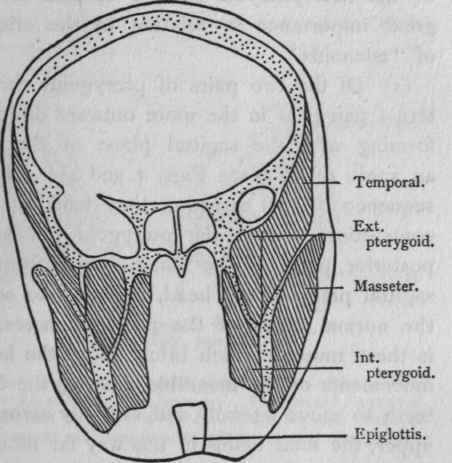
Figure 1. - Vertical transverse (slightly oblique) section through the head on a level with the epiglottis. The massiveness of the system of masticatory muscles is apparent.
(c) Of the two pairs of pterygoids the external pair pass in the more outward direction, forming with the sagittal plane of the head an angle of 45° (see Figs. 1 and 2). In consequence of this direction they tend by their contraction to pull the pterygoid plates and posterior parts of the maxilla away from the sagittal plane of the head, and thus to secure the normal width of the posterior nares. It is these muscles which bring about the lateral movements of the mandible, causing the lower teeth to move laterally and sagitally across the upper, the food being in this way far more effectually ground than by a mere vertical pressure of the teeth against one another. These lateral movements are, as we shall see, less pronounced among the moderns than among primitive peoples.
Continue to:


My Books

