


(11) Continuous Discrimination And Reaction In Finding Serial Numbers.1
Description
This section is from the book "Human Vitality And Efficiency Under Prolonged Restricted Diet", by Francis G.BENEDICT, Walter R. Miles, Paul Roth, And H. Monmouth Smith. Also available from Amazon: Human Vitality and Efficiency Under Prolonged Restricted Diet.
(11) Continuous Discrimination And Reaction In Finding Serial Numbers.1
On a sheet 8 inches by 10 inches the numbers 1 to 50 are arranged in an irregular order, as indicated in figure 37. The task assigned the subject was to point to these numbers in order, beginning with 1 and continuing, without skipping any number, until he reached 50. The complexity of the pattern which must be followed in touching each one of the numbers successively and in the right order is shown in figure 38, starting with S and ending with E. The test blank was on a table in front of the subject at the usual reading distance. He used a long pencil with a rubber eraser on the end and touched the numbers in turn with the rubber end, but did not speak them aloud. An assistant took the total time with a stop-watch and observed the entire performance to make sure no numbers were skipped.
This convenient test was brought to our attention by Dr. Francis N. Maxfield, formerly of the Psychological Laboratory and Clinic, University of Pennsylvania. In a personal communication he states that it was arranged by Mr. Charles K. Taylor, while working with Professor E. L. Thorndike at Columbia University, and suggests that it might be called "The Taylor Numbers." Mr. Taylor, now in the Government service, has used the test with subjects of different age groups. His subjects were required to connect the numbers by drawing lines (see our fig. 38), starting at 1 and continuing as far as possible during the 2-minute period allowed. He informs us through Captain Smiley Blanton that subjects about 20 years old could find and connect the first 22 numbers within 2 minutes. He was unable to supply any reference to a printed article describing the test.
In order to repeat the experiment with the same subject at different sessions, five different test blanks were prepared. The numbers placed on the sheets were half-inch, black, gummed figures. When the first sheet had been prepared with the numbers in position, as illustrated in figure 37, the next sheet was made by advancing each number one position on the sheet. Thus, on the second sheet, 2 was put in the position occupied by 1 on the first sheet, and thus throughout, until finally 1 was placed in the position occupied by 50 on the first sheet. On the third sheet the numbers were advanced one position from that given them on the second sheet, and so on for all of the blanks. Thus, the movements required in pointing to all of the numbers successively on a blank was, except for the start and finish, identical for all blanks, and could be assumed to be equally difficult. Neither the subject nor the assistant who took the time knew how the blanks were made up. No one blank was used in successive experi-ments on the same group of subjects. A more analytical result than the total time would have been desirable, but could not be conveniently arranged under the experimental circumstances and the time available. Naturally the single digits 1 to 9 could be most easily located. This served the useful purpose of giving the individual a satisfactory start. The test required from 1 to 4 minutes.1
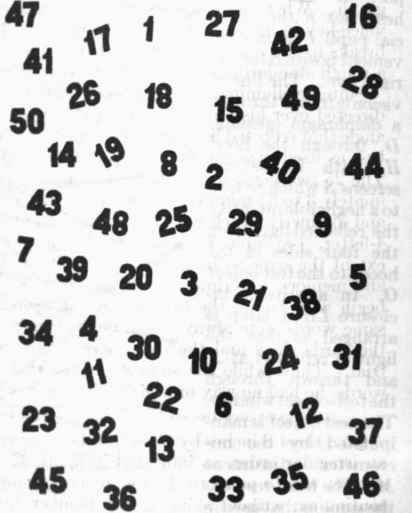
Fig. 37. - "TheTaylor Numbers." The numbers l to 50 arranged in an irregular order as in one of the test sheets.
To one watching from the side or over the shoulder of the subject the whole group of numbers occupies a position much nearer the center of the visual 6eld. The individual numbers are more easily located. It is particularly important that the operator should in no way indicate amuse-ment when the subject seems unable to locate some certain number.
Continue to:


My Books

