


Method Of Calculating Oxygen Consumption. Part 2
Description
This section is from the book "Human Vitality And Efficiency Under Prolonged Restricted Diet", by Francis G.BENEDICT, Walter R. Miles, Paul Roth, And H. Monmouth Smith. Also available from Amazon: Human Vitality and Efficiency Under Prolonged Restricted Diet.
Method Of Calculating Oxygen Consumption. Part 2
Group Respiration Apparatus
While the universal respiration apparatus in its various forms permits the measurement of the metabolism of an individual, even when he is working to the limit of human endurance, it is practically limited to the measurement of a carbon-dioxide production not exceeding 2,700 to 2,800 c.c. per minute. As a matter of fact, this particular intensity of metabolism has been accurately measured with the universal respiration apparatus, both by Cathcart1 and by Murschhauser.2 The measurements are, however, confined to those for one person and no attempt has been made to utilize the apparatus in connection with a large respiration chamber.
1 Benedict and Tompkins, Boston Med. and Surg. Journ., 1916,174, pp. 857, 898, and 939.
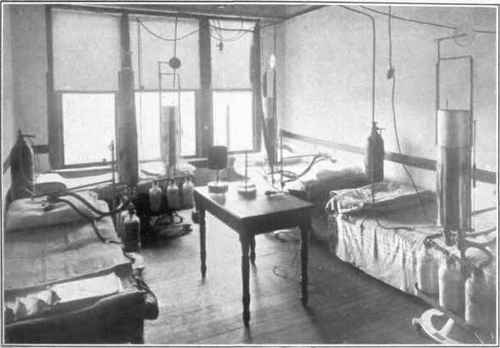
Fig. 4. - Portable respiration apparatus ready for bedside use with form subjects at the International Young Men's Christian Association College, Springfield, Massachusetts.
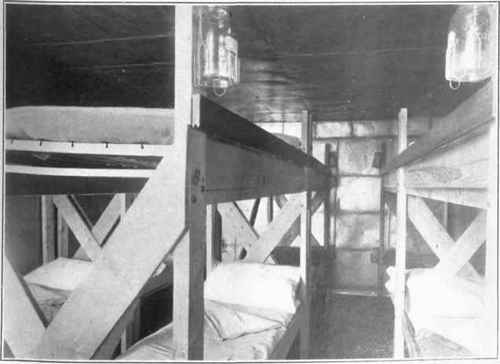
Fig. 5. - Interior of group respiration chamber showing arrangement of beds in 3 sections of 4 each. Glass jars for night urines.
A larger apparatus, based on essentially the same principle as the universal respiration apparatus, was used with a respiration chamber in the chemical laboratory at Wesleyan University, Middletown, Connecticut, for studying the carbon-dioxide output during the severe muscular work of bicycle riding. With the universal respiration apparatus the periods must be limited to 10 or 15 minutes. With the respiration chamber at Wesleyan University periods as long as 1 or 2 hours could be used. With this apparatus all of the carbon dioxide produced was absorbed from the ventilating air current by soda-lime, thus calling for literally enormous amounts of soda-lime. As a matter of fact, three large soda-lime cans in series were required to absorb the 200 or more grams of carbon dioxide produced in one hour.3 Since these earlier experiments were for only a few hours, this particular proceeding was neither too time-consuming nor too expensive, but if a research were undertaken in which a large amount of carbon dioxide was produced over a considerable period of time, the question not only of the expense but of the mere matter of providing sufficient soda-lime would be a very serious one.
With the universal respiration apparatus it would be easy to develop two independent sets of absorbing systems and shift from one to the other at the end of every 15 to 20 minutes, but even then the mechanism would not permit the absorption at a maximum of more than 3,000 c.c. per minute. Consequently, for a research involving the simultaneous measurement of the carbon-dioxide production of a number of individuals, such as in group experiments, this particular type of apparatus would not suffice.
The Nutrition Laboratory has long recognized the need of a large chamber in which not only a group of individuals could be studied simultaneously but two, three, or more individuals could be made to perform intense muscular work and their carbon-dioxide production during the activity accurately measured. Precisely this type of problem presents itself to all workers in animal nutrition, for the carbon-dioxide production with large domestic animals is so great as to demand extremely costly and elaborate apparatus, such as the marvelous installation of Professor H. P. Armsby4 of State College, Pennsylvania. While the Nutrition Laboratory is not engaged in research with large domestic animals,1 it has in the immediate future the problem of studying the metabolism of large wild animals, in connection with its investigations in progress at the New York Zoological Park. It also had the immediate problem in the reduced ration research of studying the metabolism of a group of individuals. Thus the need of a large chamber was urgent.
1 Benedict and Cathcart, Carnegie Inst. Wash. Pub. No. 187, 1913. 2 Benedict and Murschhauaer, Carnegie Inst. Wash. Pub. No. 231, 1915. 3 Benedict and Carpenter, U. S. Dept. Agr., Office Expt. Sta. Bui. 208, 1909, p. 31. 4 Armsby and Fries, U. S. Dept. Agr., Bur. Animal Industry, Bui. 51, 1903; and Experiment Station Record, 1903-1904, 15, p. 1037.
In the original architectural plan of the Nutrition Laboratory the calorimeter room was tentatively subdivided to provide for several respiration calorimeters, and space was left for the construction of a large respiration calorimeter for studying the metabolism of groups of individuals. Nearly a decade passed before it was practicable to build an apparatus of any type in this space. During that time sufficient experimental evidence had accumulated to show that direct calorimetry on a large group of this kind would not only be very expensive but also time-consuming. It was therefore considered that our experience with indirect calorimetry fully justified the construction of a respiration chamber without calorimetric features.
The only chamber of this type which has been used for the study of the metabolism of a number of individuals at one and the same time is that formerly employed in Stockholm and constructed by Sonden and Tigerstedt,2 but now demolished and subsequently duplicated in Hel-singfors by Professor Tigerstedt.3 The Sonden-Tigerstedt chamber had a capacity of 100 cubic meters and the carbon dioxide alone was determined. According to their method of determination a rather complicated meter, with blower system for ventilation, was required, an elaborate aliquoting device for the storage of samples of air from the chamber in 1-liter mercury containers, and finally, a very delicate and fragile and for Americans, at least, almost inaccessible form of gas-analysis apparatus, namely, the Sonden-Pettersson4 gas-analysis apparatus for carbon dioxide.
Continue to:


My Books

