


116. Proteins Of Cereal Grains Do Not Supplement Each Other
Description
This section is from the book "The Newer Knowledge Of Nutrition", by Elmer Verner McCollum. Also available from Amazon: The Newer Knowledge of Nutrition: The Use of Food for the Preservation of Vitality and Health.
116. Proteins Of Cereal Grains Do Not Supplement Each Other
Without exception it has been found that two cereal grains fail to supplement very well the protein deficiencies of one another and accordingly animals do little or no better when fed 9 per cent of protein derived from two cereals than they do when confined to one. There are, however, some remarkable instances of effective supplementing between certain cereal grains and certain of the legume seeds. Conspicuous among these successful combinations is wheat and pea. When fed with all necessary additions other than protein, a group of young rats grew to the full adult size and the females were very fertile. There was a slight decrease in size in succeeding generations, but the females of the third generation were still vigorous enough to produce and rear young. In this diet the wheat furnished two-thirds and the peas, one-third of the total proteins.
Maize kernel and pea, fed in combination parallel to the wheat and pea ration just mentioned, proved almost a failure for the nutrition of the rat. The young animals confined to this diet, the only fault of which lay in its protein moiety, failed to grow as rapidly as they should, and were permanently undersized. Fertility in the females was very low, and the second generation of this family after weaning increased very slowly in weight. See Charts 5 and 6.
It would take us too far afield to comment in detail upon the relative merits of all the numerous protein mixtures which were included in this study. Some of these are tabulated in condensed form in Tables V, VII and IX. Perhaps the most striking thing brought out by this series of experiments is the fact that in certain cases animal tissues are more effective for enhancing the value of cereal proteins than are the proteins of milk. Thus a mixture of rolled oats supplying 6 per cent and milk supplying 3 per cent of protein was found to be inferior to a similar combination of oats and liver, but about equal in value to mixtures of oat proteins and beef muscle or beef kidney, where the cereal
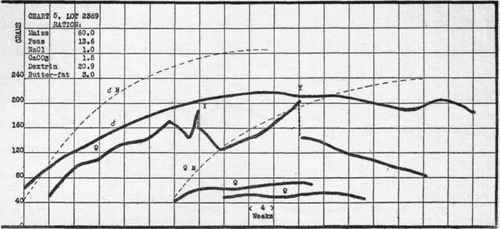
Chart 5. - This chart shows the amount of growth which it is possible to induce in a rat which is confined during growth to a diet containing but 9 per cent of protein derived from maize and peas. All the deficiencies of a mixture of maize and peas were made good by the addition of the inorganic salts and butter fat. The growth was stunted, and the fertility low. The young born of the rats which had grown on this diet were never able to grow after they were weaned, and lived only five to six months. This chart should be contrasted with Chart 6 in which the diet was essentially similar, except that the proteins were derived from a mixture of wheat and peas instead of maize and peas. The former mixture gives proteins of much greater nutritive value than does the latter combination. It is a matter of great practical importance to so combine our natural foods as to secure protein mixtures of high biological value. (See Table IX, p. 118.)

Chart 6. - The curves in this chart should be compared with those in Chart 5. The two diets were alike in their biological value except in the quality of their proteins. Lot 2370 derived its proteins from wheat and peas and were able to grow well and showed high fertility because this combination contains proteins which supplement and enhance each other. Maize and pea proteins do not, on the other hand, enhance each other's values when they are combined. In animal production as well as in human nutrition, it is very important that the proteins of the diet have a high biological value.
Table V. Showing The Effect On The Growth Of The Nursing Young Of Different Quality Of Protein In The Mother's Diet
Wt.of Mother After Birth of Young. | Wt. of Mother 10 to 22 Days Later. | Wt. of Mother at End of Nursing. | Weight of young at Different Ages. | |||||||||
No. of Experiment | No. of Young. | |||||||||||
Days. | Grams. | Days. | Grams. | Days. | Grams. | Days. | Grams. | Days. | Grams. | |||
Grams. | ||||||||||||
2369 *... | 144 | 18 | 150 | 46 | 120 | 4 | 18 | 71 | 31 | 107 | 46 | 123 |
2069 †... | 215 | 10 | 232 | 22 | 205 | 4 | 10 | 100 | 22 | 197 | . . | • • • |
2370 ‡... | 192 | 12 | 170 | 37 | 170 | 5 | 12 | 74 | 33 | 160 | 37 | 175 |
2153 §... | 175 | 15 | 182 | 28 | 192 | 5 | 15 | 137 | 28 | 277 | ., | .. |
2365 ||... | 173 | 18 | 157 | 45 | 146 | 5 | 18 | 70 | 30 | 102 | 45 | 210 |
2186 ¶... | 212 | 22 | 195 | 33 | 195 | 6 | 14 | 125 | 22 | 184 | 33 | 280 |
2767**... | 270 | 19 | 275 | 29 | 270 | 6 | 19 | 163 | 29 | 330 | . . | • • • |
2370‡... | 177 | 20 | 145 | 44 | 175 | 7 | 12 | 81 | 33 | 167 | 44 | 250 |
1236 ‡‡... | 142 | . | • • • | 40 | 146 | 7 | 16 | 133 | 30 | 286 | 40 | 544 |
2186 §§... | 215 | 17 | 213 | 45 | 215 | 9 | 11 | 123 | 17 | 153 | 45 | 382 |
2811 || ||... | 205 | 19 | 225 | 28 | 215 | 10 | 19 | 225 | 28 | 387 | • • | • • • |
*Diet contained 9 per cent of protein from maize and peas. (Formula on p. 114.)
†Diet consisted of milled cereal products, legume seeds, beefsteak, a salt mixture and cabbage. (Formula p. 114.) ‡ Diet contained 9 per cent of protein from wheat and peas. (Formula p. 114.) § Diet derived its protein from milled cereals, beefsteak and legume seeds. (Formula p. 114.) || Diet derived its 9 per cent of protein from barley and navy beans. (Formula p. 114.) ¶ Diet contained 9 per cent of protein derived from wheat and beefsteak. (Formula p. 114.) **Diet derived its protein from whole cereal grains, legume seeds and casein. (Formula p. 114.)
‡‡ A high protein diet in which the protein was furnished by 50 per cent of beefsteak. This was supplemented so as to make good all its dietary deficiencies. Note the rapid and vigorous growth of the young. The formula for this diet is given on p. 114.
§§ Diet contained 9 per cent of protein derived from wheat and beefsteak. Although the protein content was low, the quality was so high that the young made remarkable growth. (Formula of diet, p. 114.)
║║Diet contained a liberal amount of protein derived from cereal grains, legume seeds, casein and milk. Note the remarkable growth of the young during the nursing period. (Formula of diet, p. 114.)
Table VI. Composition Of Diets Described In Table V
No. of Exp. | Wheat, Grams. | Maize, Grams. | Barley, Grams. | Rolled Oat, Grams. | Bolted Wheat Flour, Grams. | Corn Meal* Grams. | Rice, Grams. | Pea, Grams. | Navy Bean, Grams. | Beefsteak, Grams. | Cabbage,† Grams. | Dextrin, Grams | NaCl, Grams. | CaC03, Grams. | Butter Fat, Grams. | Casein, Grams. | Milk Powder,\\ Grams. | Cod Liver Oil, Grams. |
2369 | 60.0 | 13.6 | 20.9 | 1.0 | 1.5 | 3.0 | ||||||||||||
2069 | 8.0 | 30.0 | 15.5 | 8.0 | 8.0 | 8.0 | 10.0 | 10.0 | 1.0 | 1.5 | ||||||||
2370 | 60.0 | 13.6 | 20.9 | 1.0 | 1.5 | 3.0 | ||||||||||||
2153 | 9.5 | 30.0 | 19.5 | 9.5 | 9.5 | 9.5 | 10.0 | 1.0 | 1.5 | |||||||||
2365 | 50.0 | 13.6 | 30.9 | 1.0 | 1.5 | 3.0 | ||||||||||||
2186 | 60.0 | 4.1 | 30.4 | 1.0 | 1.5 | 3.0 | ||||||||||||
2767 | 30.0 | 19.5 | 9.5 | 9.5 | 9.5 | 9.5 | 1.0 | 0.5 | 10.0 | 1.0 | ||||||||
2370 | 60.0 | 13.6 | 20.9 | 1.0 | 1.5 | 3.0 | ||||||||||||
1236 ‡ | 50.0 | 43.5 | 1.0 | 1.5 | 3.0 | |||||||||||||
2186 | 60.0 | 4.1 | 30.4 | 1.0 | 1.5 | 3.0 | ||||||||||||
2811 | 25.0 | 11.5 | 9.5 | 9.5 | 9.5 | 9.5 | 1.0 | 1.5 | 3.0 | 10.0 |
* Degerminated corn meal.
†Cabbage desiccated, steamed and dried.
‡ Contained 1.0 per cent of KC1.
|| Merrill-Soule Company's "Klim."
Table VII. Supplementary Relations Between Proteins From Different Sources
all diets contained 9 per cent of protein, two-thirds of which was derived from the vegetable, and one-third from the animal tissue or from milk.
No. of Experiment. | Sources of Protein. | Observations on Growth, Fertility, Infant Mortality. |
2193.... | Wheat 60, kidney 4.2 per cent. | Growth excellent; reproduction good; infant mortality low. |
2191 .... | Navy beans 27.2, kidney 42 per cent. | Growth fair; far superior to growth on 9 per cent of bean protein. |
2179 .... | Wheat 60, liver 4.1 per cent. | Growth good; high fertility but very high infant mortality. |
2177 .... | Navy beans 27.2, liver 4.1 per cent. | Same as Lot 2191. |
2182 .... | Rye 50, liver 4.1 per cent. | Growth excellent; fertility good; infant mortality high. |
2176 .... | Peas 27.2, liver 4.1 per cent. | Growth fair; far superior to that on 9 per cent of pea protein. |
2181 .... | Oats 40, liver 4.1 per cent. | Growth good; infant mortality high. |
2188 .... | Oats 40, beef muscle 4.1 per cent. | Growth not so satisfactory as Lot 2181; fertility good; infant mortality 100 per cent. |
2189 .... | Rye 50, beef muscle 4.1 per cent. | Growth good; about like Lot 2182; fertility good; infant mortality high. |
2186 .... | Wheat 60, beef muscle 4.1 per cent. | Growth excellent; reproduction good; infant mortality high. |
2387 .... | Oats 40, milk powder 9.3 per cent. | Growth good; inferior to Lot 2181; similar to Lots 2188; fertility good; infant mortality high. |
2391 .... | Barley 50, milk powder 9.3 per cent. | Growth fair; inferior to barley and liver, kidney or muscle. |
2389 .... | Soy bean 16.6, milk powder 9.3 per cent. | Similar to results with rations of soy beans with animal tissues. |
2390 .... | Peas 27.2, milk powder 9.3 per cent. | Similar to Lot 2176 ; results same as with pea3 with kidney or beef muscle, |
2384 .... | Wheat 60, milk powder 9.3 per cent. | Results not so good as with wheat with animal tissues. |
The proteins of seeds are supplemented and enhanced better by animal tissues (meats) than by milk proteins. In all cases milk proteins enhance the proteins of seeds, however, and milk has the advantage of greater superiority as a supplement in respect to inorganic elements and is far superior to muscle meats as a source of fat-soluble A. (For further details see Charts showing growth curves.) furnished two-thirds of the total protein and the animal tissue the remainder. Barley and milk proteins likewise proved inferior to barley and animal tissue proteins. Wheat and milk, while very good as a source of proteins when combined in the proportions adhered to in these experiments, was inferior to combinations of wheat and animal tissues. Soy bean or pea proteins appeared to be about as well enhanced by milk proteins as by the three animal tissues studied.
Continue to:


My Books

