


119. Animal Experiments Indicate That Liberal Protein Intake Best Promotes Health
Description
This section is from the book "The Newer Knowledge Of Nutrition", by Elmer Verner McCollum. Also available from Amazon: The Newer Knowledge of Nutrition: The Use of Food for the Preservation of Vitality and Health.
119. Animal Experiments Indicate That Liberal Protein Intake Best Promotes Health
The systematic and very extensive nutrition studies on animals during recent years, seem to place in a new light the older literature relating to human nutrition. There is no instance in our experience where a diet satisfactory in all other respects, but supplying just sufficient protein of good quality to support growth at approximately the maximum rate to the full adult size, has been found to promote as satisfactory nutrition over the entire span of adult life as would the same diet containing a more liberal supply of the protein factor. It has been frequently assumed by students and teachers of nutrition that after growth has been attained the nutritive needs of the body for protein food can safely be met by a dietary regimen in which the protein content is lower than is essential for optimal growth. Of the numerous experimental data from the work of McCollum and Simmonds, none support this view. Rather do they all point to the conclusion that when the life history of the individual is considered, a generous protein ingestion or one allowing a fair margin of safety over the lowest percentage which just suffices to induce maximal growth in the young will serve to maintain optimal vigor for the longest possible period.
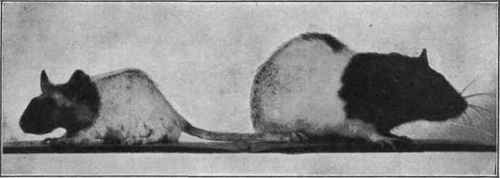
Fig. 7. - The rations of these two rats had the same composition as shown by chemical analysis. They differed only in the source of the protein which they contained. The rat on the right grew up on a mixture of proteins from the corn kernel and wheat gluten ; that on the left on a mixture of corn proteins and gelatin. The difference in size, and remarkable difference in appearance is solely the result of the difference in the quality of the proteins in the two diets. Corn proteins and gelatin do not supplement each other's amino-acid deficiencies. These animals were the same age when photographed, and had been confined for the same number of days to the experimental diets.
Continue to:


My Books

