


170. Rats Can Be Grown Successfully On A Strictly Vegetarian Diet
Description
This section is from the book "The Newer Knowledge Of Nutrition", by Elmer Verner McCollum. Also available from Amazon: The Newer Knowledge of Nutrition: The Use of Food for the Preservation of Vitality and Health.
170. Rats Can Be Grown Successfully On A Strictly Vegetarian Diet
McCollum, Simmonds and Pitz fed a group of young rats on a monotonous diet consisting of maize kernel 50, alfalfa leaf (dry) 30, and cooked (dry) peas, subsequently dried, 20 per cent. The three ingredients were ground together so that whatever was eaten represented the formula for the diet. The diet induced growth at approximately the normal rate, and reproduction and rearing of a considerable number of young. The young grew up to the full adult size and were successful in rearing a considerable number of their offspring (see Chart 7). Without ever tasting, after the weaning period, anything other than this monotonous mixture as their sole source of nutriment this family of rats remained approximately normal in vigor and successfully weaned the young of the fourth generation with no apparent diminution in vitality. At this point the experiment was discontinued (5).
McCollum, Simmonds and Pitz next carried out another series of feeding experiments with rats, the diets of which were derived solely from a mixture of a leaf and a seed ground together so that the two parts of the ration could not be picked out and separately eaten (6). In marked contrast to the failure of animals to grow on any mixture of seeds, it was found that in many cases a mixture of a seed and a leaf formed a diet on which considerable growth could be secured. Even polished rice, which, as has already been described, requires supplementing with respect to four dietary factors, mineral salts, fat-soluble A, water-soluble B and protein, before it becomes complete for the rat, was found to induce fairly good growth when fed with ground alfalfa leaves in the proportion of 60 per cent of seed to 40 per cent of leaf. On this simple and monotonous mixture young rats grew from weaning time to 83 per cent of the normal adult size. One female even produced two litters of young, but allowed them to die within a few days. A mixture of rolled oats 60 per cent and alfalfa leaves 40 per cent ground together makes a much better ration. On this simple mixture young rats have been observed to grow to the full adult size and to reproduce and rear young. One female reared fourteen out of seventeen young born in three litters. Maize and alfalfa leaf or wheat and alfalfa leaf were not so satisfactory for the promotion of growth as is the corresponding mixture containing rolled oats. Mixtures of the alfalfa leaf with the legume seeds, peas and beans gave still poorer results. The peas and beans were always cooked and subsequently dried before feeding.
These experiences made it evident that there is nothing in vegetarianism per se, which makes it impossible for an animal of the omnivorous type to be satisfactorily nourished on this kind of diet. It is only necessary to make the proper selection of food-stuffs, and to combine them in the right proportions. In all the experiments described, in which the diet was made up of so simple a mixture as one leaf and one seed, optimum growth, reproduction and rearing of young were in no case secured.
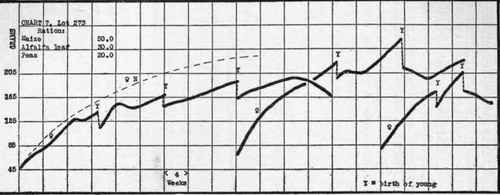
Chart 7. - This series of curves show the records of a mother, her daughter and granddaughter all of which were restricted throughout life to a diet consisting of maize, alfalfa leaves and peas. This simple mixture makes a fairly satisfactory vegetarian diet. This mother and her offspring were not so large as other animals in the same group, but her record is presented because young of the fourth generation, a great-great-granddaughter, was successfully weaned on this diet without any noticeable deterioration in the vigor of the family. The diet was not of the best quality, for the infant mortality was high, and there was a tendency for the animals to remain undersized. It shows, however, that it is easily possible to successfully rear rats on a strictly vegetarian diet.
Continue to:


My Books

