


24. Osborne And Mendel's Observations On Butter
Description
This section is from the book "The Newer Knowledge Of Nutrition", by Elmer Verner McCollum. Also available from Amazon: The Newer Knowledge of Nutrition: The Use of Food for the Preservation of Vitality and Health.
24. Osborne And Mendel's Observations On Butter
Osborne and Mendel had discovered by this time the error of their conclusion that growth and well-being could be secured in animals restricted to a diet free from fats and containing "but an insignificant trace of ether extract." The month following the appearance of the paper by McCollum and Davis demonstrating the peculiar value of certain animal fats as contrasted with other animal fats and with vegetable fats (8), Osborne and Mendel published a paper on "The Relation of Growth to the Chemical Constituents of the Diet" (3). They described in this paper the preliminary period of growth they secured with their diet of purified protein, starch, sugar, and "protein-free milk." This short period of growth, which rarely extended beyond sixty days, was followed by decline. The decline, they found, could be checked by the addition of 16.4 per cent of butter. Animals which received the butter from the beginning of the experiment grew uninterruptedly to maturity or nearly so. In their paper on nutrition with fat-free food-stuffs they had, curiously enough, interrupted their experiments at the end of sixty days or thereabouts from the time when the animals were restricted to the "protein-free milk" and "artificial protein-free milk" mixtures, and yet they described these records as successful growth "through almost the entire period during which growth ordinarily continues."
It was not possible to draw any conclusions from the data presented in their paper now under discussion as to whether the unknown food complex present in butter was in the fat fraction or in the non-fat fraction of the latter. Butter contains about 15 per cent of milk substance other than fat. This portion consists, among other things, of water, protein, cells from the mammary gland, leucocytes, and bacteria, and it was impossible to decide without further evidence whether it was in some of these or in the fat itself that the substance occurred which exerted such remarkable effects on the growth of animals. Hopkins (9) had just reported that rats restricted to diets of purified foodstuffs steadily declined, whereas similar ones which were confined to the same diets, but in addition received 1 to 3 c.c. per day of fresh milk were able to grow. Even after decline had set in on the basal diet it could be checked by this small quantity of milk, which in no instance exceeded about 4 per cent of the dry weight of the diet.
CHART I Journal of Biol. Chem., 1913, xv, 167
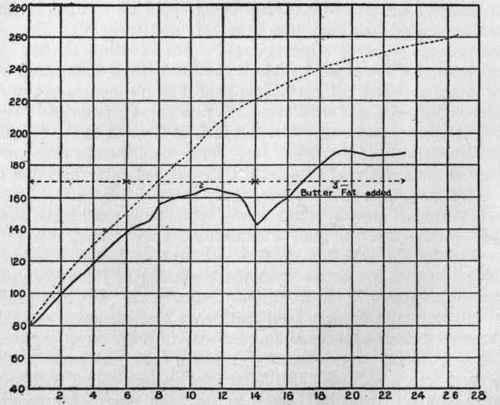
Chart 1 shows one of the original growth curves published by McCollum and Davis, which led them to the discovery of the special growth-promoting properties of butter fat as contrasted with vegetable fats and certain animal fats.
Chart I (Rat 141, male) shows the record of a rat which grew continuously although slightly under normal rate during eighty days on a ration of relatively pure food substances. There was at this time a complete suspension of growth and a rapid decline in body weight. The addition of 10 per cent of ether-soluble butter fat to the diet led to a prompt resumption of growth during the following thirty-five days, when the rat gained 50 grams.
The rations employed were as follows:
Period I | ||
per cent | ||
Salt mixture........... | 6 | |
Casein................ | 12 | |
Lard................. | 20 | |
Lactose............... | 15 | |
Starch................ | 42 | |
Agar-agar .... | 5 | |
Period II | ||
per cent | ||
Salt mixture........... | 5 | |
Casein................ | 12 | |
Lactose............... | 20 | |
Dextrin............... | 61 | |
Agar-agar............ .... | 2 | |
Period III
Same as II with butter fat replacing part of dextrin.
The salt mixture employed consisted of:
grams | |
Sodium chlorid | 0.61 |
Dipotassium phosphate | 17.00 |
Monocalcium phosphate | 1.63 |
grams | |
Calcium lactate ................ | 11.38 |
Magnesium citrate (10.2% Mg) | 23.42 |
Ferric citrate................... | 1.00 |
The lactose in the diet was not entirely pure, and contained enough of the water-soluble B to support growth.
Continue to:


My Books

