


31. Formulation Of The Biological Method For The Analysis Of A Food-Stuff
Description
This section is from the book "The Newer Knowledge Of Nutrition", by Elmer Verner McCollum. Also available from Amazon: The Newer Knowledge of Nutrition: The Use of Food for the Preservation of Vitality and Health.
31. Formulation Of The Biological Method For The Analysis Of A Food-Stuff
Chemical analysis shows the cereal grains to contain all the essential food substances for which we know how to analyze, and it was assumed as a working hypothesis that the only unknown factor contained in the diet was that associated with certain fats. The first intensive study was made on the wheat kernel. It was reasoned that since all the types of nutrients are represented in a seed such as the wheat kernel, except possibly the unknown one which had been demonstrated to be present in certain fats, the fault or faults of wheat from the dietary standpoint must lie in the quality of one or more of these food factors. It was reasoned that valuable data might be secured by enhancing the protein, the inorganic moiety and the fat factors separately in feeding experiments. It seemed possible to discover by means of a systematic series of feeding experiments in which the quality of the seed should be improved with respect to one dietary factor at a time, which factor was interfering with growth (16). Accordingly McCollum and Davis fed the wheat kernel in the following combinations, and obtained the results noted:
1. Wheat alone . . . No growth, short life.
2. Wheat plus purified protein . . . No growth, short life.
3. Wheat plus a salt mixture which gave it a mineral content similar to that of milk . . . Very little growth.
4. Wheat plus a growth promoting fat (butter fat) . . . No growth.
From these results it seemed apparent that either the working hypothesis regarding the factors which are necessary in the diet must be wrong, or there must be more than a single dietary factor deficient in wheat, and jointly responsible for the poor nutrition of the animals. In order to test this theory another series of experiments were carried out, in which wheat was supplemented with two purified food additions:
5. Wheat plus protein, plus the salt mixture . . . Good growth for a time.
Few or no young. Short life.
6. Wheat plus protein, plus a growth promoting fat (butter fat) . . . No growth. Short life.
7. Wheat plus the salt mixture, plus a growth promoting fat (butter fat) .. Fair growth for a time. Few or no young. Short life.
The behavior of the animals fed wheat with two purified food additions was highly suggestive that there are three dietary factors of poor quality in the wheat kernel. This was demonstrated to be true by a feeding trial in which wheat was fed, supplemented with three purified food additions:
8. Wheat plus protein, plus the salt mixture, plus a growth promoting fat (butter fat) . . . Good growth, normal number of young, good success in rearing young. Life approximately the normal span. See chart 2.
McCollum and Davis were, in 1914, more than ever convinced that the only element of mystery in the normal diet was the unidentified substance in butter fat, for with the improvement of three dietary factors wheat became a satisfactory food for the nutrition of an animal during growth, and for the support of all the functions of reproduction and rearing of young.
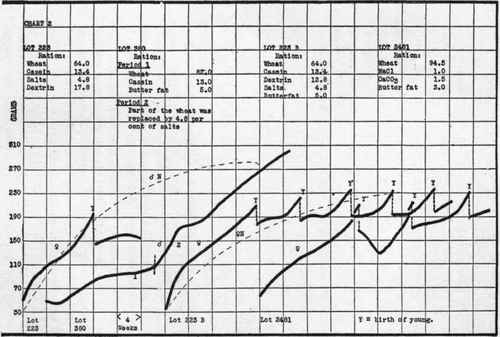
Chart 2. - This series of curves illustrate the nature of the deficiencies of the wheat kernel from the dietary standpoint. Lot 223 lacked sufficient fat-soluble A but was otherwise complete. Lot 380 contained everything which was essential except certain mineral salts (Period 1). In Period 2 the animals became able to grow because of the inclusion of the missing calcium, sodium and chlorin. Lot 223 B grew well and were very fertile and successful in rearing young on wheat supplemented with respect to protein, mineral salts and fat-soluble A (in butter fat). The record of the animal on ration 2481 shows clearly that the mineral deficiencies of wheat are most serious, for without enhancing the proteins of this cereal, good growth and moderate fertility were secured. This curve further shows that only a calcium salt and common salt or sodium chlorid are necessary to complete the inorganic moiety so as to make possible fairly satisfactory nutrition.
Continue to:


My Books

